Facts
The petitioners sought to quash the charge sheet and proceedings in G.R. Case No. 213 of 2015, arising from allegations that the deceased principal accused had concealed his existing marriage and that the petitioners had participated in arranging the marriage and subjecting the complainant to cruelty.
Source reference: paras. 1–5, 18The charge sheet alleged offences under Sections 417, 494, 498A, 376, 406 and 120B IPC and Sections 3 and 4 of the Dowry Prohibition Act.
Source reference: paras. 1–5, 18The same petitioners had earlier challenged the proceedings in C.R.R. No. 1448 of 2020. In that matter, the Court set aside the proclamation and attachment order for non-compliance with Section 82 CrPC but declined to terminate the proceedings.
Source reference: paras. 15, 30The principal accused later died; the petitioners relied also on a separate order quashing proceedings against a co-accused.
Source reference: paras. 6, 20, 31–32Issues
1. Whether the petitioners could maintain a successive application under Section 482 CrPC seeking to quash the same proceedings after an earlier application had been considered and refused on its merits.
Source reference: paras. 22, 29–302. Whether the death of the principal accused or the quashing of proceedings against a co-accused constituted a change in circumstances sufficient to reopen the earlier decision.
Source reference: paras. 31–32Law Applied
Section 482 CrPC preserves the High Court’s inherent power to prevent abuse of process and secure the ends of justice, but does not create a new jurisdiction or permit circumvention of an express statutory bar.
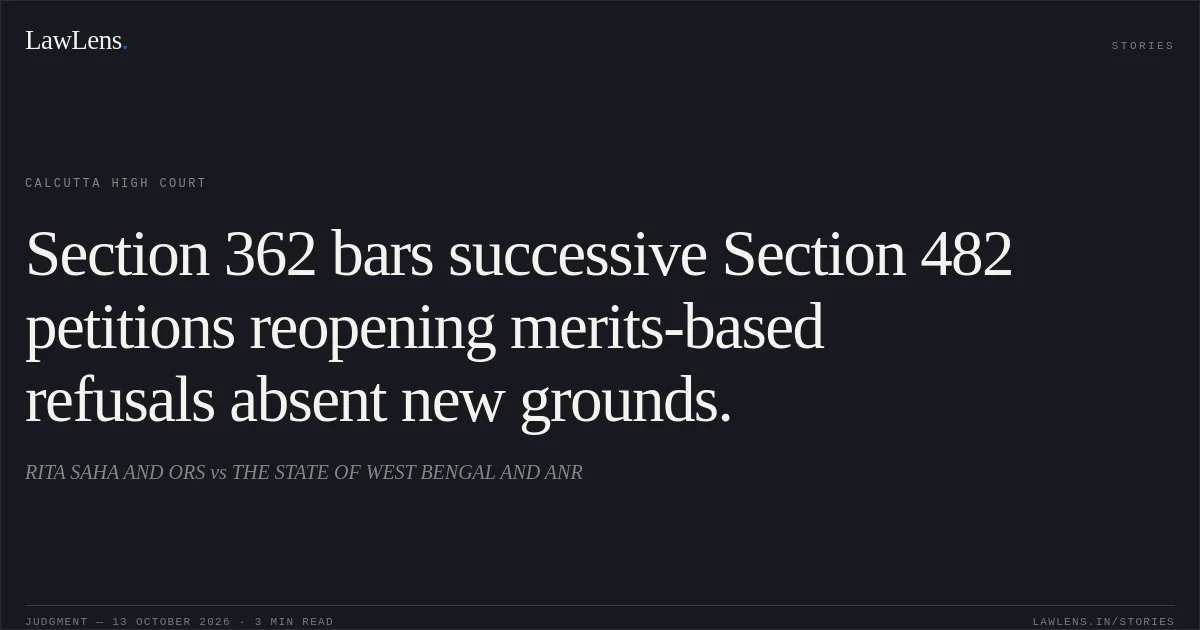
Source reference: para. 24Section 362 CrPC prohibits a court from altering or reviewing a signed final judgment or order, except to correct clerical or arithmetical errors; the judgment applied this bar to the High Court’s criminal revisional and inherent jurisdiction.
Source reference: para. 25A successive application is not invariably barred, but may be entertained where the earlier application was not adjudicated on the merits or where a subsequent change in facts or law gives rise to a fresh cause; it cannot be used merely to reargue matters already decided or that could have been raised earlier.
Source reference: paras. 26–29The Court considered M.C. Ravikumar v. D.S. Velmurugan, Bhisham Lal Verma v. State of Uttar Pradesh, Anil Khadkiwala v. State (Government of NCT of Delhi) and Vinod Kumar, IAS v. Union of India in applying that principle.
Source reference: paras. 26–29Reasoning
The earlier application involved the same petitioners and the same criminal proceedings, and the coordinate Bench had considered the materials before refusing to terminate the case; its decision was therefore a merits determination, not a disposal on a limited procedural ground.
Source reference: para. 30The subsequent death of the principal accused affected the proceedings against him alone and did not alter the petitioners’ position, which had already been before the earlier Bench.
Source reference: para. 31Nor did the order concerning the co-accused establish a change in law or in the petitioners’ own circumstances.
Source reference: para. 32Since the application failed on maintainability, the Court did not decide the petitioners’ substantive arguments about vague allegations, delay or mechanical cognizance.
Source reference: para. 33Holding
The Court held that the successive Section 482 application was not maintainable because the earlier application had been considered and the prayer to terminate the proceedings refused, with no new ground shown to reopen that decision.
C.R.R. No. 1707 of 2025 was dismissed, and the proceedings and charge sheet were to continue against the petitioners.
Source reference: paras. 35, 37The petitioners were left at liberty to seek discharge before the trial court, which was directed to decide any such application in accordance with law and without being influenced by the High Court’s observations.
Source reference: para. 38Acts & Sections Cited
10 provisions across 3 statutes referred to in this judgment. Each provision opens on LawLens.
Code of Criminal Procedure, 19734
Indian Penal Code, 18604
Original Court PDF
RITA SAHA AND ORSvsTHE STATE OF WEST BENGAL AND ANR
Click to open original judgment
Original judgment, available to read, download and summarize on LawLens.in