01Facts
On November 25, 1998, the respondent allegedly lured the deceased, Dinesh, from his home under the pretext of watching a movie
¶ 2The deceased’s body was discovered the following morning with gunshot wounds, leading to an FIR under Section 302 IPC
¶ 2While the Trial Court acquitted the respondent of murder under Section 302, it convicted him under Section 364 IPC (kidnapping or abducting in order to murder), reasoning that the act of luring the deceased was sufficiently established
¶ 3The High Court of Judicature at Allahabad subsequently reversed this conviction, holding that the absence of a formal charge under Section 364 IPC prejudiced the accused and that Section 364 is not a "minor offence" relative to Section 302 IPC
¶ 4The State appealed this acquittal to the Supreme Court.
02Issues
i.1. Whether an accused charged under Section 302 IPC can be convicted under Section 364 IPC in the absence of a specific charge for the latter
¶ 4, 8ii.2. Whether Section 364 IPC constitutes a "minor offence" relative to Section 302 IPC within the meaning of Section 222 of the Cr.P.C.
¶ 9, 1003Law Applied
The Court primarily examined Section 302 IPC (Murder) and Section 364 IPC (Kidnapping/Abducting in order to murder)
¶ 1, 10It applied Section 222 of the Cr.P.C., which permits conviction for a "minor offence" even if not specifically charged, provided the offences are "cognate" and share common essential ingredients
¶ 9The Court relied on the precedent in Shamnsaheb M. Multtani v. State of Karnataka, which clarified that a "minor offence" is determined not just by a lesser punishment but by whether the two offences are cognate
¶ 9It also referenced Dalbir Singh v. State of U.P. regarding the validity of convictions on lesser charges
¶ 6Provisions in the judgment · 3 · Linked ones open on LawLens
Indian Penal Code, 1860 Section 302Section 362Section 364
04Reasoning
The Court observed that for Section 222 Cr.P.C. to apply, the two offences must be cognate, meaning their main ingredients are common
¶ 9It determined that Section 302 and Section 364 IPC are separate and distinct offences with vastly different compositions; therefore, they cannot be considered cognate
¶ 10The Court reasoned that Section 364 requires proof of kidnapping or abduction with the specific intent to murder, which is an independent legal framework from Section 302
¶ 10Furthermore, the Court noted that the prosecution failed to provide evidence of forceful taking or abduction, as the deceased left voluntarily with the respondent
¶ 11Since no charge under Section 364 was ever framed, convicting the respondent under that section without prior notice violated fair trial norms and caused serious prejudice
¶ 4, 1005Holding
The Supreme Court dismissed the appeal and upheld the High Court’s judgment of acquittal
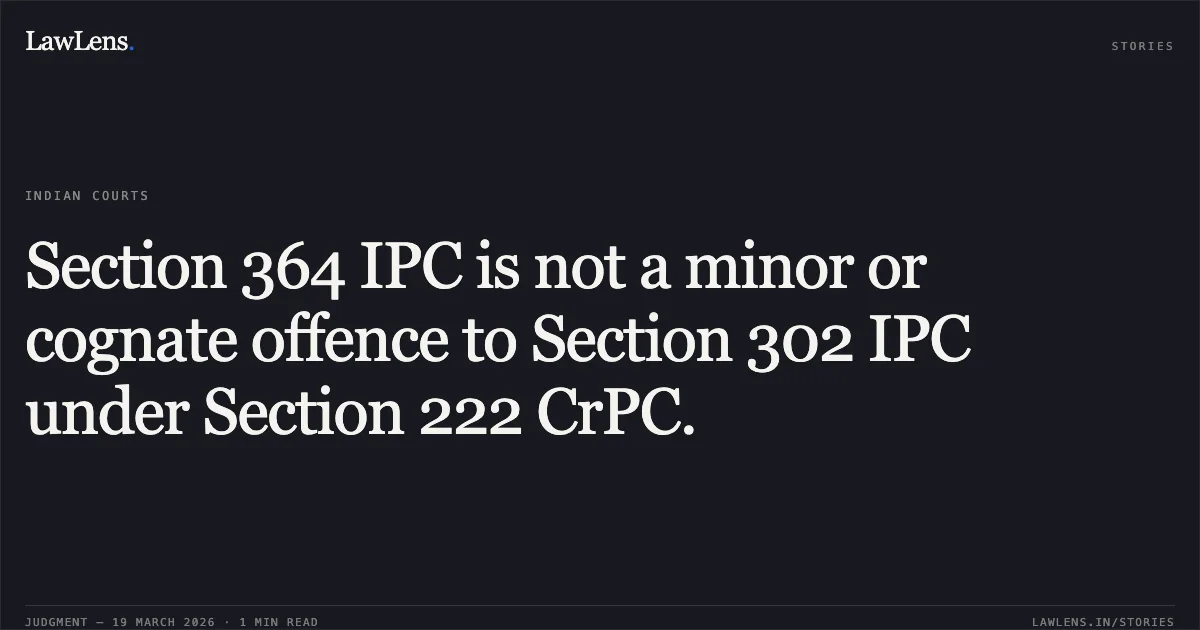
¶ 12The Court held that Section 364 IPC is not a minor or cognate offence of Section 302 IPC, and thus a conviction under Section 364 cannot be sustained under Section 222 Cr.P.C. if the accused was only charged under Section 302
¶ 10The Court further concluded that the evidence did not support the elements of abduction required for a conviction under Section 364 IPC
¶ 11Original Court PDF
The State Of Uttar PradeshvsRam Swaroop @ Barkat
Click to open original judgment
Original judgment, available to read, download and summarize on LawLens.in