01Facts
On 17 November 2002, the complainant Rameshwar Yadav and other passengers were returning from the Jashpur cattle market in a Commander jeep when their vehicle was stopped near Bendo Nala by logs and stones placed across the road.
¶ 2–4Two armed assailants allegedly threatened the occupants, assaulted the driver, Dinesh Ram, and robbed cash and documents from the passengers.
¶ 2–4The appellant, Arun Kumar Naidu, allegedly attempted to flee but was apprehended near the nala by the complainant’s son and another passenger.
¶ 2–4An FIR was registered the same evening, and the injured persons were medically examined.
¶ 2–4The Trial Court framed charges under Sections 394 and 397 IPC and Sections 25 and 27 of the Arms Act.
¶ 5–7It acquitted co-accused Nandlal of all charges and acquitted the appellant of the Arms Act charges, but convicted him under Sections 394 and 397 IPC, sentencing him to seven years’ rigorous imprisonment and fine under each provision, with the substantive sentences to run concurrently.
¶ 5–7In appeal, the appellant did not challenge the conviction under Section 394 IPC, but contested the conviction under Section 397 IPC and sought reduction of the sentence under Section 394 IPC to the period already undergone.
¶ 802Issues
i.Whether the appellant’s conviction under Section 397 IPC was sustainable when the medical evidence established only simple injuries and the appellant had been acquitted under the Arms Act?
¶ 14–16ii.Whether the substantive sentence imposed under Section 394 IPC should be reduced to the period already undergone in view of the appellant’s incarceration and the passage of time?
¶ 18–2003Law Applied
Section 397 IPC prescribes a minimum sentence of seven years where, at the time of committing robbery or dacoity, the offender uses a deadly weapon, causes grievous hurt, or attempts to cause death or grievous hurt.
¶ 14Section 394 IPC applies where hurt is voluntarily caused during the commission or attempted commission of robbery.
¶ 15–16The Court relied on the medical evidence and the requirement that the ingredients of Section 397 must be affirmatively established.
¶ 15–16On sentencing, the Court relied on the reformative principles stated in Mohammad Giasuddin v. State of Andhra Pradesh, (1977) 3 SCC 287, emphasizing rehabilitation rather than purely retributive punishment.
¶ 18Provisions in the judgment · 7 · Linked ones open on LawLens
Indian Penal Code, 1860 Section 394Section 397
Arms Act, 1959 Section 25Section 27
Code of Criminal Procedure, 1973 Section 313Section 437
Bharatiya Nagarik Suraksha Sanhita, 2023 Section 481
04Reasoning
The Court accepted that the prosecution evidence, particularly the testimony of the injured witnesses, established that the appellant voluntarily caused hurt while participating in the robbery, thereby sustaining the conviction under Section 394 IPC.
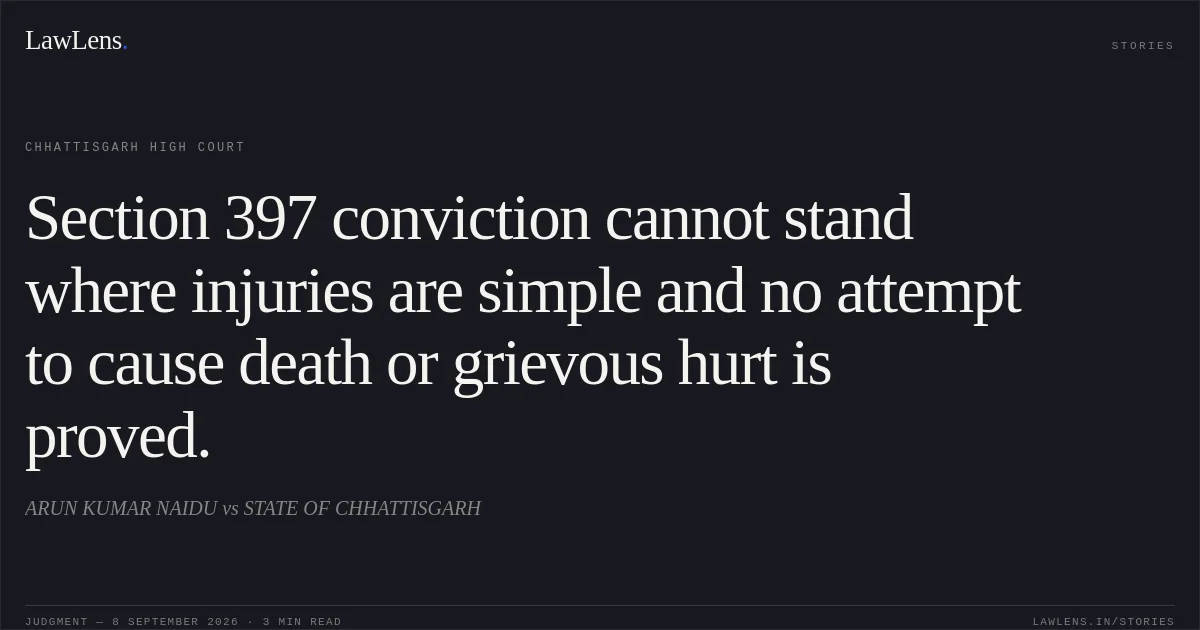
¶ 17However, the medical officer found only simple injuries on Rameshwar, Dinesh and Trilochan, caused by hard and blunt objects; there was no medical or circumstantial evidence demonstrating grievous hurt or an attempt to cause death.
¶ 13Since the appellant had also been acquitted of the Arms Act charges, the Court treated the alleged use of a deadly weapon as insufficiently established for Section 397 IPC.
¶ 16It therefore held that the aggravated ingredients necessary for the minimum sentence under Section 397 were not proved.
¶ 16For sentencing under Section 394 IPC, the Court considered that the appellant had remained in custody from 19 November 2002 to 19 January 2007—more than four years—and that the incident was over two decades old.
¶ 18–19Applying the reformative approach to sentencing, it found that the ends of justice would be met by limiting the substantive sentence to the period already undergone.
¶ 18–1905Holding
The appeal was partly allowed.
¶ 20The appellant’s conviction under Section 397 IPC was set aside, and he was acquitted of that charge.
¶ 20His conviction under Section 394 IPC was maintained, but the substantive sentence was reduced to the period already undergone in custody from 19 November 2002 to 19 January 2007.
¶ 20The fine imposed under Section 394 IPC remained intact.
¶ 21As the appellant was already on bail, he was not required to surrender; his bail bonds were directed to remain operative for six months under Section 437-A CrPC, corresponding to Section 481 of the BNSS, 2023.
¶ 22Original Court PDF
ARUN KUMAR NAIDUvsSTATE OF CHHATTISGARH
Click to open original judgment
Original judgment, available to read, download and summarize on LawLens.in