Facts
Chandulal Bhogilal Shah owned agricultural land bearing Survey No. 991 at Village Vandara, Taluka Dabhoi, District Vadodara. Parshottam Kashibhai Patel cultivated the land as a tenant.
Source reference: paras. 3–5The landlord obtained a certificate under Section 88C of the Gujarat Tenancy and Agricultural Lands Act, 1948 (“Tenancy Act”) and terminated the tenancy under Section 32T on the ground of bona fide personal cultivation.
Source reference: paras. 3–5Possession was restored to the landlord on 16 November 1976 pursuant to the High Court’s order dated 12 August 1976, and that proceeding attained finality.
Source reference: paras. 3–5, 78–79Parshottam died on 24 April 1983.
Source reference: para. 6His alleged heirs—two nephews and three brothers—subsequently applied under Sections 37 and 39 of the Tenancy Act, contending that the landlord had failed to personally cultivate the land after obtaining possession.
Source reference: paras. 6–12The Mamlatdar allowed the application, and the Assistant Collector affirmed it; however, the Gujarat Revenue Tribunal (“GRT”) reversed those orders.
Source reference: paras. 6–12The heirs thereafter challenged the GRT’s decision in Special Civil Application No. 10365 of 1995, which was dismissed by the learned Single Judge on 10 August 2016.
Source reference: paras. 6–12LPA No. 1062 of 2016 was filed by the surviving original petitioners, who claimed to be nephews of the deceased tenant.
Source reference: paras. 1, 26–29LPA No. 885 of 2022 was filed by the heirs of the deceased original petitioner Nos. 3, 4 and 5, who had died during the pendency of the writ proceedings without being substituted.
Source reference: paras. 26–29, 34The Division Bench considered both appeals together.
Source reference: paras. 1, 34Issues
Whether LPA No. 885 of 2022, filed by the heirs of deceased writ petitioners who were never substituted in the writ proceedings within a reasonable time, was maintainable?
Source reference: paras. 34–57Whether the heirs or alleged successors of a tenant whose tenancy had been terminated under Section 32T and whose possession had been restored to the certified landlord could invoke Sections 37 and 39 of the Tenancy Act for restoration of possession?
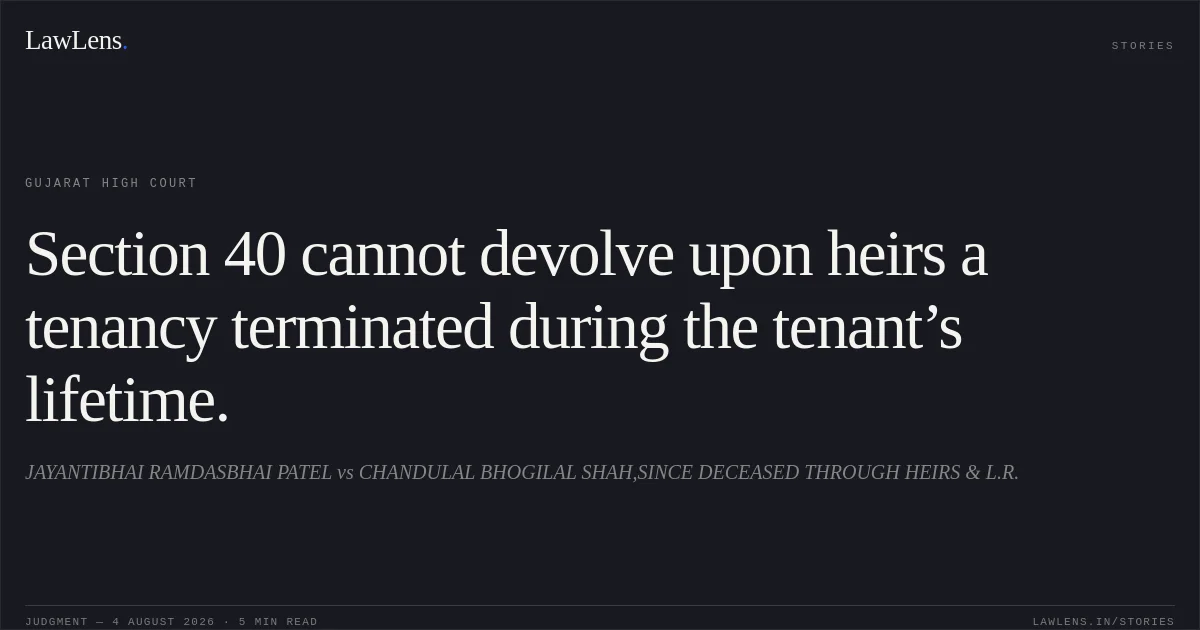
Source reference: paras. 78–91, 103–117Whether Section 40 of the Tenancy Act operated to devolve the tenancy upon the heirs after the tenant’s death, notwithstanding the prior termination of tenancy and restoration of possession to the landlord?
Source reference: paras. 81–92, 112–117Whether the alleged nephews and brothers had established an inheritable tenancy or any enforceable right through the alleged will, gift deed, or joint-family status?
Source reference: paras. 58–70, 105–110, 118–129Whether the decision in Savaliram Gotiram Teli v. Madhukar Yeshwant Patankar applied to permit the appellants to seek restoration under the Tenancy Act?
Source reference: paras. 93–103, 117Law Applied
The Court applied Sections 2(5), 2(6), 2(7A), 2(11), 2(18), 4, 32(1B), 32T, 37, 39 and 40 of the Tenancy Act.
Source reference: paras. 71–78, 82–91, 112–117Section 32T permits a certified landlord to terminate an excluded tenant’s tenancy for bona fide personal cultivation and obtain possession.
Source reference: paras. 71–78Section 37 provides for restoration where the landlord fails to use the land for the purpose stated in the termination notice, subject to the statutory procedure under Sections 37(1A) and 37(1B).
Source reference: paras. 82–91Section 39 provides machinery for recovery of possession and compensation.
Source reference: paras. 82–91Section 40 continues a tenancy after the tenant’s death only where the tenancy was subsisting and being held by the tenant at the time of death.
Source reference: paras. 112–117The Court relied on Puran Singh v. State of Punjab, (1996) 2 SCC 205, for the principle that although Order XXII CPC does not automatically apply to writ proceedings, substitution of legal representatives must nevertheless be sought within a reasonable time and delay may be condoned only on sufficient cause.
Source reference: paras. 37–49The Court distinguished Savaliram Gotiram Teli v. Madhukar Yeshwant Patankar, (1996) 11 SCC 28, which concerned restoration under Section 32(1B) following an allegedly unlawful dispossession before the tiller’s day, where the statutory tenancy rights had not been validly extinguished.
Source reference: paras. 93–103, 117The Court also affirmed the principle from Swami Motor Transports (P) Ltd. v. Sri Sankaraswamigal Mutt, AIR 1963 SC 864, that a statutory right to apply for restoration or purchase is not, by itself, a proprietary or transferable property right capable of being bequeathed by will.
Source reference: paras. 120–124Reasoning
As to LPA No. 885 of 2022, the Court held that the original writ petition had been filed by the five petitioners in their individual capacities, not representatively.
Source reference: paras. 50–56After petitioner Nos. 3, 4 and 5 died, their heirs did not seek substitution before the writ court within a reasonable time.
Source reference: paras. 50–56Applying the principle in Puran Singh, the Court held that the right to pursue the deceased petitioners’ claims could not be revived for the first time through a later Letters Patent Appeal, particularly after a valuable finality-related right had accrued to the respondent.
Source reference: paras. 50–56On the substantive issue, the Court found that the tenancy had been validly terminated under Section 32T, possession had been restored to the landlord in 1976, and the termination proceedings had attained finality.
Source reference: paras. 103–117Consequently, Parshottam had no subsisting tenancy when he died in 1983, and there was therefore no tenancy capable of devolving under Section 40.
Source reference: paras. 103–117The Court distinguished Savaliram because that case involved an unlawful dispossession governed by Section 32(1B), whereas the present dispossession followed a valid and final Section 32T proceeding.
Source reference: paras. 93–103, 117The appellants also failed to establish that they had inherited the tenancy independently.
Source reference: paras. 58–70, 105–110The alleged gift deed or will could not transfer a tenancy or restoration right that no longer existed in the deceased tenant.
Source reference: paras. 118–124Their alternative claim that the land had been cultivated by a joint family was unsupported by adequate evidence; the original tenant alone had contested the Section 32T proceedings, and there was no material showing that he acted as karta or represented the alleged joint family.
Source reference: paras. 58–70, 105–110, 118–129Accordingly, the appellants lacked locus to seek restoration under Section 37.
Source reference: paras. 112–129Holding
The Gujarat High Court dismissed LPA No. 885 of 2022 as not maintainable because the heirs of the deceased writ petitioners had not sought substitution within a reasonable time and could not revive the deceased petitioners’ claims through a later appeal.
It also dismissed LPA No. 1062 of 2016 on merits, holding that the tenancy had been validly terminated under Section 32T before the tenant’s death, no tenancy subsisted for devolution under Section 40, and the alleged heirs could not derive restoration rights through the will, gift deed, or unproved joint-family claim.
Source reference: paras. 112–129The judgment of the learned Single Judge and the concurrent findings of the GRT were affirmed.
Source reference: para. 130No order as to costs was made, and the pending civil applications were disposed of.
Source reference: para. 130Acts & Sections Cited
17 provisions across 5 statutes referred to in this judgment. Each provision opens on LawLens.
Bombay Tenancy and Agricultural Lands Act-1948
Hindu Succession Act, 19561
Code of Civil Procedure, 19081
Limitation Act, 19631
Indian Succession Act, 19251
Original Court PDF
JAYANTIBHAI RAMDASBHAI PATELvsCHANDULAL BHOGILAL SHAH,SINCE DECEASED THROUGH HEIRS & L.R.
Click to open original judgment
Original judgment, available to read, download and summarize on LawLens.in