Facts
The suit property had been settled on Visalatchi Ammal by her husband under a 1949 settlement deed, which gave her a life interest and provided for the property to pass to her children after her death.
Source reference: p. 3–4In 1971, during her lifetime, she sold part of the property to the first defendant.
Source reference: p. 3–4Her daughter, the plaintiff, sued for declaration and recovery of possession; the trial court dismissed the suit, but the first appellate court decreed it.
Source reference: p. 3–4, 7–9The purchaser’s legal heir appealed, contending, among other things, that the sale was protected by the subsequent devolution of the deceased daughter’s share to their mother and that the suit was barred by limitation.
Source reference: p. 3–4, 7–9The High Court partly allowed the second appeal.
Source reference: p. 10–13Issues
1. Whether the life interest created by the 1949 settlement deed enlarged into an absolute estate under Section 14(1) of the Hindu Succession Act, or remained subject to Section 14(2).
Source reference: p. 6, 11–122. Whether the purchaser could claim the deceased daughter’s share under Section 43 of the Transfer of Property Act, applying the doctrine of feeding the grant by estoppel.
Source reference: p. 7–8, 10–113. Whether the plaintiff’s claim was barred by limitation, including in light of the time elapsed since the 1971 sale and the plaintiff’s asserted age.
Source reference: p. 124. Whether the first appellate court was justified in decreeing the plaintiff’s claim to the entire suit property.
Source reference: p. 10–13Law Applied
The Court applied Sections 14(1) and 14(2) of the Hindu Succession Act, holding that a restricted estate expressly created by a settlement deed, without a power of alienation, was not enlarged into an absolute estate and fell within Section 14(2).
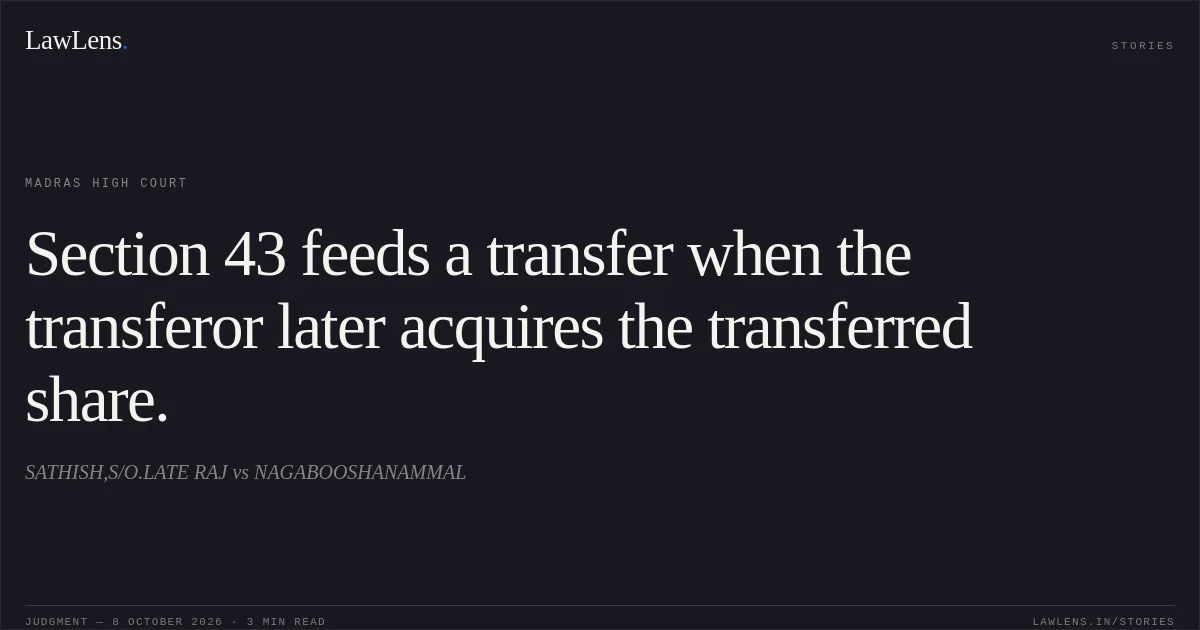
Source reference: p. 12It also applied Section 43 of the Transfer of Property Act and the doctrine of feeding the grant by estoppel: where a transferor purports to transfer property without title but later acquires an interest in it, that interest may, in the circumstances recognised by the provision, benefit the transferee.
Source reference: p. 10–11On limitation, the Court referred to the three-year period it considered applicable after the plaintiff attained majority and to Article 65 of the Limitation Act for recovery of possession.
Source reference: p. 12Reasoning
The settlement deed conferred only a life interest on Visalatchi Ammal, so the Court held that Section 14(1) did not convert it into absolute ownership; her 1971 sale therefore could not convey the interests then belonging to her daughters.
Source reference: p. 10, 12However, after the younger daughter died unmarried during her mother’s lifetime, the Court held that the mother became entitled to that daughter’s share and that, under Section 43, the interest could feed the earlier transfer to the purchaser.
Source reference: p. 10–11The purchaser was therefore entitled to that share, which the Court described as half of the property.
Source reference: p. 10–11The Court also noted that the plaintiff, who said she was born in 1964, brought suit in 1994, produced no records concerning attainment of majority, and had not challenged the 1971 sale deed; it concluded that the claim was time-barred.
Source reference: p. 12Holding
The Court partly allowed the second appeal and modified the first appellate decree: the suit was dismissed insofar as it concerned the property purchased by the first defendant, while the first appellate judgment and decree remained intact in all other respects.
No costs were awarded, and the connected miscellaneous petitions were closed.
Source reference: p. 13Acts & Sections Cited
5 provisions across 4 statutes referred to in this judgment. Each provision opens on LawLens.
Code of Civil Procedure, 19081
Hindu Succession Act, 19562
Transfer of Property Act, 18821
Limitation Act, 19631
Original Court PDF
SATHISH,S/O.LATE RAJvsNAGABOOSHANAMMAL
Click to open original judgment
Original judgment, available to read, download and summarize on LawLens.in