Facts
The appellant challenged the order dated 28.03.2014 passed by the Special Judge (Electricity Act), Korba, in M.J.C. No. 21 of 2008, whereby the bail bond/surety bond of ₹20,000 furnished by the appellant’s father, Sukul Singh, was forfeited and, upon default, the appellant was directed to undergo civil imprisonment for four months.
Source reference: para. 1Sukul Singh had stood surety for accused Mohammad Ahsan and 27 others. When one of the accused failed to appear before the trial Court on 27.12.2007, the bail bond was forfeited and proceedings under Section 446 CrPC were initiated against Sukul Singh.
Source reference: para. 2(A)–(B)Sukul Singh was subsequently arrested and produced before the Court, but died on 15.04.2011 while the recovery proceedings were pending.
Source reference: para. 2(B)Notices were thereafter issued to his legal heirs, including the appellant, for recovery of ₹20,000. The appellant eventually appeared, filed a reply, and assured the Court that he would pay ₹5,000 per month; nevertheless, the trial Court directed recovery of the surety amount.
Source reference: para. 2(C)–(D)Issues
Whether the estate of a surety who dies after the bond has been forfeited is discharged from liability under Section 446(4) CrPC?
Source reference: para. 6Whether the appellant, as the legal heir of the deceased surety, could be directed to pay the forfeited surety amount of ₹20,000?
Source reference: paras. 10–12Law Applied
The Court applied Section 446 CrPC, under which, upon proof of forfeiture of a bond, the Court may require the person bound by it to pay the penalty or show cause, and may recover the unpaid penalty as a fine; the surety may also be committed to civil jail if the penalty cannot otherwise be recovered.
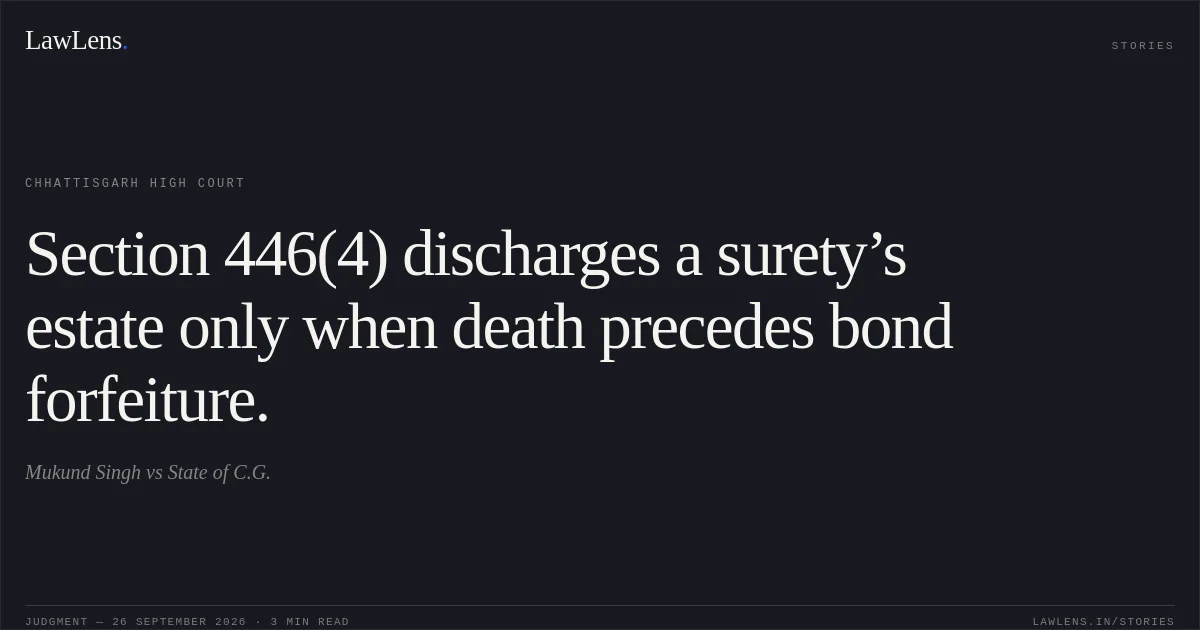
Source reference: para. 7Section 446(4) provides that where a surety dies before the bond is forfeited, his estate is discharged from liability.
Source reference: para. 7Section 447 CrPC permits the Court to require fresh security when a surety dies or when a bond is forfeited.
Source reference: para. 7Relying on State of Maharashtra v. Dadamiya Babumiya Sheikh, (1972) 3 SCC 85, the Court held that a surety bond is a contractual undertaking intended to secure the accused’s appearance and must be construed in light of that purpose.
Source reference: para. 9Relying on Mohammed Kunju v. State of Karnataka, (1998) 8 SCC 660, the Court held that forfeiture attracts the penalty undertaken by each surety.
Source reference: para. 10The Court also relied on Ram Singh v. State of Madhya Pradesh, (2006) 2 MPLJ 506, which distinguished cases where the surety died before forfeiture and held that Section 446(4) does not protect the estate where forfeiture had already occurred during the surety’s lifetime.
Source reference: para. 11Reasoning
The Court found that the bail bond had been forfeited on 27.12.2007, while Sukul Singh was alive. Thereafter, notices were served upon him, warrants were issued, and he was even produced before the trial Court pursuant to the recovery proceedings.
Source reference: para. 10Thus, the material event for purposes of Section 446(4) was the date of forfeiture, not the later date of the surety’s death. Since the surety died after the bond had already been forfeited, the statutory protection applicable where death precedes forfeiture was unavailable.
Source reference: paras. 9–12The forfeiture created liability under the surety contract, and the subsequent death of the surety did not extinguish that accrued liability. Consequently, the appellant, as legal heir, could be required to satisfy the liability from the deceased surety’s estate.
Source reference: paras. 9–12Holding
The High Court held that Section 446(4) CrPC discharged a surety’s estate only where the surety died before forfeiture. Since Sukul Singh died after the bond had been forfeited, his estate remained liable for the surety amount.
The Court upheld the order dated 28.03.2014, dismissed the criminal appeal, vacated the interim order dated 12.05.2014, and directed the appellant to deposit the amount in monthly instalments as earlier assured before the trial Court.
Source reference: paras. 12–14Acts & Sections Cited
19 provisions across 4 statutes referred to in this judgment. Each provision opens on LawLens.
Code of Criminal Procedure, 19737
Indian Penal Code, 1860
Official Secrets Act, 19231
Electricity Act, 20031
Original Court PDF
Mukund SinghvsState of C.G.
Click to open original judgment
Original judgment, available to read, download and summarize on LawLens.in