Facts
The parties entered into a land transaction under which the respondent allegedly paid ₹45.50 lakhs to the petitioner for purchase of land at Srinagar, with the sale deed to be executed in favour of the respondent’s wife.
Source reference: paras. 4–5; p. 2When the petitioner failed to execute the sale deed, he issued ten cheques towards repayment of the amount. The cheques were dishonoured, following which the respondent issued two demand notices and filed two complaints under Section 138 of the Negotiable Instruments Act, 1881 (NI Act), one concerning nine cheques and the other concerning one cheque.
Source reference: paras. 4–5; p. 2The Trial Magistrate took cognizance and issued process on 8 October 2022 and 22 December 2022, and subsequently issued a production warrant on 24 March 2023.
Source reference: para. 6; p. 2The petitioner challenged the complaints, cognizance orders and warrant under Section 482 CrPC, contending, inter alia, that the cheques were security cheques obtained under pressure, that the actual amount received was ₹32 lakhs, that the statutory notices were defective or not served, and that the complaints were not maintainable.
Source reference: paras. 10–13; pp. 3–4By the time of hearing, the complainant’s evidence was complete and the petitioner had examined two defence witnesses; the trials were therefore at an advanced stage.
Source reference: paras. 8–9, 16; pp. 3–4Issues
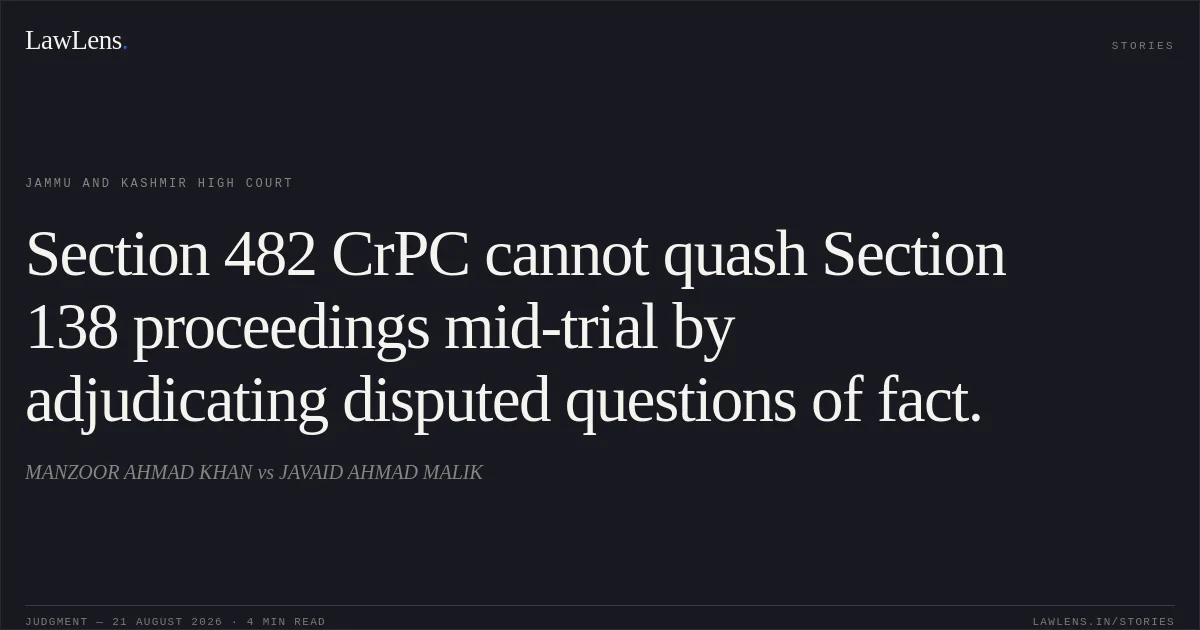
1. Whether the complaints under Section 138 of the NI Act and the consequential cognizance orders could be quashed under Section 482 CrPC on grounds concerning security cheques, the existence and amount of the legally enforceable debt, defective or non-service of demand notice, and the alleged settlement?
Source reference: paras. 10–12, 16–18, 23–26; pp. 3–72. Whether two separate complaints relating to ten dishonoured cheques, arising from the same transaction but covered by two demand notices, were maintainable?
Source reference: paras. 12, 19–20; pp. 4–53. Whether the alleged non-disclosure of the transaction in the complainant’s income-tax returns, with reference to Sections 269-B/269SS of the Income Tax Act, 1961, defeated the legally enforceable debt or rebutted the presumptions under Sections 118 and 139 of the NI Act?
Source reference: paras. 13, 21–22; pp. 4–64. Whether the advanced stage of the trials militated against interference by the High Court in its inherent jurisdiction under Section 482 CrPC?
Source reference: paras. 16–18, 25–27; pp. 4–7Law Applied
The Court applied Section 482 CrPC, holding that inherent jurisdiction is exceptional and cannot ordinarily be used to conduct a mini-trial or determine disputed questions of fact, particularly when the trial has substantially progressed.
Source reference: paras. 17–18, 25–26; pp. 4, 6–7Sections 138 and 139 of the NI Act were applied: once the foundational facts of cheque issuance, dishonour and statutory demand are prima facie established, the presumption under Section 139 operates in favour of the holder, subject to rebuttal by the accused at trial.
Source reference: paras. 17, 23, 25; pp. 4, 6–7Relying on Fayaz Ahmad Rather v. Tariq Ahmad Wani, CRM(M) No. 405/2023, the Court held that separate complaints are maintainable where separate demand notices have been issued, including in respect of multiple cheques arising from one transaction.
Source reference: para. 20; p. 5Relying on Sanjabij Tari v. Kishore S. Borcar, AIR Online 2025 SC 980, the Court held that violation of Section 269SS of the Income Tax Act attracts the statutory penalty but does not render the transaction unenforceable or rebut the presumptions under Sections 118 and 139 of the NI Act.
Source reference: para. 21; pp. 5–6Section 269-B was held irrelevant because it concerns acquisition of undervalued immovable property and not loans, deposits or cheque transactions.
Source reference: para. 22; p. 6The Court also relied on Rathish Babu Unnikrishnan v. State (NCT of Delhi) & Anr., AIR Online 2022 SC 632, for the principle that the accused must be permitted to rebut the statutory presumption through a fair trial, rather than through quashing proceedings.
Source reference: para. 24; p. 6Reasoning
The Court found that the complaints prima facie disclosed the ingredients of Section 138 of the NI Act and that the complainant had already led evidence, including evidence from the Postal Department.
Source reference: para. 23; p. 6The petitioner’s assertions that the cheques were security instruments, that the amount was inflated, that notice was not served, and that the transaction was settled involved disputed factual questions requiring appreciation of evidence by the Trial Magistrate; they could not be adjudicated in a Section 482 proceeding.
Source reference: paras. 17, 23, 25; pp. 4, 6–7The two complaints were held maintainable because two separate demand notices had been issued, notwithstanding that all ten cheques arose from the same transaction.
Source reference: paras. 19–20; p. 5The income-tax objection was rejected because the alleged non-disclosure or breach of Section 269SS did not extinguish the underlying liability or displace the statutory presumptions under the NI Act, while Section 269-B had no application.
Source reference: paras. 21–22; pp. 5–6Given that the complainant’s evidence was complete and two defence witnesses had already been examined, quashing the proceedings would improperly short-circuit a trial nearing conclusion.
Source reference: paras. 16–18, 26–27; pp. 4, 6–7Holding
The Court answered the issues against the petitioner and dismissed both petitions, CRM(M) No. 392/2024 and CRM(M) No. 219/2024, along with the connected applications.
The complaints, cognizance orders dated 8 October 2022 and 22 December 2022, and consequential proceedings were not quashed.
Source reference: para. 29; p. 7The Trial Court was directed to complete the examination of the remaining witnesses through day-to-day proceedings and dispose of both complaints expeditiously, preferably within one month, in accordance with the earlier direction issued in CRM(M) No. 481/2023.
Source reference: para. 29; p. 7Acts & Sections Cited
4 provisions across 2 statutes referred to in this judgment. Each provision opens on LawLens.
Code of Criminal Procedure, 19731
Negotiable Instruments Act, 18813
Original Court PDF
MANZOOR AHMAD KHANvsJAVAID AHMAD MALIK
Click to open original judgment
Original judgment, available to read, download and summarize on LawLens.in