01Facts
Respondent No. 2 (the complainant) attended three interviews conducted by the petitioners, who were employees of Cognizant Technology Solutions India Pvt. Ltd. (Accused No. 1 was a Hiring Manager). During the process, they collected his personal, employment and bank information, and he was appointed.
¶ 3He alleges that in March 2020 he was detained at accommodation arranged by the company, and that on 13.03.2020 (around 5.23 p.m.) an HR employee assaulted him at the HR office entrance.
¶ 3 · ¶ 11He further alleges that his background was verified repeatedly, that a person visited his house, and that the petitioners' conduct caused him to resign.
¶ 3He resigned on 14.10.2020, effective 16.10.2020.
¶ 4The complaint was lodged on 19.11.2020, about one month after resignation, leading to FIR in Crime No. 164/2020 at Sampigehalli Police Station for offences under Sections 323, 448, 406 and 420 IPC.
¶ 3 · ¶ 11The petitioners sought quashing under Section 482 CrPC, contending that the complaint was belated, that their role was limited to recruitment, that the resignation was voluntary, and that the dispute was contractual.
¶ 2, 5The petitions were heard and reserved on 06.11.2026.
pp. 3–4 (order header)02Issues
i.1. Whether the petitioners have made out a case for quashing the FIR and complaint (Annexures A and B) under Section 482 CrPC.
¶ 10ii.2. Whether the allegations under Sections 406 and 420 IPC, and the question of the petitioners' individual liability as company employees, can be decided at the quashing stage or require investigation.
¶ 12, 1303Law Applied
Section 482 CrPC, under which quashing is limited to examining the contents of the complaint.
¶ 12, 13Sunil Bharti Mittal v. CBI, (2015) 4 SCC 609, which holds that a director or officer of a company may be proceeded against on the "alter ego" principle or under statutory vicarious liability only where incriminating evidence and criminal intent are present.
¶ 6, 12Prof. R.K. Vijayasarathy v. Sudha Seetharam, (2019) 16 SCC 739, which holds that a complaint lacking prima facie ingredients of an offence, and used to cloak a civil dispute, is an abuse of process and may be quashed.
¶ 7, 12Delhi Race Club (1940) Ltd. v. State of U.P., (2024) 10 SCC 690, which distinguishes criminal breach of trust (s. 406 IPC) from cheating (s. 420 IPC) and holds that both cannot be invoked on the same facts without the ingredients of each.
¶ 8, 12Dineshbhai Chandubhai Patel, which holds that the FIR should not be quashed where the complaint discloses an offence.
¶ 13 · no citationProvisions in the judgment · 6 · Linked ones open on LawLens
Code of Criminal Procedure, 1973 Section 482
Indian Penal Code, 1860 Section 323Section 448Section 406Section 420Section 496
04Reasoning
The Court first confined its enquiry to the complaint's contents, as Section 482 CrPC requires.
¶ 12, 13It accepted that the resignation was undisputed and that the complaint was delayed by about a month. It held that the delay and the claimed voluntariness of the resignation were matters of fact to be tested during investigation, not grounds for quashing.
¶ 11As to the petitioners' authorities, the Court held that Sunil Bharti Mittal's alter-ego principle could not be applied before the Investigating Officer had collected material against the individuals.
¶ 12It held that Vijayasarathy applies only where the absence of ingredients is apparent, and that the complaint here required a probe to establish them.
¶ 12It held that the Delhi Race Club distinction between ss. 406 and 420 IPC could be determined only from the material gathered during investigation and at the stage of the final report.
¶ 12Because the complaint alleged specific acts of assault and trespass (ss. 323, 448 IPC) by the petitioners, and the ingredients of ss. 406 and 420 IPC needed investigation, the Court found that the FIR could not be quashed at the threshold.
¶ 13, 1405Holding
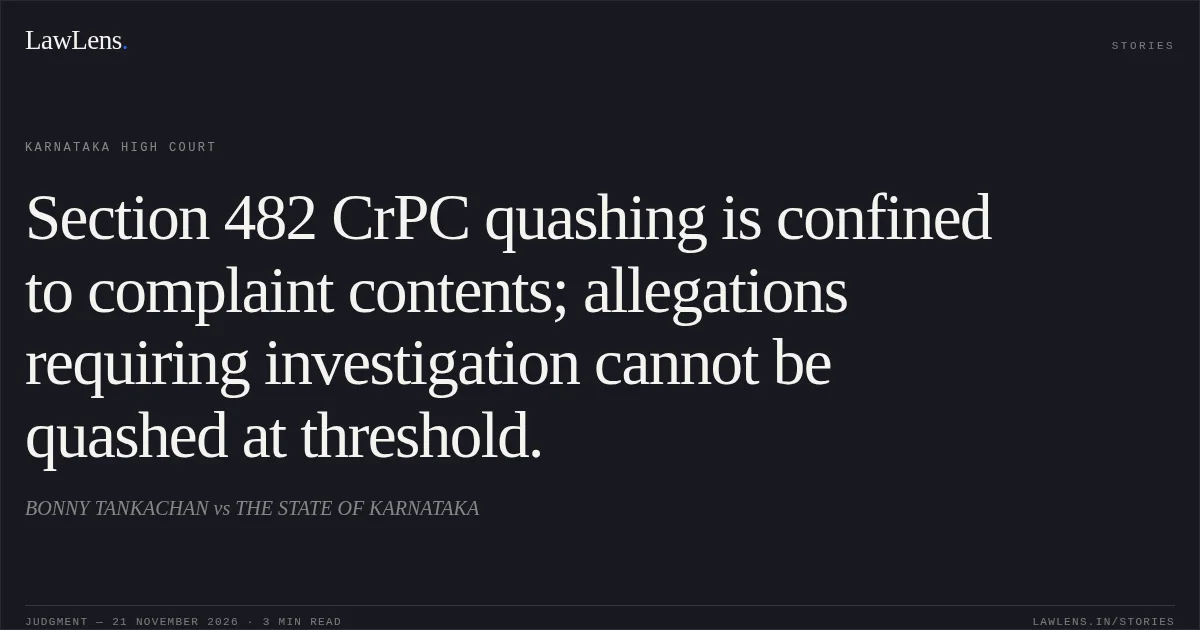
On Issue 1, the Court held that the petitioners had not made out a case for quashing under Section 482 CrPC, because the complaint disclosed offences under ss. 323 and 448 IPC and the remaining allegations required investigation.
¶ 13, 14On Issue 2, the Court held that the ingredients of ss. 406 and 420 IPC, and whether the petitioners acted with an oblique motive, must be determined by the Investigating Officer and cannot be decided at the quashing stage.
¶ 12, 14Both criminal petitions were dismissed, and the FIR and complaint in Crime No. 164/2020 (4th Additional CMM, Bengaluru) were left to proceed.
¶ 15Original Court PDF
BONNY TANKACHANvsTHE STATE OF KARNATAKA
Click to open original judgment
Original judgment, available to read, download and summarize on LawLens.in