Facts
On 16 September 2006, a police party headed by ASI Gurdev Singh received secret information that the appellant was habitually selling poppy husk.
Source reference: paras. 2–4; pp. 2–4A raid was conducted at the appellant’s cattle shed, where two gunny bags were allegedly found concealed behind straw bales.
Source reference: paras. 2–4; pp. 2–4The appellant was convicted under Section 15 of the Narcotic Drugs and Psychotropic Substances Act, 1985, and sentenced to ten years’ rigorous imprisonment and a fine of ₹1,00,000, with six months’ rigorous imprisonment in default.
Source reference: para. 1; p. 1In appeal, the appellant challenged the recovery on grounds including defective consent memos under Section 50, weaknesses in the testimony of the police witnesses, non-examination of the independent witness, absence of proof regarding possession of the cattle shed, and false implication/alibi.
Source reference: paras. 11, 20, 26, 31–32; pp. 5–6, 10–11, 14, 16–17Issues
Whether the recovery of poppy husk from the gunny bags was vitiated because the consent memos offered the appellant the impermissible third option of being searched by the police officer himself, contrary to Section 50 of the NDPS Act?
Source reference: paras. 11–19; pp. 5–10Whether the testimony of PW1, particularly his lack of knowledge regarding several spot proceedings, created a reasonable doubt regarding the recovery and chain of custody?
Source reference: paras. 20–25; pp. 10–14Whether the non-examination of the independent witness, Jit Singh, rendered the prosecution case unreliable?
Source reference: paras. 26–30; pp. 14–16Whether the prosecution failed to establish that the cattle shed was in the appellant’s possession or control, and whether the defence evidence established the appellant’s plea of alibi or false implication?
Source reference: paras. 31–40; pp. 16–20Law Applied
The Court applied Section 15 of the NDPS Act, under which possession of poppy straw attracts criminal liability, and Section 50 of the NDPS Act, which mandates that a person subjected to a personal search be informed of the right to be searched before a Gazetted Officer or Magistrate.
Source reference: paras. 13–15; pp. 7–9Relying on State of Rajasthan v. Parmanand, (2014) 5 SCC 345, the Court recognised that introducing a third option of being searched by the police officer himself is impermissible where Section 50 applies.
Source reference: paras. 13–15; pp. 7–9However, relying also on Ranjan Kumar Chadha v. State of Himachal Pradesh, 2023 INSC 878, the Court held that Section 50 safeguards apply to a search of the person and not merely to a bag, container, or other article.
Source reference: paras. 13–15; pp. 7–9The Court further applied the principles that credible testimony of official witnesses can sustain a conviction without mandatory corroboration by an independent witness, and that conscious possession or control of the place of recovery may be established from the surrounding circumstances even without formal proof of ownership.
Source reference: paras. 28–29, 34; pp. 15–18Reasoning
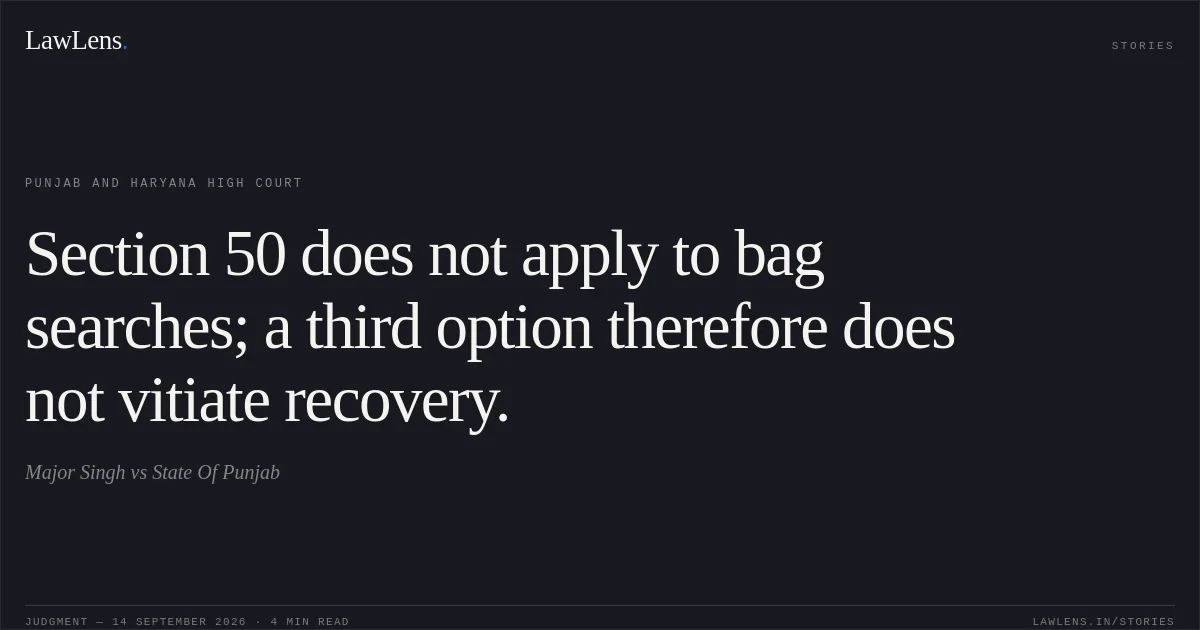
The Court held that the consent memos related to the search of the two gunny bags in the cattle shed, not to a personal search of the appellant.
Source reference: paras. 16–19; pp. 9–10Although a personal search was subsequently conducted, nothing was recovered from it; the contraband was recovered solely from the bags.
Source reference: paras. 16–19; pp. 9–10Consequently, Section 50 was not attracted, and the alleged third option did not invalidate the recovery.
Source reference: paras. 16–19; pp. 9–10PW1’s evidence was considered limited to the handling and transmission of the case property; his lack of knowledge about the details of the spot proceedings did not contradict the recovery evidence of PW3 and PW4 or establish fabrication.
Source reference: paras. 22–25; pp. 12–14The seals remained intact and the sample reached the Chemical Examiner with the seals tallying with the specimen seal, thereby establishing the chain of custody.
Source reference: paras. 22–25; pp. 12–14The non-examination of Jit Singh was not fatal because he had initially been associated with the proceedings but was later given up as won over, and the recovery was otherwise supported by consistent official testimony.
Source reference: paras. 28–30; pp. 15–16The Court further found that the defence had not specifically disputed the appellant’s possession or control of the cattle shed; the circumstances of concealment and the recovery witnesses connected him with the place.
Source reference: paras. 34–40; pp. 17–20The testimony of the defence witness regarding the appellant’s presence at a fair was uncorroborated and unsupported by any contemporaneous complaint or independent material, and therefore failed to establish alibi or false implication.
Source reference: paras. 34–40; pp. 17–20Holding
The Court answered all issues against the appellant.
It held that Section 50 of the NDPS Act was inapplicable because the contraband was recovered from gunny bags and not from the appellant’s person; the alleged defect in the consent memos therefore did not vitiate the recovery.
Source reference: paras. 18–19; pp. 9–10The Court also held that the prosecution had satisfactorily established the recovery, chain of custody, the appellant’s connection with the cattle shed, and the reliability of the official witnesses.
Source reference: paras. 22–25, 28–30, 34–40; pp. 12–20The appeal was dismissed, the conviction under Section 15 of the NDPS Act and sentence dated 18 December 2007 were upheld, and directions were issued for the appellant’s re-arrest to undergo the remaining sentence, if any.
Source reference: paras. 42–45; pp. 20–21Acts & Sections Cited
3 provisions across 2 statutes referred to in this judgment. Each provision opens on LawLens.
Narcotic Drugs and Psychotropic Substances Act, 19852
Code of Criminal Procedure, 19731
Original Court PDF
Major SinghvsState Of Punjab
Click to open original judgment
Original judgment, available to read, download and summarize on LawLens.in