01Facts
On 12.08.2020, Respondent No. 2 (State President of Jaibhima Akhil Bharat Dalit Kriya Samiti (R)) lodged a complaint with Bagalur Police. He alleged that on 07.08.2020 at about 12:00 noon, while inspecting Panchayat works at Bandikodigenahalli village with the Assistant Executive Officer of the Taluk Panchayat, the PDO abused him. The petitioner, a village resident, allegedly also abused him and threatened him with dire consequences.
p. 2 · ¶ 2The complaint did not disclose any motive for the incident.
¶ 5An FIR (Crime No. 90/2020) was registered against the petitioner and three others under Sections 504 and 506 read with Section 34 IPC.
p. 3 · ¶ 3After investigation, the police filed a charge sheet against the petitioner only, under Section 504 IPC. The other accused were dropped, and Accused Nos. 1 and 4 were cited as witnesses (CWs. 4 and 5).
p. 3 · ¶ 3The Principal Civil Judge and JMFC, Devanahalli, took cognizance in C.C. No. 5230/2020.
p. 3 · ¶ 3The petitioner sought quashing under Section 482 CrPC.
It was admitted that neither the Assistant Executive Officer nor the Project Officer of the Zilla Panchayat, who were present during the inspection, had lodged any complaint.
p. 5 · ¶ 8The petitioner contended that he had no connection with the inspection and that the allegations were bald and omnibus.
p. 4 · ¶ 5The State contended that the statements of CWs. 2 to 7 showed that the petitioner abused the complainant.
p. 5 · ¶ 602Issues
i.1. Whether the allegations in the charge sheet, taken at face value, disclose an offence under Section 504 IPC against the petitioner, such that continuation of C.C. No. 5230/2020 amounts to an abuse of the process of law.
p. 4 · ¶ 5 · p. 11 · ¶ 11ii.2. Whether the complaint and charge sheet establish the requisite mens rea (intention or knowledge that the insult would provoke a breach of the peace) on the part of the petitioner.
p. 6 · ¶ 9 · p. 10 · ¶ 1103Law Applied
The Court relied on Section 504 IPC, which penalises intentional insult provoking a breach of the peace or the commission of another offence.
Following Mohammad Wajid v. State of U.P. (as quoted in B.V. Ramkumar v. State of Telangana, (2025) 3 SCC 475), mere abuse, discourtesy, rudeness, or insolence does not amount to an offence unless it is an intentional insult likely to provoke the insulted person to breach the peace or commit an offence, judged by the ordinary effect of the words and not the complainant's temperament.
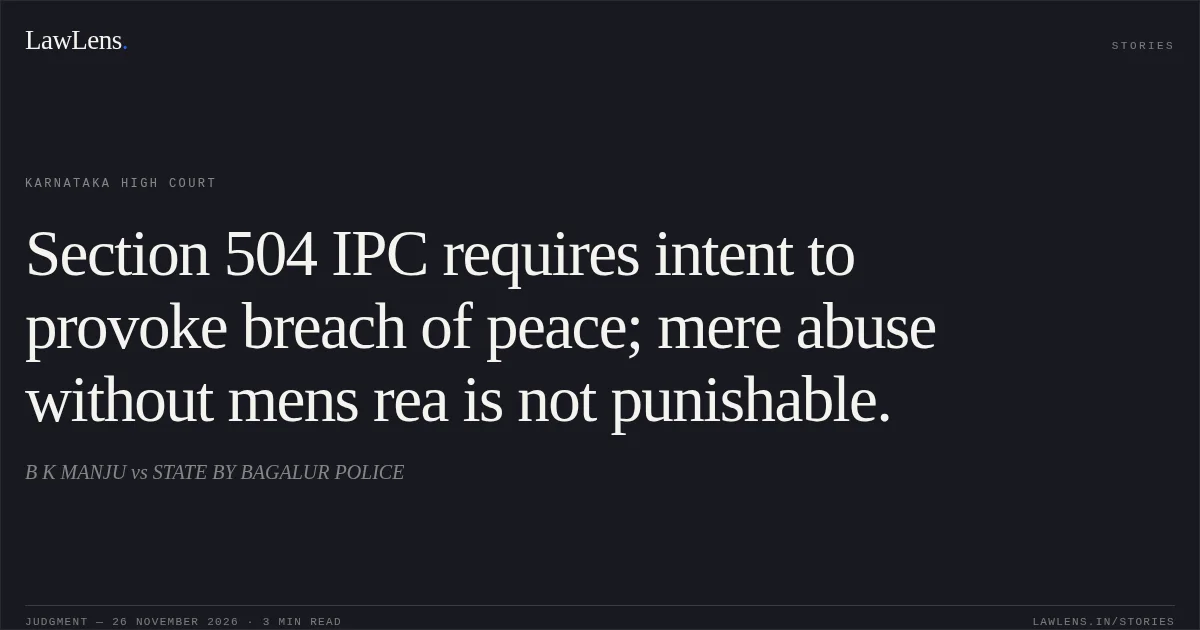
p. 7 · ¶ 10 (paras 24, 29–31 of Ramkumar) · p. 9 · ¶ 10Section 504 has two components: an actus reus (intentional insult causing provocation) and mens rea (intention or knowledge that the provocation is likely to cause a breach of the peace or another offence). Intention or knowledge is a sine qua non, and an insult without intention to provoke is not punishable.
p. 10 · ¶ 10 (paras 26–27 of Ramkumar)The Court also relied on the power under Section 482 CrPC to quash proceedings that amount to an abuse of process.
p. 11 · ¶ 11Provisions in the judgment · 4 · Linked ones open on LawLens
Code of Criminal Procedure, 1973 Section 482
Indian Penal Code, 1860 Section 504Section 506Section 34
04Reasoning
The Court found that the petitioner had no apparent connection with the work inspection and that no material showed any motive or mens rea on his part to abuse the complainant or the officials.
p. 6 · ¶ 9The complaint and charge sheet contained only bald and omnibus allegations against him, and the witness statements repeated these generic allegations without particulars.
p. 6 · ¶ 9The Court noted that the officials who were present and whose conduct was in question had not complained, and that the PDO and the other named person were dropped from the charge sheet, leaving the petitioner as the sole accused.
p. 5 · ¶ 8 · p. 3 · ¶ 3Applying Ramkumar, the Court held that the material did not show an intentional insult with the requisite intention or knowledge of provoking a breach of the peace, so the essential ingredients of Section 504 IPC were absent even at face value.
p. 11 · ¶ 11Continuing the prosecution in these circumstances would therefore be an abuse of process.
p. 11 · ¶ 1105Holding
The Court held that, even accepting the charge sheet allegations at face value, no offence under Section 504 IPC is made out against the petitioner, and continuation of the proceedings would amount to an abuse of process.
p. 11 · ¶ 11The petition is allowed, and the proceedings against the petitioner in C.C. No. 5230/2020 (arising out of Crime No. 90/2020, Bagalur Police Station) pending before the Prl. Civil Judge and JMFC, Devanahalli, are quashed.
p. 11 · order (i)–(ii)Original Court PDF
B K MANJUvsSTATE BY BAGALUR POLICE
Click to open original judgment
Original judgment, available to read, download and summarize on LawLens.in