Facts
The plaintiff sought a declaration that a gift deed dated 18 July 2023 was void, partition of the suit lands, and separate possession of his share.
Source reference: para. 2–5He claimed that the lands remained joint and that no partition had taken place among the relevant family members.
Source reference: para. 2–5Defendants Nos. 2 and 3 disputed this, asserting that the lands had been partitioned and that defendant No. 1 had gifted the lands allotted to him to them.
Source reference: para. 2–5The trial court restrained the defendants from alienating the lands during the suit; the appellate court reversed that order, relying on Section 52 of the Transfer of Property Act, 1882.
Source reference: para. 2–5The plaintiff challenged the appellate order under Article 227 of the Constitution.
Source reference: para. 2–5Issues
1. Whether the plaintiff had raised a triable issue and shown sufficient grounds for temporary injunction against alienation of the suit lands pending trial.
Source reference: para. 6–72. Whether the appellate court was justified in setting aside the injunction on the ground that Section 52 of the Transfer of Property Act adequately protected the plaintiff’s interests.
Source reference: para. 7Law Applied
Article 227 of the Constitution was invoked to challenge the appellate court’s order.
Source reference: para. 2Order 39 Rules 1 and 2 of the Code of Civil Procedure provide for temporary injunctions to preserve property pending suit.
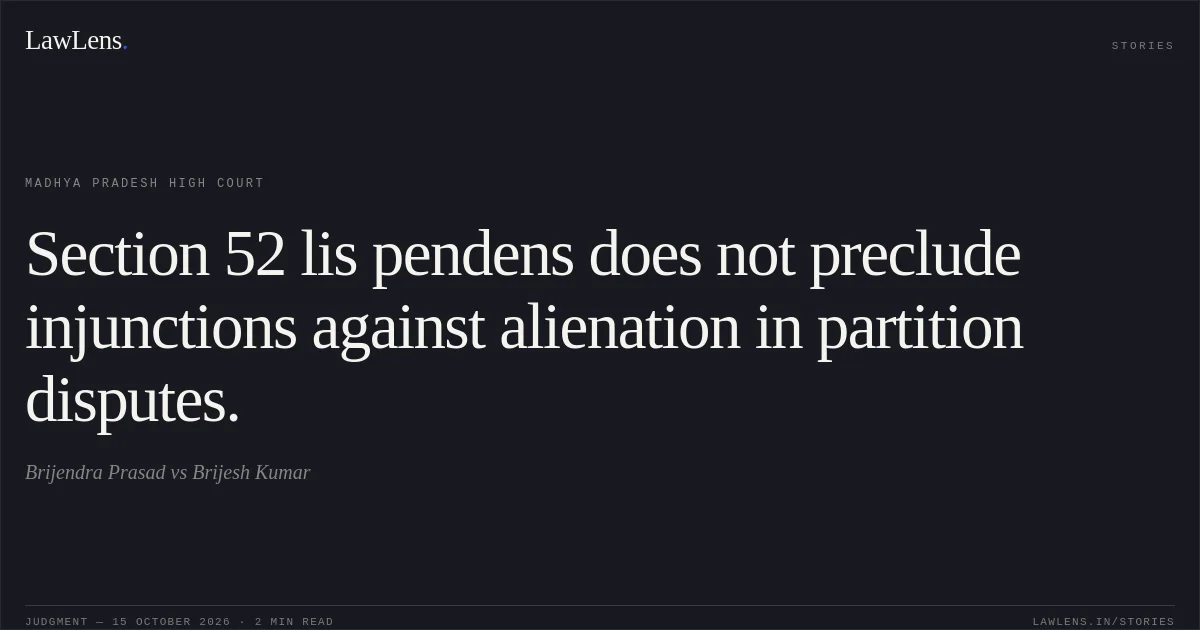
Source reference: para. 4Section 52 of the Transfer of Property Act embodies the doctrine of lis pendens, under which a transfer during litigation is subject to the outcome of the suit; however, the Court held that, in the circumstances of this case, that protection alone was insufficient to prevent complications, third-party involvement, and multiplicity of proceedings.
Source reference: para. 7A disputed question requiring evidence may constitute a triable issue at the interim stage, without being finally determined on the injunction application.
Source reference: para. 6Reasoning
The competing claims about whether partition had occurred, and whether defendant No. 1 could gift the lands to defendants Nos. 2 and 3, required determination after evidence and could not be resolved at the interim stage.
Source reference: para. 6The plaintiff had therefore raised a triable issue.
Source reference: para. 6The Court also noted defendant No. 1’s position that the gift deed had been procured by fraud, which further supported a prima facie case, while recognizing that the allegation itself remained to be proved.
Source reference: para. 7Permitting alienation could bring strangers into the family dispute and cause complications and further litigation.
Source reference: para. 6–7The appellate court therefore erred in treating Section 52 as sufficient protection and in setting aside the trial court’s injunction.
Source reference: para. 6–7Holding
The High Court allowed the petition, set aside the appellate court’s order dated 7 May 2025, and restored the trial court’s order dated 30 December 2023 restraining the defendants from alienating the suit lands during the pendency of the suit.
Acts & Sections Cited
1 provisions across 1 statute referred to in this judgment. Each provision opens on LawLens.
Transfer of Property Act, 18821
Original Court PDF
Brijendra PrasadvsBrijesh Kumar
Click to open original judgment
Original judgment, available to read, download and summarize on LawLens.in