Facts
The appellant, a distribution licensee, sanctioned a 2,000 KVA electricity load to Respondent No. 3 under an agreement dated 24 February 1997, although the consumer had initially applied for 4,000 KVA.
Source reference: para. 4On 31 January 1998, the appellant offered to provide the additional 2,000 KVA, subject to execution of a further agreement. The consumer declined the additional supply by letter dated 14 September 1998.
Source reference: para. 4On 13 February 2007, the appellant raised a demand of ₹57,74,164 towards Minimum Consumption Guarantee Charges for the period February–September 1998, contending that the consumer was liable because the appellant had been ready to supply the additional load.
Source reference: paras. 5–6The Consumer Grievance Redressal Forum rendered a split decision. On the consumer’s representation under Regulation 8.1 of the U.P. Electricity Regulatory Commission (Consumer Grievance Redressal Forum and Electricity Ombudsman) Regulations, 2007, the Electricity Ombudsman set aside the demand, holding, inter alia, that the consumer had not consented to the additional load and that the demand was barred by Section 56(2) of the Electricity Act, 2003.
Source reference: para. 7The appellant’s writ petition was dismissed by the Allahabad High Court. The High Court also held that Regulations 8.1 and 8.2, insofar as they permitted a distribution licensee to approach the Electricity Ombudsman, were ultra vires Section 42(6) of the Electricity Act, 2003.
Source reference: paras. 8–8.2Issues
Whether Regulations 8.1 and 8.2 of the 2007 Regulations, permitting a representation before the Electricity Ombudsman, were ultra vires Section 42(6) of the Electricity Act, 2003.
Source reference: para. 8Whether the appellant’s demand dated 13 February 2007 for Minimum Consumption Guarantee Charges relating to February–September 1998 was barred by the limitation contemplated under Section 56(2) of the Electricity Act, 2003.
Source reference: paras. 8.1, 10–11Whether the consumer became liable for the additional 2,000 KVA load merely because the appellant offered to supply it, despite the absence of the consumer’s consent or proof that the load had actually been released.
Source reference: para. 8.2Law Applied
Section 42(5) of the Electricity Act, 2003 provides for redressal of consumer grievances before the Consumer Grievance Redressal Forum, while Section 42(6) permits a consumer who is aggrieved by non-redressal of the grievance to approach the Electricity Ombudsman.
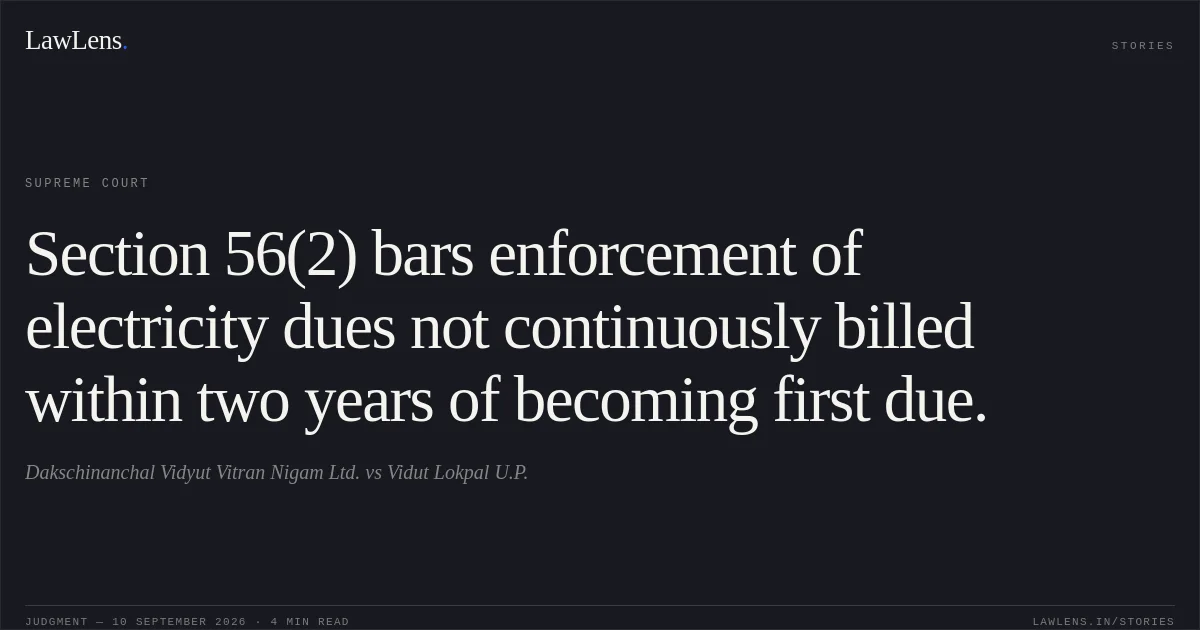
Source reference: paras. 5.1, 8Section 56(2) restricts the licensee’s power to disconnect electricity supply for unpaid dues where the amount became first due more than two years earlier, unless it has been continuously shown as recoverable arrears in subsequent bills.
Source reference: para. 10Relying on Assistant Engineer (D1), Ajmer Vidyut Vitran Nigam Ltd. v. Rahamatullah Khan alias Rahamjulla, (2020) 4 SCC 650, the Court reiterated that electricity charges become “first due” when the bill quantifying them is issued, and that Section 56(2) limits the licensee’s statutory power of disconnection after expiry of two years, though it does not necessarily bar every other mode of recovering a supplementary demand.
Source reference: para. 10The Court also noted K.C. Ninan v. Kerala State Electricity Board, 2023 INSC 560, in relation to the appellant’s ancillary regulatory arguments.
Source reference: para. 10Reasoning
The Supreme Court observed that the appellant did not seriously press its challenge to Regulation 8 and, consequently, declined to re-examine the High Court’s conclusion on the validity of Regulations 8.1 and 8.2.
Source reference: para. 10On the substantive demand, the amount related to electricity allegedly available in 1998 but was first demanded only on 13 February 2007.
Source reference: para. 8.1No contemporaneous bills had been raised for the additional 2,000 KVA, nor had the appellant shown that the amount was continuously carried forward as arrears.
Source reference: para. 8.1Applying Section 56(2) and the principle in Rahamatullah Khan, the Court held that the appellant could not rely on the statutory provision to sustain such a belated demand.
Source reference: para. 8.1Further, the consumer had neither accepted the additional load nor received it; therefore, mere readiness or offer by the appellant did not establish liability for Minimum Consumption Guarantee Charges.
Source reference: para. 8.2The Court accordingly found no basis to interfere with the Ombudsman’s decision or the High Court’s judgment.
Source reference: para. 11Holding
The Supreme Court dismissed the appeal.
It declined to reconsider the High Court’s finding concerning the validity of Regulations 8.1 and 8.2, as the challenge had not been seriously pressed.
Source reference: para. 10It further held that the appellant’s demand dated 13 February 2007, relating to the period February–September 1998, could not be sustained under Section 56(2) of the Electricity Act, 2003, particularly when no timely bills had been issued and the additional load had neither been accepted nor released to the consumer.
Source reference: paras. 10–11The demand was therefore set aside, and the amounts deposited pursuant to it were directed to be adjusted against the consumer’s future electricity bills.
Source reference: para. 7Acts & Sections Cited
3 provisions across 1 statute referred to in this judgment. Each provision opens on LawLens.
Electricity Act, 20033
Original Court PDF
Dakschinanchal Vidyut Vitran Nigam Ltd.vsVidut Lokpal U.P.
Click to open original judgment
Original judgment, available to read, download and summarize on LawLens.in