Facts
The petitioners claimed title to 8.56 acres of land originally purchased by their father, Based Ali, in favour of their grandmother, Hafeza Khatun, on 19 April 1965, and subsequently gifted by Hafeza to the petitioners through two hiba-bil-iwaz deeds dated 2 May 1979. Their names were allegedly recorded in the LR record-of-rights, and they claimed possession and payment of rent.
Source reference: para. 3A proceeding under Section 14T of the West Bengal Land Reforms Act, 1955 was initiated on the basis of a Form 7A return submitted by Hafeda Khatun, the other wife of Badiruddin Ahmed. The Revenue Officer treated the land of Hafeza and Hafeda as part of the same family holding and ordered vesting of surplus land in the State.
Source reference: para. 3The petitioners instituted O.C. Suit No. 231 of 1981, challenging the vesting and the relevant record-of-rights, principally contending that Hafeza was divorced, lived separately, and could not be treated as a member of Hafeda’s family. The civil suit was decreed in their favour on 27 July 1988, and the decree was affirmed in O.C. Appeal No. 30 of 1988 on 29 June 1989.
Source reference: paras. 3–4Subsequently, proceedings were initiated for annulment of pattas granted to third parties over portions of the land and for substitution of equivalent land from the retained schedule of the former big raiyat. The Revenue Officer ordered annulment of the pattas and correction of the record-of-rights.
Source reference: para. 5The petitioners thereafter sought correction of the record-of-rights by the BL & LRO, Hemtabad. The West Bengal Land Reforms and Tenancy Tribunal, in O.A. 2907 of 2025, declined to grant relief. The present writ petition challenged the Tribunal’s judgment dated 19 December 2025.
Source reference: paras. 1–2, 8Issues
1. Whether the civil court had jurisdiction to adjudicate the petitioners’ challenge to vesting and the consequential correction of the record-of-rights, in view of the bar under Section 57B of the West Bengal Estate Acquisition Act, 1953 and the relevant provisions of the West Bengal Land Reforms Act, 1955.
Source reference: paras. 9–132. Whether the civil court’s decree declaring the petitioners’ title and restraining the State from interfering with possession was binding so as to require the BL & LRO to rectify the record-of-rights.
Source reference: paras. 8, 13–163. Whether the case fell within the recognised exceptions to the statutory bar, including violation of natural justice, lack of authority, matters outside Section 57B(2), or a suit principally seeking declaration of title with record correction as consequential relief.
Source reference: para. 14Law Applied
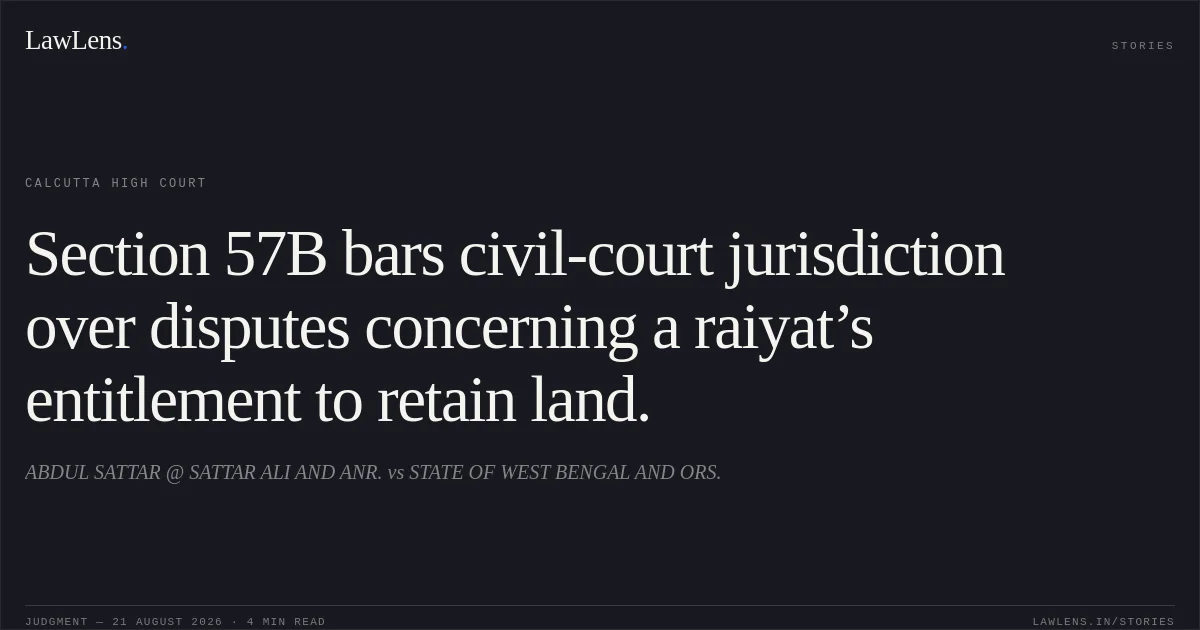
Section 57B(2) of the West Bengal Estate Acquisition Act, 1953 bars civil suits concerning alteration of finally published or corrected records-of-rights, disputes as to whether a raiyat or intermediary is entitled to retain land, and matters required to be decided by authorities under the Act.
Source reference: para. 9Section 61 of the West Bengal Land Reforms Act, 1955 similarly excludes the jurisdiction of courts over questions relating to land which are required to be or have been decided by Revenue Officers or prescribed authorities.
Source reference: para. 10Section 14T governs the furnishing of returns and determination of surplus land liable to vest.
Source reference: para. 11In Sudharani Maity v. State of West Bengal, (2003) 1 CHN 1, as explained in Sridam Mahata v. State of West Bengal, 2026 SCC OnLine Cal 1715, the statutory bar is not absolute where there is a violation of natural justice, the deciding authority lacked jurisdiction, the dispute falls outside Section 57B(2)(a)–(c), or the principal relief is declaration of title and record correction is merely consequential.
Source reference: para. 14The Court also referred to Abdul Hakim Mondal v. State of West Bengal, 2025 SCC OnLine Cal 6997.
Source reference: para. 7Reasoning
The Court held that the real controversy was not an independent adjudication of title but whether Hafeza Khatun’s land could be included while determining the ceiling and retainable area of Hafeda Khatun’s holding. That question directly concerned retention and vesting of land under the statutory land-reforms scheme and therefore fell within Section 57B(2)(b).
Source reference: paras. 13–16Although the petitioners alleged absence of notice, the appellate civil court had found that Based Ali appeared on behalf of Hafeza and filed hajira, making it impossible to sustain the plea of total non-service and natural-justice violation.
Source reference: para. 15The authority which passed the vesting order was not shown to lack statutory empowerment, and the dispute did not fall outside Section 57B(2).
Source reference: paras. 14–16Further, despite the form of the original civil suit, the present controversy principally related to statutory vesting and correction of land records rather than an independent title dispute beyond the competence of the revenue authorities.
Source reference: paras. 14–16Accordingly, the recognised exceptions to the jurisdictional bar were inapplicable.
Source reference: no citationHolding
The Court answered the jurisdictional issue against the petitioners, holding that the dispute concerning inclusion of Hafeza Khatun’s land in the ceiling calculation and the consequential correction of the record-of-rights was barred from civil-court adjudication under Section 57B of the 1953 Act.
The Tribunal’s refusal to direct the BL & LRO to act upon the civil court decree was therefore upheld.
Source reference: no citationWPLRT 70 of 2026 was dismissed, with no interference with the impugned Tribunal judgment.
Source reference: para. 17Acts & Sections Cited
7 provisions across 3 statutes referred to in this judgment. Each provision opens on LawLens.
West Bengal Land Reforms And Tenancy Tribunal Act, 19971
west bengal land reforms act, 19554
west bengal estates acquisition act, 19532
Original Court PDF
ABDUL SATTAR @ SATTAR ALI AND ANR.vsSTATE OF WEST BENGAL AND ORS.
Click to open original judgment
Original judgment, available to read, download and summarize on LawLens.in