Facts
The Petitioner, a proprietorship concern registered under the CGST and DGST Acts, claimed input tax credit (“ITC”) on invoices issued by M.R. Enterprises.
Source reference: p.2, paras. 5–6The State GST authorities had earlier issued a notice under Section 73 of the CGST Act for FY 2017–18, including a proposed demand concerning ITC claimed from M.R. Enterprises; after remand by the High Court, a fresh order was passed on 29 July 2024.
Source reference: pp. 3–4, paras. 7–9Subsequently, the DGGI and CGST Delhi North issued notices dated 2 August 2024 and 4 August 2024 under Section 74, alleging fraudulent availment of ITC through invoices unsupported by actual supply of goods. The proceedings culminated in orders dated 31 January 2025 and 10 January 2025, respectively, confirming demands of ₹6,12,000/- along with interest and penalty.
Source reference: pp. 4–5, paras. 10–15The Petitioner challenged the notices and orders, principally contending that the Central proceedings were barred by Section 6(2)(b) because the State proceedings concerned the same ITC and supplier. It also alleged non-consideration of its reply, non-supply of relied-upon documents, violation of natural justice, and improper invocation of Section 74.
Source reference: pp. 5–8, paras. 16–17Issues
1. Whether the proceedings initiated by the Central GST authorities under Section 74 concerned the “same subject matter” as the earlier proceedings initiated by the State GST authorities under Section 73, so as to attract the bar under Section 6(2)(b) of the CGST Act.
Source reference: pp. 9–12, paras. 19–322. Whether the allegations of non-consideration of the Petitioner’s reply, non-supply of relied-upon documents, violation of natural justice, and non-application of mind warranted interference under Article 226 of the Constitution.
Source reference: pp. 12–15, paras. 33–413. Whether the alleged duplication or overlapping of the two Central proceedings justified quashing of the impugned orders.
Source reference: pp. 14–15, paras. 38–39Law Applied
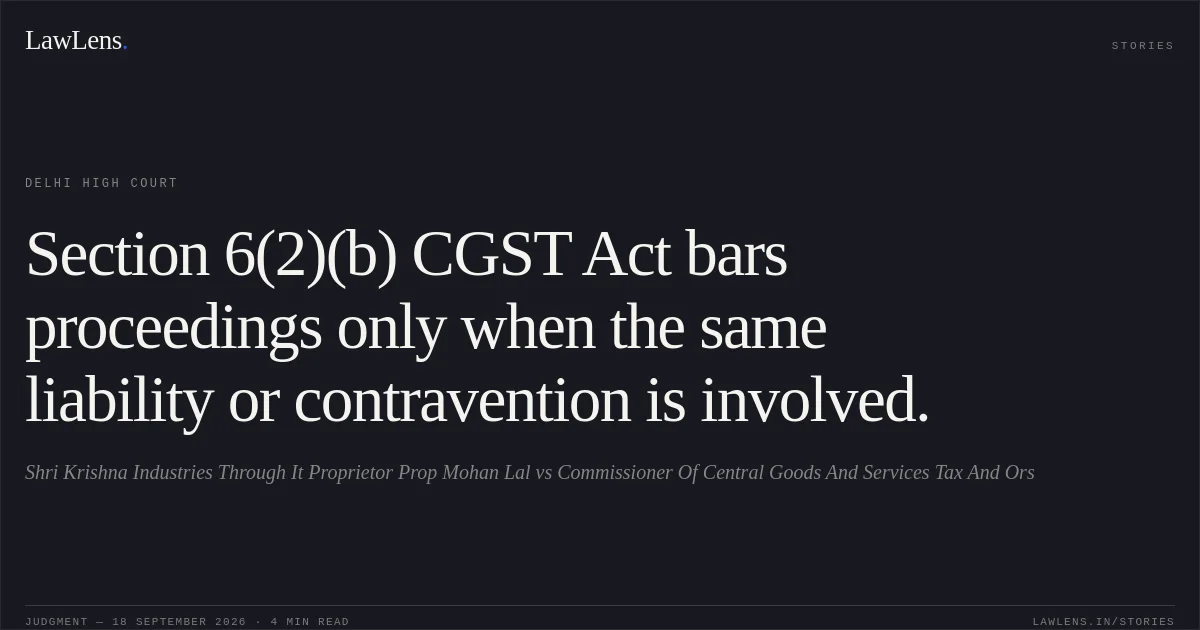
The Court applied Section 6(2)(b) of the CGST Act, which bars proceedings by one tax authority where proceedings on the “same subject matter” have already been initiated by the other tax authority.
Source reference: p. 9, para. 19The expression “same subject matter” refers to the same liability, deficiency, or contravention, and not merely to the same assessee, tax period, or broadly similar tax liability.
Source reference: p. 9, para. 20The Court relied principally on Armour Security (India) Ltd. v. Commissioner, CGST, Delhi East Commissionerate & Anr. , 2025 SCC OnLine SC 1700, for the distinction between proceedings involving the same subject matter and proceedings arising from distinct infractions.
Source reference: pp. 6–8, paras. 16.3, 17.5; p. 12, paras. 30–31It also considered the principle that the statutory appellate remedy under Section 107 ordinarily ought to be pursued where the challenge involves disputed facts, the adjudication record, and the merits of the demand.
Source reference: pp. 12–15, paras. 34–41Sections 73 and 74 were treated as provisions governing proceedings respectively involving non-fraud and fraud, wilful misstatement, or suppression of facts, although the applicability and merits of Section 74 were left open for appellate determination.
Source reference: p. 15, para. 43Reasoning
The Court held that the State proceedings and the Central proceedings had a factual connection because both involved the Petitioner’s ITC and referred to M.R. Enterprises, but that circumstance did not establish identity of the legally relevant liability or contravention.
Source reference: pp. 9–10, paras. 21–25The Central proceedings were founded on DGGI intelligence alleging bogus transactions and fraudulent availment of ITC through invoices not accompanied by actual supply of goods, whereas the Petitioner had not shown that this specific contravention had already been adjudicated in the State proceedings.
Source reference: pp. 10–12, paras. 23–29The different GSTINs attributed to M.R. Enterprises in the two Central proceedings were also relevant, though not conclusive, to determining whether the transactions and subject matter were identical.
Source reference: p. 10, para. 26The Court rejected the argument that the mere use of a different statutory provision could justify duplication, but emphasized that the underlying liability and contravention—not merely Sections 73 and 74—had to be compared.
Source reference: p. 11, para. 28The remaining objections required examination of replies, documents, investigation material, factual findings, and the existence of fraud or actual receipt of goods; these matters were therefore held suitable for the statutory appeal under Section 107 rather than writ adjudication.
Source reference: pp. 12–15, paras. 33–41Holding
The Court held that the Petitioner had failed to establish that the Central proceedings related to the “same subject matter” as the earlier State proceedings and therefore failed to show that Section 6(2)(b) barred the Central action.
The writ petition was dismissed, and the pending application was disposed of.
Source reference: p. 16, paras. 44, 48The Petitioner was granted liberty to pursue statutory appeals under Section 107 against the orders dated 10 January 2025 and 31 January 2025.
Source reference: p. 16, para. 45All contentions—including those concerning Section 6(2)(b), overlapping demands, consideration of the reply, supply of relied-upon documents, invocation of Section 74, and the merits of the tax, interest, and penalty—were expressly left open for independent consideration by the appellate authority.
Source reference: pp. 15–16, paras. 43, 46–47Acts & Sections Cited
6 provisions across 1 statute referred to in this judgment. Each provision opens on LawLens.
Central Goods and Services Tax Act, 20176
Original Court PDF
Shri Krishna Industries Through It Proprietor Prop Mohan LalvsCommissioner Of Central Goods And Services Tax And Ors
Click to open original judgment
Original judgment, available to read, download and summarize on LawLens.in