Facts
The plaintiff filed a suit for specific performance, alleging an agreement to purchase immovable property co-owned by the appellant and her brother.
Source reference: para. 1–9The Trial Court restrained the defendants from alienating or creating third-party interests in the property pending disposal of the suit.
Source reference: para. 1–9The appellant, the sister and co-owner, challenged that order, denying that she had authorised or entered into any agreement and disputing the reliance on email and WhatsApp printouts, the absence of a written contract, and the non-payment of earnest money.
Source reference: para. 1–9The plaintiff relied on the parties’ communications and offered to deposit the agreed advance of Rs. 6 lakh if directed.
Source reference: para. 14–19Issues
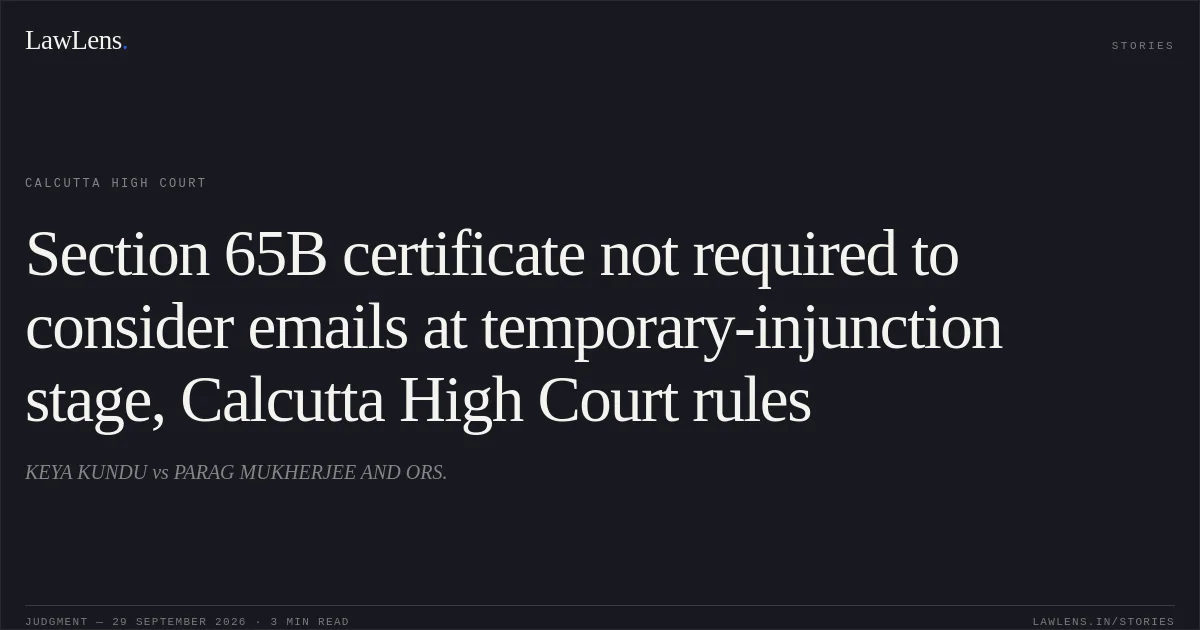
Whether the email and WhatsApp communications could be considered at the temporary-injunction stage despite the alleged non-compliance with Section 65B of the Indian Evidence Act, 1872.
Source reference: para. 24–27Whether the communications disclosed a concluded contract sufficient to support an injunction, notwithstanding the absence of a formal written agreement or payment of earnest money.
Source reference: para. 28–35, 44–51Whether the Trial Court’s injunction was justified on the principles governing interim relief.
Source reference: para. 36–43, 56–58Law Applied
Section 65B of the Indian Evidence Act, 1872 governs the admissibility of electronic records when they are tendered in evidence; the Court held that its compliance need not be determined at the preliminary stage of an injunction application.
Source reference: para. 24–27Section 10 of the Indian Contract Act, 1872 sets out the requirements for a valid contract and does not generally require an agreement to be in writing, subject to laws that specifically impose a writing, witnessing or registration requirement.
Source reference: para. 32–34The Court also relied on the proviso to Section 49 of the Registration Act, 1908 concerning use of an unregistered document as evidence of a contract in a suit for specific performance.
Source reference: para. 52The Court further considered the 2018 amendment to the Specific Relief Act, 1963, holding that it removed the statute’s former discretionary character where the requirements for specific performance are otherwise established.
Source reference: para. 37–39Reasoning
The Court held that deciding Section 65B compliance at the injunction stage would improperly convert that hearing into a trial; the communications could therefore be considered provisionally, without determining their ultimate admissibility.
Source reference: para. 24–27The emails and related communications—including a draft agreement, the stated price of Rs. 66 lakh, the plaintiff’s acceptance, and a subsequent communication declining to proceed—prima facie showed agreement on essential terms.
Source reference: para. 44–51The later refusal did not undo the agreement already reached.
Source reference: para. 44–51The absence of a formal written agreement was not fatal, and the Court treated payment of earnest money as following formation of the contract; it also regarded the plaintiff’s offer to deposit Rs. 6 lakh as evidence of readiness and willingness at this stage.
Source reference: para. 28–34Unlike Ambalal Sarabhai, the record disclosed no subsequent third-party rights or comparable change of position.
Source reference: para. 36–43, 56–58The Court therefore found a prima facie case, with the balance of convenience and risk of irreparable injury also favouring preservation of the property.
Source reference: para. 36–43, 56–58Holding
The appeal was dismissed on contest, and the Trial Court’s injunction restraining alienation or creation of third-party interests was affirmed.
The connected application was disposed of; the Trial Court may, if appropriate during the suit, direct the plaintiff to deposit the agreed advance of Rs. 6 lakh, subject to the suit’s outcome.
Source reference: para. 61–62The Court clarified that its observations were tentative and would not bind the Trial Court at later stages; there was no order as to costs.
Source reference: para. 63–64Acts & Sections Cited
2 provisions across 2 statutes referred to in this judgment. Each provision opens on LawLens.
Indian Contract Act, 18721
Registration Act, 19081
Original Court PDF
KEYA KUNDUvsPARAG MUKHERJEE AND ORS.
Click to open original judgment
Original judgment, available to read, download and summarize on LawLens.in