Facts
The disputed agricultural land, comprising Survey Nos. 311 and 683 at Village Rafu, Taluka Sami, District Patan, was granted by the State to Thakor Ranchhodbhai Motibhai on payment of occupancy price, and Entry No. 469 was mutated in 1965.
Source reference: pp. 2, 9Ranchhodbhai died in 1995 without leaving any Class-I legal heir. The petitioner, his nephew and claimed Class-II heir, was thereafter recorded in the revenue records through Entry No. 1430 dated 6 October 1996, which was certified on 2 December 1996.
Source reference: pp. 2, 4, 9–11During subsequent scrutiny of the revenue record, the authorities treated the mutation as an impermissible transfer of new-tenure land without prior permission.
Source reference: no citationProceedings under Section 79A of the Gujarat Land Revenue Code, 1879, were initiated approximately 16 years after the mutation. The Deputy Collector ordered cancellation of the entry, forfeiture of the land, and vesting of the property in the Government on 31 August 2012.
Source reference: pp. 7, 10The District Collector dismissed the petitioner’s appeal on 28 February 2018, and the Special Secretary, Revenue Department, dismissed the revision on 11 June 2018.
Source reference: pp. 1–3, 9–10The petitioner challenged all three orders under Article 226 of the Constitution and Section 211 of the Gujarat Land Revenue Code.
Source reference: para. 1Issues
Whether mutation of the petitioner’s name in the revenue record after the original grantee’s death, on the basis of succession and family relationship, constituted a prohibited transfer of new-tenure land requiring prior permission.
Source reference: pp. 12–14; paras. 7.6–7.7Whether proceedings under Section 79A of the Gujarat Land Revenue Code, initiated approximately 16 years after certification of the mutation entry, were barred by unreasonable and inordinate delay.
Source reference: pp. 12, 14; paras. 7.5, 7.8Whether the authority exercising powers under Section 79A had jurisdiction to order forfeiture of the land and direct that it vest in the Government.
Source reference: pp. 15–17; paras. 7.9, 8.1Law Applied
The Court considered Article 226 of the Constitution and Sections 79A and 211 of the Gujarat Land Revenue Code, 1879.
Source reference: para. 1A mutation entry made on the basis of succession merely records a claim of succession in the revenue record; by itself, it neither creates nor transfers title and cannot automatically be treated as a prohibited transfer requiring prior permission.
Source reference: pp. 13–14; para. 7.6Statutory powers must be exercised within a reasonable period even where the statute prescribes no limitation period. Relying on State of Gujarat v. Patel Raghav Natha, (1969) 2 SCC 187, the Court held that an unexplained exercise of power after an unreasonable delay is unsustainable.
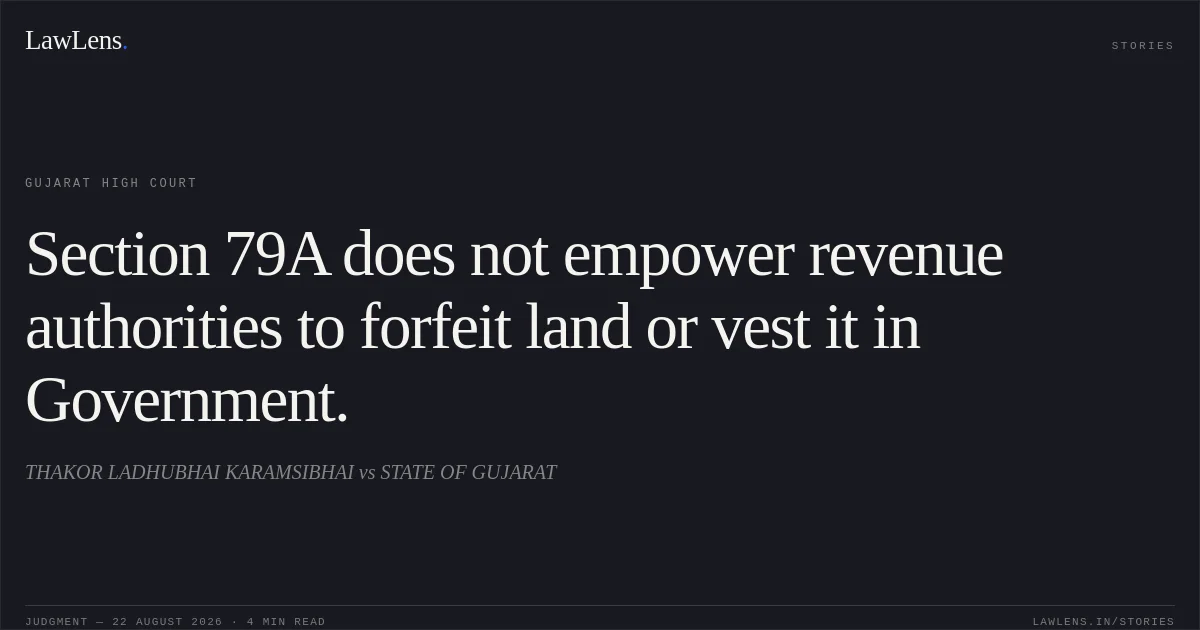
Source reference: p. 14; para. 7.8Further, Section 79A does not confer power upon the revenue authority to forfeit or resume land in favour of the Government where no such power is expressly provided; the provision cannot be expanded to authorise confiscation or extinguishment of lawful rights.
Source reference: pp. 15–16; para. 7.9The Court relied on Shardaben W/o Govindbhai Kodipatel D/o Mathurbhai Gafurbhai v. State of Gujarat, 2022 (0) AIJEL-HC 244751, and referred to the settled principle that proceedings under Section 79A are summary and non-confiscatory in nature.
Source reference: pp. 15–16; para. 7.9Reasoning
The Court found that the petitioner’s name was entered after Ranchhodbhai’s death on the basis of the pedigree, death certificate, family statements, and asserted succession, and that no sale deed, transfer deed, or other instrument evidencing a transfer had been executed.
Source reference: pp. 13–14; para. 7.6The authorities therefore erred in equating the succession-based mutation with a prohibited transfer.
Source reference: pp. 13–14; para. 7.6The petitioner’s alleged joint cultivation with Ranchhodbhai and the no-objection affidavits filed by other family members further required consideration by the revenue authorities.
Source reference: p. 14; para. 7.7The entry had remained certified and operative for approximately 16 years, while the authorities offered no satisfactory explanation for the delayed initiation of proceedings; applying Patel Raghav Natha, the Court held that the delay was gross and inordinate.
Source reference: pp. 12, 14; paras. 7.5, 7.8Independently, the forfeiture and vesting directions exceeded the jurisdiction conferred by Section 79A because that provision did not authorise confiscation or resumption of the land in favour of the Government.
Source reference: pp. 15–17; paras. 7.9, 8.1Holding
The Court answered all issues in favour of the petitioner.
It held that the succession-based mutation did not, by itself, amount to an unauthorised transfer; the proceedings were initiated after an unreasonable and unexplained delay of approximately 16 years; and the authorities lacked jurisdiction under Section 79A to order forfeiture and vesting of the land in the Government.
Source reference: paras. 8.1–8.2The Court quashed and set aside the Deputy Collector’s order dated 31 August 2012, the District Collector’s appellate order dated 28 February 2018, and the SSRD’s revisional order dated 11 June 2018.
Source reference: para. 8.2; p. 18The petition was allowed and the Rule was made absolute to that extent.
Source reference: para. 8.2; p. 18Acts & Sections Cited
3 provisions across 1 statute referred to in this judgment. Linked provisions open on LawLens.
Gujarat Land Revenue Code, 18793
Original Court PDF
THAKOR LADHUBHAI KARAMSIBHAIvsSTATE OF GUJARAT
Click to open original judgment
Original judgment, available to read, download and summarize on LawLens.in