Facts
The plaintiffs/respondents obtained decrees for eviction against the appellant, who remained in occupation of the premises after the death of the original tenant and was treated as a trespasser
Source reference: para. 1During an earlier suit, the plaintiffs applied to bring the original tenant’s heirs and legal representatives on record, but that application was dismissed for non-prosecution; the earlier suit abated, and the plaintiffs later brought a fresh eviction suit against the appellant
Source reference: paras. 2–3, 9The appellant challenged the decrees, relying on the earlier application as an admission that the heirs had become tenants, asserting that the property was governed by the West Bengal Thika Tenancy (Acquisition and Regulation) Act, 2001, and arguing that the description of the premises as one room was inconsistent with evidence that it had been partitioned into two
Source reference: paras. 4–6Issues
Whether the earlier substitution application prevented the plaintiffs from treating the appellant as a trespasser under the West Bengal Premises Tenancy Act, 1997
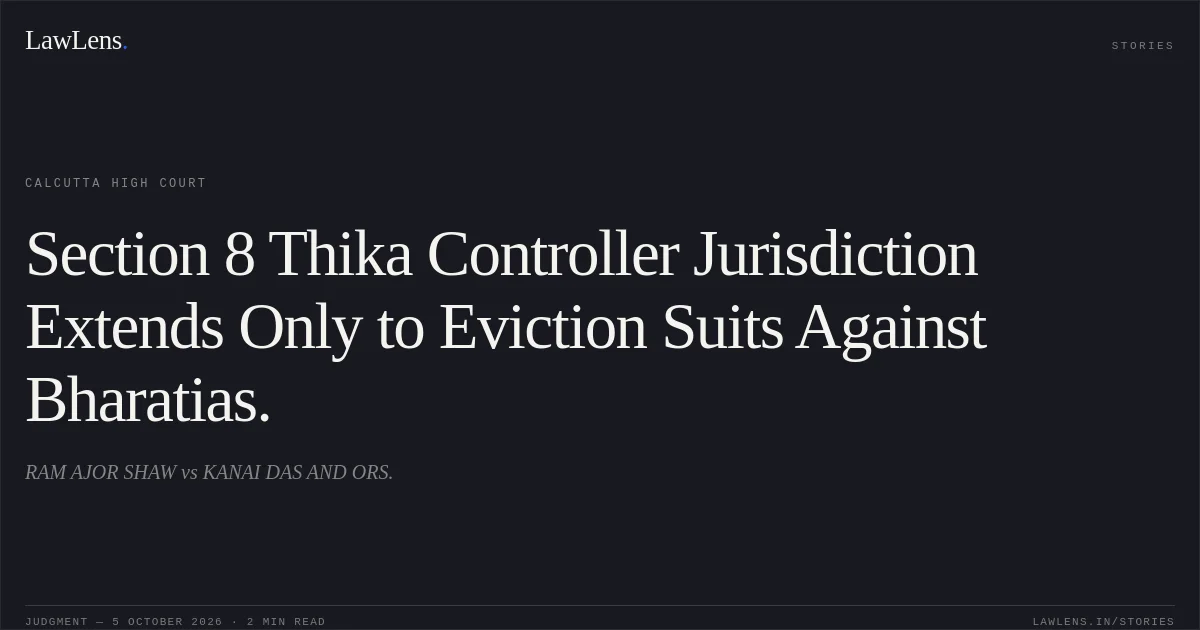
Source reference: paras. 4, 8–10Whether the eviction suit was required to be brought before the Thika Controller under Section 8 of the West Bengal Thika Tenancy (Acquisition and Regulation) Act, 2001
Source reference: paras. 5, 11Whether the internal partition of the suit room made the property description in the plaint materially inaccurate
Source reference: paras. 6, 12–13Whether any of these grounds raised a substantial question of law warranting consideration in second appeal
Source reference: paras. 7, 14Law Applied
Section 2(g) of the West Bengal Premises Tenancy Act, 1997 governs the statutory status of a person occupying premises after the tenant’s death; that status arises by operation of law and cannot be displaced by estoppel
Source reference: para. 10Section 8 of the West Bengal Thika Tenancy (Acquisition and Regulation) Act, 2001 requires eviction suits against bharatias (tenants) to be filed before the Thika Controller; the court held that the provision did not apply to a suit brought against a trespasser
Source reference: para. 11The court also applied Order XLI Rule 11 of the Code of Civil Procedure to dismiss the second appeal where the grounds raised no substantial question of law
Source reference: paras. 14–15Reasoning
The plaintiffs’ abandoned application in the earlier suit did not bind them by admission, acquiescence, or estoppel, particularly because that suit had abated and the later action was based on a continuing cause of action; moreover, the appellant’s status was determined by Section 2(g), not by the earlier application
Source reference: paras. 8–10Since the suit was against the appellant as a trespasser rather than a bharatia, Section 8 of the 2001 Act did not require the matter to be brought before the Thika Controller
Source reference: para. 11The alleged partition was internal and did not materially alter the room’s essential character or its description in the plaint
Source reference: paras. 12–13Accordingly, none of the grounds raised a substantial question of law
Source reference: para. 14Holding
The High Court dismissed SA No. 109 of 2025 under Order XLI Rule 11 CPC and dismissed CAN 1 of 2026 consequentially
It left the appellant at liberty to apply to the executing court for time to vacate, if execution had been levied, for that court to decide in accordance with law; there was no order as to costs
Source reference: paras. 17–19Acts & Sections Cited
2 provisions across 2 statutes referred to in this judgment. Each provision opens on LawLens.
West Bengal Premises Tenancy Act, 19971
West Bengal Thika Tenancy ( Acquisition And Regulation ) Act, 20011
Original Court PDF
RAM AJOR SHAWvsKANAI DAS AND ORS.
Click to open original judgment
Original judgment, available to read, download and summarize on LawLens.in