Facts
M/s DLF Projects Ltd. was engaged in constructing residential and commercial projects and paid service tax under the Composition Scheme applicable to works contract services.
Source reference: para. 2.1–2.3Certain projects had commenced before 1 June 2007 but continued thereafter; the assessee nevertheless applied the Composition Scheme to those ongoing projects.
Source reference: para. 2.1–2.3Following the Supreme Court’s decision in Nagarjuna Construction Co. Ltd. v. Union of India, 2012 (28) S.T.R. 561 (S.C.), the Department considered that such projects were taxable under the earlier valuation provisions and issued a show-cause notice dated 18 October 2012 for FY 2011–12.
Source reference: para. 2.3, 2.6During adjudication, the assessee submitted project-wise details and a Chartered Accountant’s certificate.
Source reference: para. 2.5–2.6The differential service tax of Rs. 3,57,22,070, interest of Rs. 1,49,63,475, and CENVAT credit of Rs. 74,19,404, along with applicable interest, were paid or reversed before the impugned order was passed.
Source reference: para. 2.5–2.6; para. 6.2The Commissioner confirmed and appropriated these amounts, imposed penalties under Sections 76 and 77 of the Finance Act, 1994, and refrained from imposing a penalty under Section 78.
Source reference: para. 1.1The assessee challenged only the penalties.
Source reference: para. 2.7The Revenue filed a cross-appeal contending that the Commissioner had wrongly relied on the assessee’s Chartered Accountant’s certificate, failed to examine income of Rs. 43,39,90,174, overlooked project-wise discrepancies, and ignored a difference of Rs. 30,25,791 between tax payments reflected in the certificate and the ST-3 returns.
Source reference: paras. 2.7, 10.1–10.2Issues
1. Whether penalties under Sections 76 and 77 of the Finance Act, 1994 were imposable when the assessee had acted under a bona fide interpretational belief regarding the applicability of the Composition Scheme and had paid the differential tax, interest, and reversed CENVAT credit before adjudication?
Source reference: paras. 2.7, 6.3–72. Whether the assessee had demonstrated a “reasonable cause” within the meaning of Section 80 of the Finance Act, 1994 so as to warrant waiver of penalties under Sections 76 and 77?
Source reference: paras. 4.2–4.4, 73. Whether the Commissioner had properly examined the assessee’s computations, the nature of the disputed income, the CENVAT records, the reconciliation statements, and the alleged difference between the tax payment figures?
Source reference: paras. 10.1–10.2, 12.1–12.3Law Applied
The Tribunal applied Sections 76 and 77 of the Finance Act, 1994, concerning penalties for failure to pay service tax and contravention of statutory requirements, including proper filing of ST-3 returns.
Source reference: para. 1.1(d)–(e)It applied Section 80, which contained a non-obstante provision authorising waiver of penalties under Sections 76, 77, and 78 where the assessee proved that there was a “reasonable cause” for the failure.
Source reference: paras. 4.2–4.3, 7Relying on Nagarjuna Construction Co. Ltd. v. Union of India, 2012 (28) S.T.R. 561 (S.C.), the Tribunal accepted that ongoing projects commenced before 1 June 2007 were required to be assessed under the earlier valuation provisions rather than the subsequently introduced Composition Scheme.
Source reference: paras. 2.6, 6.3It also relied on Bajaj Travels Ltd. v. Commissioner, 2012 (25) S.T.R. 417 (Delhi), for the principle that a bona fide and honest interpretational belief, absent fraud or deceit, may constitute “reasonable cause” under Section 80.
Source reference: para. 4.2Reasoning
The Tribunal found that the dispute concerned the interpretation and applicability of the service-tax valuation scheme to ongoing projects, and that the legal position became clear only after the Supreme Court’s decision in Nagarjuna Construction.
Source reference: paras. 6.3, 7The assessee had paid the entire differential service tax and applicable interest and had reversed the CENVAT credit with interest before the impugned order; these payments were duly appropriated by the Commissioner.
Source reference: paras. 6.2, 6.4In those circumstances, the assessee’s initial failure was attributable to a bona fide interpretational doubt and constituted reasonable cause under Section 80.
Source reference: paras. 7–8The penalties under Sections 76 and 77 were therefore unwarranted.
Source reference: paras. 7–8Regarding the Revenue’s appeal, the Tribunal examined the impugned order and held that the Commissioner had not relied merely on the Chartered Accountant’s certificate.
Source reference: para. 12.1The Commissioner had considered the CENVAT Register, GAR-7 challans, CENVAT reversal records, reconciliation charts, and the supporting certificate.
Source reference: para. 12.1The additional Chartered Accountant’s certificate dated 19 November 2019 further clarified the nature of the disputed income.
Source reference: para. 12.2The alleged difference of Rs. 30,25,791 was explained as relating to reversal of CENVAT credit on the sale of capital goods and had already been considered in the adjudication proceedings.
Source reference: para. 11.5The Tribunal consequently found no infirmity in the Commissioner’s factual or legal findings.
Source reference: para. 12.3Holding
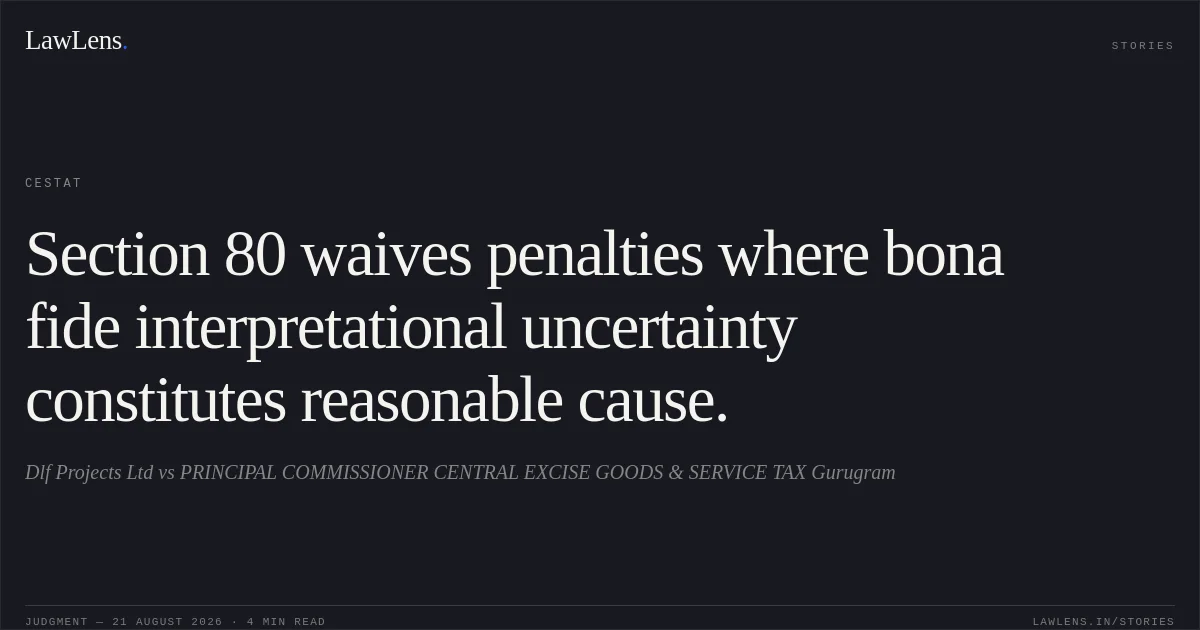
The assessee established a reasonable cause for the initial short-payment of service tax because the dispute arose from a genuine uncertainty concerning the applicable valuation scheme, and the entire tax, interest, and CENVAT-credit reversal had been completed before adjudication.
Accordingly, the penalties imposed under Sections 76 and 77 were set aside, and Appeal No. ST/54780/2014 filed by DLF Projects Ltd. was allowed.
Source reference: para. 8; para. 13The Revenue failed to establish any error in the Commissioner’s examination of the assessee’s records and computations; therefore, Appeal No. ST/55405/2014 was dismissed and the remaining findings of the impugned order were upheld.
Source reference: paras. 12.1–12.3; para. 13Acts & Sections Cited
7 provisions across 1 statute referred to in this judgment. Linked provisions open on LawLens.
Finance Act, 19947
Original Court PDF
Dlf Projects LtdvsPRINCIPAL COMMISSIONER CENTRAL EXCISE GOODS & SERVICE TAX Gurugram
Click to open original judgment
Original judgment, available to read, download and summarize on LawLens.in