Facts
The petitioners comprised a company engaged in the textile business and its two directors.
Source reference: para. 2–3The Madhya Pradesh Pollution Control Board filed a private complaint alleging operation of a garment industry without the requisite consent, in violation of Sections 25, 26 and 44 of the Water (Prevention and Control of Pollution) Act, 1974, read with Sections 21, 37 and 39 of the Air (Prevention and Control of Pollution) Act, 1981.
Source reference: para. 2–3The Trial Court initially issued bailable warrants, which were returned unserved.
Source reference: para. 4–5Despite the defective service, the Trial Court issued further arrest warrants on 10 April 2024 and subsequently initiated proceedings under Section 82 of the Code of Criminal Procedure, 1973, declaring the petitioners absconders and directing issuance of permanent arrest warrants on 10 September 2024.
Source reference: para. 4–5The petitioners challenged both orders under Articles 226 and 227 of the Constitution, contending that they had never been validly served with summons or warrants.
Source reference: para. 6The State later conceded that the initial summons had been wrongly routed to Police Station Pithampur instead of Police Station Tukoganj, Indore, corresponding to the petitioners’ recorded address.
Source reference: para. 10–12Issues
1. Whether the writ petition was maintainable despite the alternative remedy under Section 70(2) of the Cr.P.C. for cancellation or recall of warrants.
Source reference: para. 7, 92. Whether the Trial Court could validly initiate proceedings under Section 82 of the Cr.P.C. and declare the petitioners absconders when the foundational summons and warrants had not been effectively served.
Source reference: para. 6, 143. Whether the orders dated 10 April 2024 and 10 September 2024 issuing arrest warrants and declaring the petitioners absconders were liable to be quashed.
Source reference: para. 14, 16Law Applied
The Court applied Articles 226 and 227 of the Constitution, under which interference in ongoing criminal proceedings is exercised sparingly but remains available in cases of patent jurisdictional error, manifest procedural illegality, or violation of natural justice resulting in miscarriage of justice.
Source reference: para. 9Section 82 of the Cr.P.C. requires the Court to have reason to believe that a person against whom a warrant has been issued has absconded or is concealing himself so that the warrant cannot be executed; such satisfaction must rest on valid prior process and effective service.
Source reference: para. 6, 14Section 70(2) of the Cr.P.C. provides an alternative remedy for cancellation of a warrant, but the existence of such remedy does not bar constitutional intervention where the impugned action is founded on a fundamental procedural defect.
Source reference: para. 7, 9No judicial precedent was cited or relied upon in the judgment.
Source reference: no citationReasoning
The Court found that the initial summons had been incorrectly sent to Police Station Pithampur rather than Police Station Tukoganj, Indore, and consequently had never been effectively served on the petitioners.
Source reference: para. 10–13Although the issuance of the initial bailable warrants was not treated as an inherent jurisdictional error, the defective service meant that the petitioners’ subsequent non-appearance could not reasonably establish deliberate evasion or concealment.
Source reference: para. 11, 13Since the statutory “reason to believe” required under Section 82 Cr.P.C. was premised on an invalid procedural foundation, the proclamation and permanent arrest warrants could not be sustained.
Source reference: para. 14The defect was sufficiently fundamental to justify exercise of the Court’s jurisdiction under Articles 226 and 227 notwithstanding the respondents’ objection concerning the alternative remedy.
Source reference: para. 7, 9, 16Holding
The High Court allowed the writ petition and quashed the Trial Court’s orders dated 10 April 2024 and 10 September 2024, including the orders declaring the petitioners absconders and directing issuance of permanent arrest warrants.
The matter was remanded to the Trial Court, and the petitioners were directed to appear before it and participate diligently in the proceedings.
Source reference: para. 16–17The petition was disposed of without any order as to costs.
Source reference: para. 16–17Acts & Sections Cited
8 provisions across 3 statutes referred to in this judgment. Each provision opens on LawLens.
Water (Prevention and Control of Pollution) Act, 19743
Air (Prevention and Control of Pollution) Act, 19813
Code of Criminal Procedure, 19732
Original Court PDF
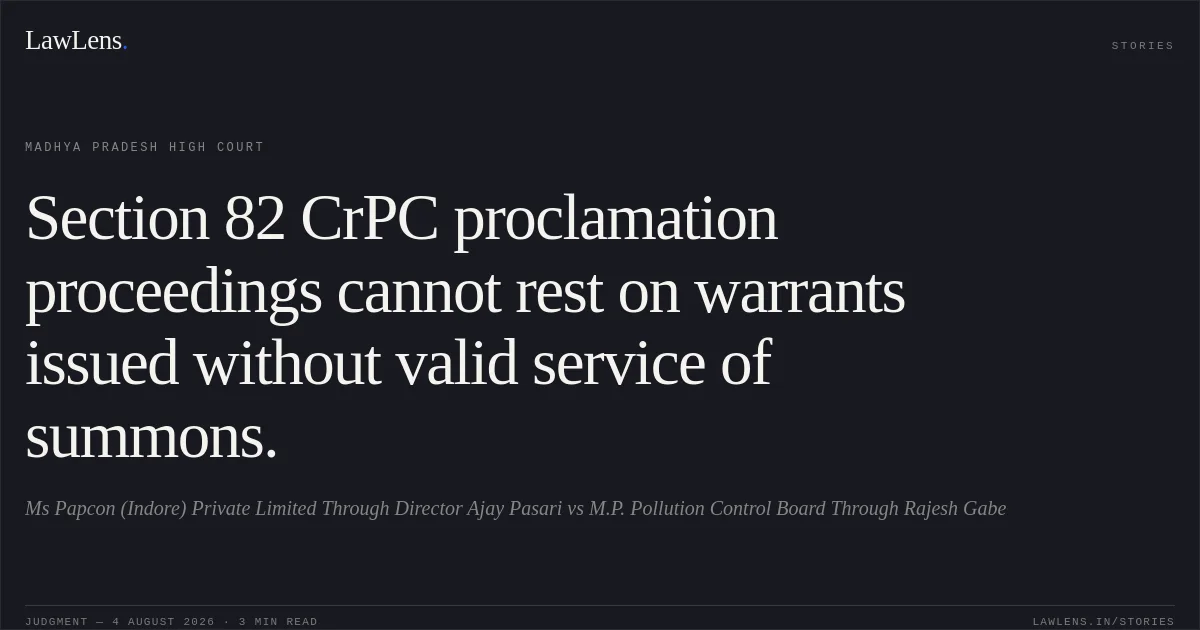
Ms Papcon (Indore) Private Limited Through Director Ajay PasarivsM.P. Pollution Control Board Through Rajesh Gabe
Click to open original judgment
Original judgment, available to read, download and summarize on LawLens.in