Facts
Aroha Labs Pte. Ltd., a Singapore-incorporated company, engaged Respondent Nos. 1–5 under Master Service Agreements (MSAs) for software, artificial-intelligence, marketing and related services.
Source reference: paras. 3.1–3.3The MSAs contained Singapore governing-law and SIAC arbitration clauses, with Singapore as the seat, while permitting parties to seek interim relief from “any court”.
Source reference: paras. 10.1–10.2Aroha alleged that the respondents developed applications including “ASTRO 247,” “CREATO,” “ASTHA 247” and “AMORE” using its resources and funding, and that all related intellectual property was assigned to it under the MSAs.
Source reference: paras. 3.2–3.5Respondent No. 6, Creato Club Pvt. Ltd., was incorporated after a term sheet contemplated Aroha receiving a 38% stake in the proposed company; Respondent No. 1 held 99.99% of its shares.
Source reference: paras. 3.4–3.8, 11.18–11.22Following disputes concerning ownership and control of the applications, Aroha terminated the MSAs and filed a petition under Section 9 of the Arbitration and Conciliation Act, 1996, seeking an injunction restraining use or dealing with the applications and delivery of company property, source code and related materials.
Source reference: paras. 3.9–3.14, 1–2The respondents disputed ownership, asserted that “ASTRO 247” was independently developed by Respondent No. 6, and contended that Respondent No. 6 was a non-signatory to the arbitration agreement.
Source reference: paras. 4.1–4.19, 5.1–5.12Issues
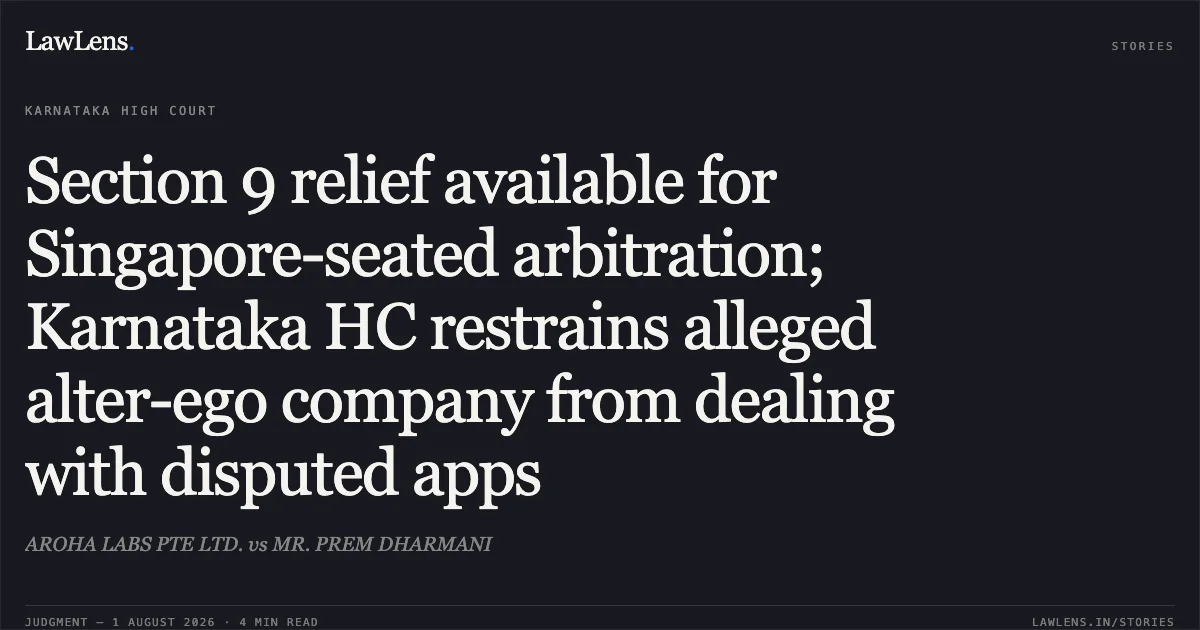
Whether a petition under Section 9 of the Arbitration and Conciliation Act, 1996 is maintainable before an Indian court where the arbitration is seated outside India, particularly in Singapore.
Source reference: para. 9.1Whether interim relief under Section 9 can be sought against Respondent No. 6, which was admittedly a non-signatory to the arbitration agreement, on the basis of alter ego, piercing the corporate veil or related principles.
Source reference: para. 9.2Whether Aroha Labs established a prima facie case, balance of convenience and need for interim protection against the respondents.
Source reference: para. 9.3Whether the applicant was entitled, at the interim stage, to a mandatory injunction directing delivery of laptops, computers, storage devices, documents, source code and other materials.
Source reference: paras. 12.15–12.17Law Applied
The Court applied Section 2(2) of the Arbitration and Conciliation Act, 1996, including its proviso, which makes Section 9 available in relation to foreign-seated international commercial arbitrations unless the parties have agreed otherwise.
Source reference: paras. 10.4–10.6It relied on PASL Wind Solutions Pvt. Ltd. v. GE Power Conversion India Pvt. Ltd., (2021) 7 SCC 1, and Raffles Design International India Pvt. Ltd. v. Educomp Professional Education Ltd., 2016 SCC OnLine Del 5521, for the principle that a foreign seat alone does not constitute an agreement excluding Section 9, and that SIAC Rules permitting applications to judicial authorities for interim relief support such recourse.
Source reference: para. 10.7The Court considered Cox & Kings Ltd. v. SAP India Pvt. Ltd., (2024) 4 SCC 1, distinguishing the group-of-companies doctrine from alter ego or piercing the corporate veil, and holding that the latter may be invoked where the facts establish misuse of separate legal personality.
Source reference: paras. 11.3–11.9It also applied the principle in Vidya Drolia v. Durga Trading Corpn., (2021) 2 SCC 1, that claims concerning infringement of copyright against a particular person may be arbitrable even though copyright is a right in rem.
Source reference: paras. 11.14–11.15Interim relief under Section 9 was governed by the ordinary requirements of a prima facie case, balance of convenience and comparative hardship, whereas a mandatory injunction required a substantially stronger evidentiary showing than a prohibitory, preservatory injunction.
Source reference: paras. 12.14–12.16Reasoning
The Court held that the Singapore seat and Singapore governing law did not, by themselves, exclude the proviso to Section 2(2); the MSAs contained no express agreement excluding Section 9, and Clause 13.1.7 expressly authorised a party to seek interim relief from any court.
Source reference: paras. 10.12–10.14As to Respondent No. 6, the Court treated the question of its liability as tentative and limited to the interim stage.
Source reference: no citationThe pre-incorporation references to “ASTRO 247,” coding documents referring to Aroha’s platform, payments and invoices mentioning “Astro Marketing” or “Astro Mark,” the term sheet, Respondent No. 1’s 99.99% shareholding, and his conduct in acting on behalf of Respondent No. 6 collectively established a strong prima facie basis to regard Respondent No. 6 as Respondent No. 1’s alter ego and as prima facie bound by the arbitration arrangement.
Source reference: paras. 11.23–11.38The Court left questions of arbitrability and the ultimate applicability of alter ego principles to the arbitral tribunal.
Source reference: paras. 11.37–11.40On the merits, the documents indicated that “ASTRO 247” existed before Respondent No. 6 was incorporated and was connected with Aroha’s platform and the services performed by Respondent Nos. 1–5.
Source reference: paras. 12.5–12.11This established a prima facie case and justified protective restraint against further exploitation, transfer or creation of third-party rights.
Source reference: no citationHowever, the demand for delivery of property and source code required proof of a higher degree and would effectively grant mandatory final relief; therefore, it was unsuitable for the interlocutory stage.
Source reference: paras. 12.15–12.17Holding
The petition was partly allowed.
The Court held that the Section 9 petition was maintainable despite Singapore being the seat of arbitration, since there was no express agreement excluding the statutory remedy.
Source reference: paras. 10.12–10.14It also held, prima facie and only for purposes of interim relief, that proceedings could be maintained against Respondent No. 6 notwithstanding its non-signatory status.
Source reference: paras. 11.37–11.40, 14Respondents 1–6 and persons claiming through them were restrained from using, copying, modifying, exploiting, operating, publishing, commercialising, licensing, transferring, assigning, disclosing, claiming rights in, or otherwise dealing with the applications and related materials described in the schedule.
Source reference: para. 15(ii)The injunction was to remain in force for the period prescribed under Rule 9(4) of the Arbitration (Proceedings before the Courts) Rules, 2001.
Source reference: para. 15(iii)The prayer for a mandatory injunction requiring delivery of devices, documents, source code and other materials was refused.
Source reference: paras. 12.16–12.17Original Court PDF
AROHA LABS PTE LTD.vsMR. PREM DHARMANI
Click to open original judgment
Original judgment, available to read, download and summarize on LawLens.in