Facts
The petitioner filed a return for Assessment Year 2014–15 on 29 April 2015, declaring total income of ₹1,71,85,170, including short-term capital gain of ₹16,93,430 from the sale of land.
Source reference: p. 2, para. 2Following a search of the Akshar Group on 23 September 2015, documents were found recording an alleged cash payment of ₹2,41,35,600 to the landowners, in addition to ₹1,80,00,000 paid by cheque.
Source reference: p. 2, para. 2The respondent issued a notice under Section 148A(b), and, after the petitioner replied, passed an order under Section 148A(d) and issued a notice under Section 148, both dated 28 July 2022.
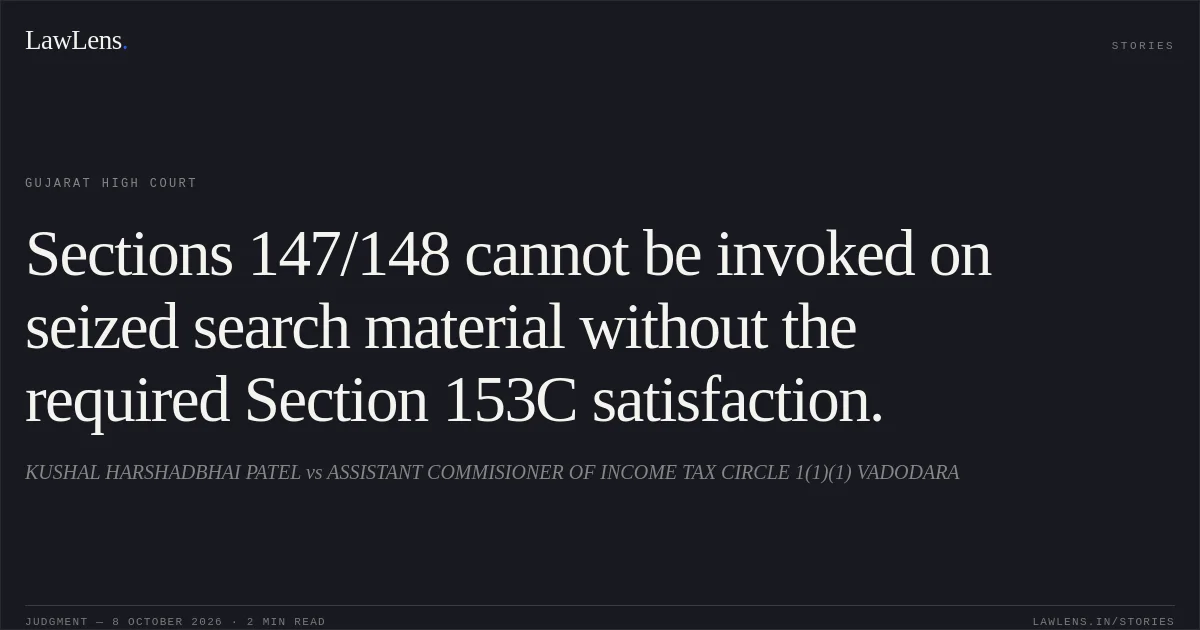
Source reference: pp. 1–2, paras. 1–2The petitioner challenged those actions, arguing that the reassessment was based solely on search material and that the statutory route was Section 153C.
Source reference: pp. 1, 3, paras. 1, 3The judgment refers to Assessment Year 2013–14 in paragraph 1 but to the petitioner’s 2014–15 return in paragraph 2; it does not resolve that discrepancy.
Source reference: p. 2, paras. 1–2Issues
1. Whether the Assessing Officer could invoke Sections 147 and 148 on the basis of incriminating material found in a search of another person, where no satisfaction note had been recorded or communicated under Section 153C.
Source reference: pp. 3–5, paras. 5–72. Whether the impugned Section 148 notice and Section 148A(d) order were liable to be quashed as without jurisdiction.
Source reference: pp. 1, 5–6, paras. 1, 7–8Law Applied
The Court applied Sections 147 and 148 of the Income Tax Act, 1961, concerning reassessment, alongside Section 153C, which provides the assessment route for an “other person” where seized material relates to that person.
Source reference: pp. 4–5, para. 6Relying on Paras Chandreshbhai Koticha v. Income-tax Officer, [2026] 182 taxmann.com 204 (Gujarat), the Court stated that the Assessing Officer of the searched person must record satisfaction on the seized material and communicate it to the jurisdictional Assessing Officer of the other person.
Source reference: pp. 4–5, para. 6Where such satisfaction is recorded and the material is transmitted, the other person is to be proceeded against under Section 153C, not Sections 147 and 148.
Source reference: pp. 4–5, para. 6Reassessment under Sections 147 and 148 remains available on material from an independent source, including material collected after the search.
Source reference: pp. 4–5, para. 6Reasoning
The Court found that the reassessment was founded solely on material seized during the search of the Akshar Group and that there was no satisfaction recorded by the Assessing Officer of the searched person in respect of that material.
Source reference: pp. 3–4, paras. 4–5; p. 5, para. 7Applying Paras Chandreshbhai Koticha, it held that the Revenue could not use Sections 147 and 148 to reassess the petitioner on that search material; the absence of a satisfaction note did not make those provisions an alternative route for doing so.
Source reference: pp. 4–5, paras. 6–7Holding
The Court answered the jurisdictional issue in the petitioner’s favour and allowed the writ petition.
It quashed and set aside the Section 148 notice and the Section 148A(d) order, both dated 28 July 2022.
Source reference: p. 6, para. 8Acts & Sections Cited
9 provisions across 1 statute referred to in this judgment. Linked provisions open on LawLens.
Income Tax Act, 1961
Original Court PDF
KUSHAL HARSHADBHAI PATELvsASSISTANT COMMISIONER OF INCOME TAX CIRCLE 1(1)(1) VADODARA
Click to open original judgment
Original judgment, available to read, download and summarize on LawLens.in