Facts
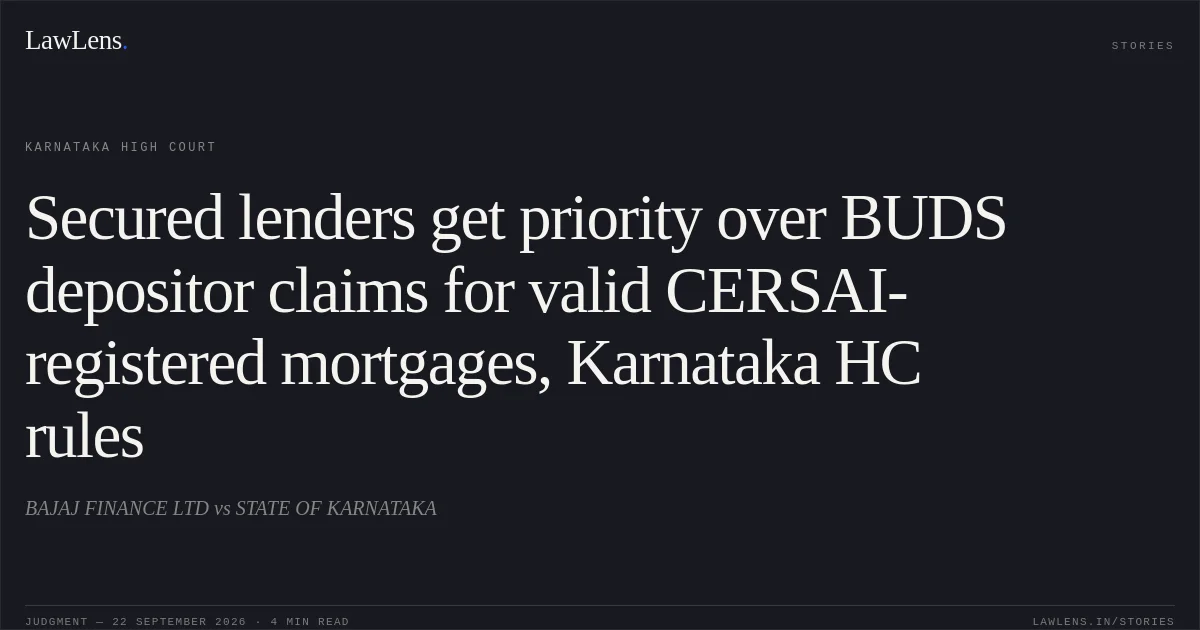
Bajaj Finance Ltd., a secured creditor, sanctioned a loan of ₹78,25,000 to A.S. Puttaswamy Gowda and the co-borrowers, secured by an equitable mortgage created through deposit of title deeds over the subject property.
Source reference: pp. 3–4Following default, the loan account was classified as a non-performing asset and the petitioner issued a demand notice under Section 13(2) of the SARFAESI Act, 2002.
Source reference: pp. 3–4The petitioner thereafter obtained an order dated 12 February 2025 under Section 14 of the SARFAESI Act from the 37th ACMM/ACJM, Bengaluru, authorising it to obtain physical possession of the mortgaged property.
Source reference: pp. 3–4During the pendency of criminal proceedings in Crime No. 125/2024 registered by Byatarayanapura Police for offences under Sections 34, 120B, 406 and 420 IPC and Sections 3, 4 and 5 of the Banning of Unregulated Deposit Schemes Act, 2019 (“BUDS Act”), the police seized the property, prepared a mahazar and retained its keys.
Source reference: pp. 4–5The petitioner contended that the police action prevented it from enforcing the security interest despite the order under Section 14 of the SARFAESI Act.
Source reference: pp. 4–5It sought a declaration that the SARFAESI Act prevailed over the BUDS Act and a direction for return of the keys.
Source reference: pp. 4–5Issues
1. Whether the claim and attachment under the BUDS Act have priority over the rights of a secured creditor under the SARFAESI Act, 2002?
Source reference: p. 152. Whether the police could retain the keys of the secured asset after an order had been passed under Section 14 of the SARFAESI Act?
Source reference: p. 15Law Applied
The Court applied Sections 12 and 13 of the BUDS Act, which give priority to depositors’ claims and BUDS-related attachments, but expressly make that priority subject to the SARFAESI Act and the Insolvency and Bankruptcy Code, 2016.
Source reference: pp. 16–18It considered Section 34 of the BUDS Act, the general overriding provision, but held that it must be read harmoniously with the specific saving clauses in Sections 12 and 13.
Source reference: pp. 20–21Under Sections 26D and 26E of the SARFAESI Act, a secured creditor cannot enforce its security unless the security interest is registered with the Central Registry, while a validly registered security interest receives statutory priority over other debts and government claims.
Source reference: pp. 18–19The Court also relied on the principles reflected in City Union Bank Ltd. v. State of Tamil Nadu and HDB Financial Services Ltd. v. Sub Registrar, namely that a duly registered security interest is protected notwithstanding subsequent proceedings under the BUDS Act.
Source reference: pp. 11–14, 19It further recognised that an attachment preserves property but does not, by itself, extinguish a pre-existing and valid mortgage; this protection would not extend to a fraudulent, collusive or subsequently created mortgage intended to defeat depositors’ claims.
Source reference: p. 20Reasoning
The Court held that the BUDS Act and the SARFAESI Act could be harmoniously construed.
Source reference: pp. 17–22Although the BUDS Act is a later enactment and contains an overriding clause, Sections 12 and 13 expressly preserve rights arising under the SARFAESI Act.
Source reference: pp. 17–22Therefore, where the mortgage was created before the BUDS proceedings and the security interest was duly registered in accordance with Sections 26D and 26E, the secured creditor’s enforcement rights could not be defeated merely because the property was subsequently attached under the BUDS Act.
Source reference: pp. 17–22The Court nevertheless declined to declare that the BUDS Act, as a whole, was subservient to the SARFAESI Act, holding that the protection was confined to valid and duly registered security interests.
Source reference: p. 22As to the keys, the Court distinguished the criminal investigation from enforcement of the security interest.
Source reference: pp. 23–24The police could inspect the premises, prepare an inventory, take photographs and complete other investigative formalities, but indefinite retention of the keys would effectively nullify the petitioner’s statutory rights under the SARFAESI Act despite the Section 14 order.
Source reference: pp. 23–24Returning the keys would not terminate or prejudice the criminal investigation.
Source reference: pp. 23–24The Court also protected depositors by directing that any surplus remaining after satisfaction of the petitioner’s lawful secured dues and permissible expenses should be preserved for the competent authority under the BUDS Act.
Source reference: p. 24Holding
The Court declined to grant a general declaration that the BUDS Act is subservient to the SARFAESI Act.
It held, however, that the priority under Sections 12 and 13 of the BUDS Act is subject to the rights of a secured creditor possessing a valid and duly registered security interest under Sections 26D and 26E of the SARFAESI Act.
Source reference: p. 25The police were directed to complete any necessary inventory and investigative formalities and hand over the keys to the petitioner within two weeks of receiving the order.
Source reference: pp. 25–26The petitioner was permitted to proceed against the secured asset under the SARFAESI Act, while the investigation and BUDS proceedings could continue.
Source reference: pp. 25–26Any surplus from the sale, after payment of the petitioner’s lawful dues and expenses, was to be made available to the competent authority under the BUDS Act and not released to the borrower.
Source reference: pp. 25–26The writ petition was accordingly allowed in part.
Source reference: pp. 25–26Acts & Sections Cited
16 provisions across 6 statutes referred to in this judgment. Each provision opens on LawLens.
Banning of Unregulated Deposit Schemes Act, 20197
Securitisation and Reconstruction of Financial Assets and Enforcement of Security Interest Act, 20023
Indian Penal Code, 18603
Insolvency and Bankruptcy Code, 2016.1
Gujarat Value Added Tax Act, 2003.1
Code of Criminal Procedure, 19731
Original Court PDF
BAJAJ FINANCE LTDvsSTATE OF KARNATAKA
Click to open original judgment
Original judgment, available to read, download and summarize on LawLens.in