Facts
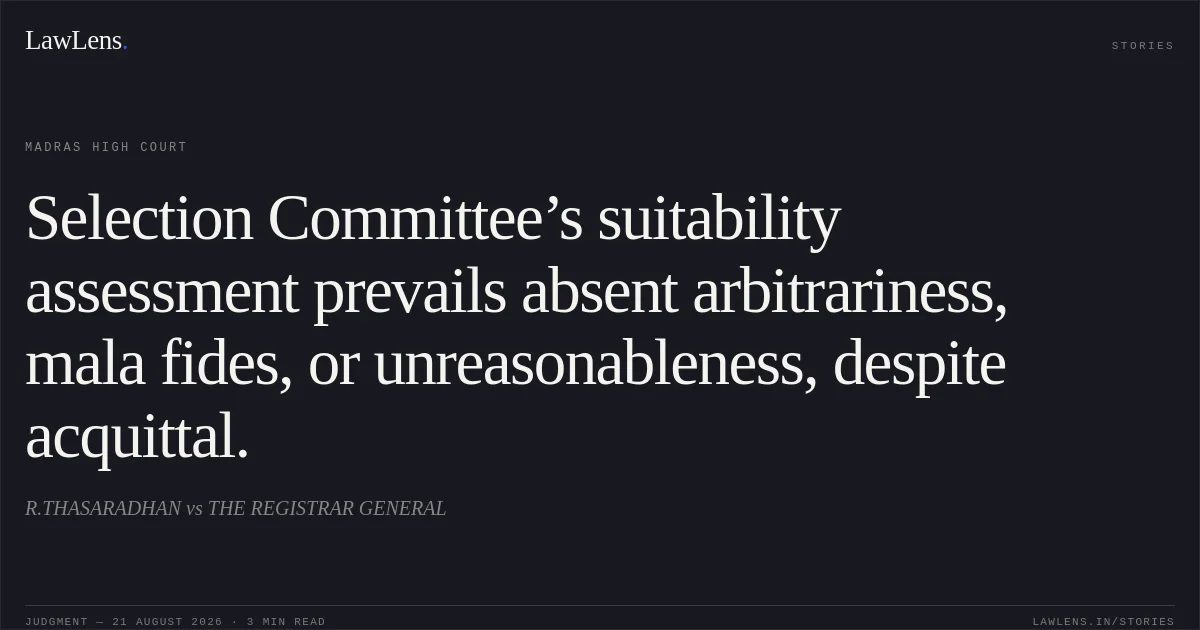
The petitioner applied for recruitment to Group IV posts, including Sanitary Worker, Watchman, Night Watchman and Masalachi, in the High Court Recruitment, 2025, under application number 241703030505.
Source reference: no citationAlthough he was successful in the written examination, he was not selected.
Source reference: no citationIn response to his application under the Right to Information Act, the petitioner was informed that the Selection Committee had rejected his candidature on suitability grounds because he had been involved in S.C. No. 442 of 2013 before the Additional Sessions Court, Tindivanam.
Source reference: p.2, para.2The petitioner contended that the criminal case had ended in his acquittal in 2014 and that no criminal case was pending when he applied for recruitment.
Source reference: p.2, para.3He challenged the order dated 23 July 2026 and sought reconsideration of his candidature under Article 226 of the Constitution.
Source reference: p.2, para.1Issues
Whether the High Court, in exercise of judicial review under Article 226, could interfere with the Selection Committee’s assessment that the petitioner was unsuitable for appointment on account of his criminal antecedents.
Source reference: p.3, para.4Whether the petitioner’s acquittal in the criminal case automatically entitled him to appointment or required the respondents to reconsider his candidature.
Source reference: p.3, para.6; p.7, para.10Whether the High Court could substitute its own view for that of the Selection Committee on the petitioner’s suitability for public employment.
Source reference: p.3, para.5; p.8, paras.11–12Law Applied
The Court applied the principle that assessment of a candidate’s suitability and fitness for public employment lies primarily within the domain of the employer or Selection Committee, and that a court exercising judicial review cannot substitute its own assessment for that of the competent authority.
Source reference: p.3, paras.5–7Relying on Avtar Singh v. Union of India, (2016) 8 SCC 471, Union Territory of Chandigarh v. Pradeep Kumar, (2018) 1 SCC 797, and Commissioner of Police v. Mehar Singh, (2013) 7 SCC 685, the Court held that acquittal does not automatically entitle a candidate to appointment and that the employer may consider the candidate’s antecedents and suitability.
Source reference: p.3, paras.5–7The Court also relied on Rajasthan High Court, Jodhpur v. Akashdeep Morya, 2021 INSC 485, for the principle that judicial review primarily examines the decision-making process rather than the merits of the decision.
Source reference: p.6, para.9The Court further relied on Union of India v. Methu Meda, 2021 INSC 623, and State of Madhya Pradesh v. Rajkumar Yadav, 2026 INSC 225, for the proposition that review is limited to arbitrariness, unreasonableness, whimsicalness or mala fides.
Source reference: p.7, para.10; p.8, para.11The Court further referred to Ashutosh Pawar v. High Court of M.P., 2018 (1) CTC 353, concerning the limits on judicial intervention in determining character and suitability.
Source reference: p.4, para.8Reasoning
The Selection Committee had considered the petitioner’s involvement in the criminal case and independently found him unsuitable for appointment.
Source reference: p.8, para.13The Court held that the petitioner’s acquittal did not, by itself, erase the employer’s authority to examine his antecedents or determine whether he was suitable for public employment.
Source reference: p.7, para.11; p.8, paras.12–13Since the assessment was made by the competent Selection Committee and the petitioner did not establish arbitrariness, mala fides, unreasonableness or a defective decision-making process, the Court declined to reassess the merits of the suitability determination or substitute its own view for that of the Committee.
Source reference: p.7, para.11; p.8, paras.12–13Holding
The Court answered the issues against the petitioner.
It held that the Selection Committee was entitled to consider the petitioner’s criminal antecedents notwithstanding his acquittal, and that the High Court could not interfere merely because it might have reached a different conclusion on suitability.
Source reference: p.9, para.14The writ petition challenging the order dated 23 July 2026 was dismissed, without costs, and the connected miscellaneous petition was closed.
Source reference: p.9, para.14Original Court PDF
R.THASARADHANvsTHE REGISTRAR GENERAL
Click to open original judgment
Original judgment, available to read, download and summarize on LawLens.in