Facts
The appellants are candidates who applied for the post of Vocational Instructors in Industrial Training Institutes (ITIs) in Uttar Pradesh pursuant to advertisements in 2014 and 2015
Source reference: p. 3-4Historically, a Craft Instructor Training Scheme (CITS) certificate was a mandatory "essential qualification" per Central Government directions (1996) and the 2003 amendment to the State Rules
Source reference: p. 3However, the State of U.P. promulgated the 2014 Rules, which diluted the CITS certificate to a "preferential qualification"
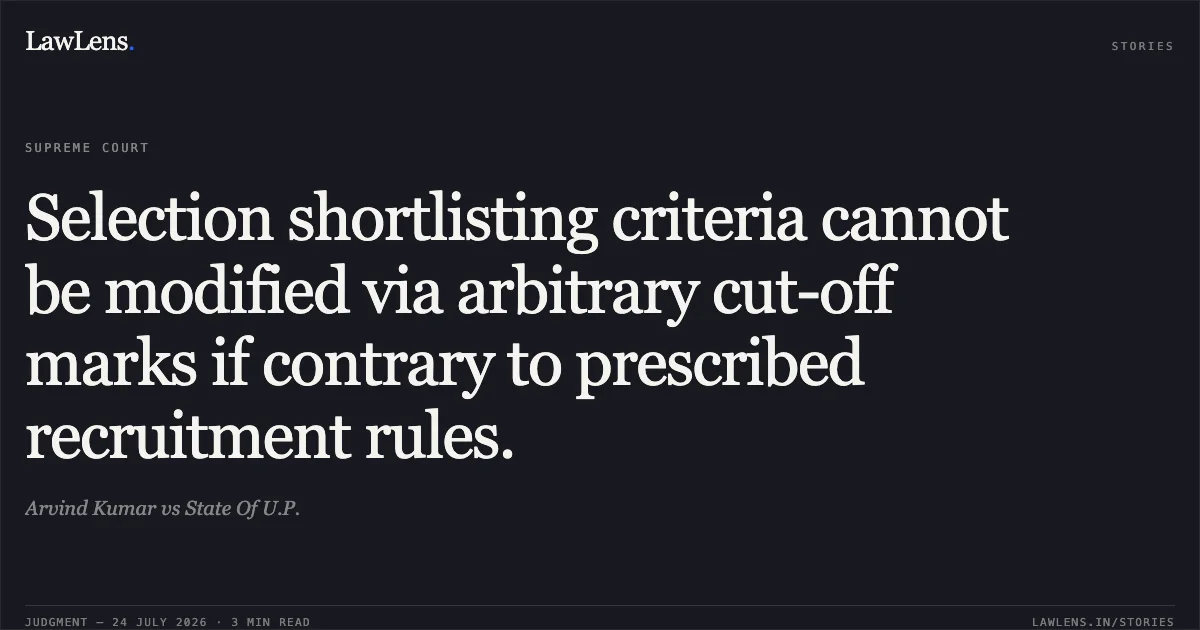
Source reference: p. 3The appellants, who possessed CITS certificates, participated in the selection process but were excluded because they failed to meet a "cut-off" mark established by the Selection Committee for the interview stage
Source reference: p. 7They challenged the validity of the 2014 Rules and the selection process before the Allahabad High Court, which dismissed their petitions on January 4, 2023
Source reference: p. 5Issues
1. Whether the 2014 Rules were invalid for contravening the Central Government’s executive directions dated July 24, 1996, which mandated CITS as an essential qualification.
Source reference: p. 5, para. 62. Whether the Selection Committee/State acted arbitrarily and contrary to the 2014 Rules by fixing qualifying/cut-off marks to exclude candidates when the number of vacancies exceeded the number of applicants.
Source reference: p. 10, para. 18Law Applied
The Court applied the principle of estoppel, noting that candidates who participate in a selection process with full knowledge of the criteria generally cannot challenge those criteria afterward
Source reference: p. 5-6, para. 10However, this is subject to the exception that a selection process can be challenged if there is patent arbitrariness or "illegality writ large"
Source reference: p. 6, para. 11The Court strictly interpreted Rule 16(3)(b)(i) of the 2014 Rules, which provides for shortlisting (limiting candidates to four times the vacancies) only when applications are received in "large numbers"
Source reference: p. 9-10, para. 17-18It also applied the administrative law principle that the "rules of the game" cannot be changed mid-way through a selection process to the detriment of candidates
Source reference: p. 11, para. 19Reasoning
The Court found that while the appellants were technically estopped from challenging the "preferential" status of the CITS certificate after participating, the actual conduct of the selection was vitiated by arbitrariness.
Source reference: p. 6Under Rule 16(3)(b)(i), shortlisting is only permitted to manage an excess of candidates.
Source reference: p. 10In this case, the facts revealed a contrary situation: there were 2,498 vacancies but only ~2,200 offers were made, leaving substantial vacancies unfilled.
Source reference: p. 10The Selection Committee’s imposition of an extra-statutory "cut-off" or qualifying mark to exclude the appellants—despite the availability of vacancies and the absence of such a threshold in the Rules—was deemed an arbitrary exercise of power.
Source reference: p. 10-11The Court held that since the State action was unauthorized by its own recruitment rules, the participation of the candidates did not validate the illegality.
Source reference: p. 11Holding
The Supreme Court allowed the appeals and set aside the High Court’s judgment.
While it did not formally strike down the 2014 Rules (noting they were superseded in 2021), it held the selection process was arbitrary.
Source reference: p. 11The Court directed the State to: (a) permit the appellants and members of the representative society to approach the appointing authority within two weeks; (b) conduct interviews for these eligible candidates and determine inter-se merit; and (c) offer appointments against existing vacancies (or create supernumerary posts) within four months. Relief is prospective, granting service benefits (pension/gratuity) but excluding back wages and seniority.
Source reference: p. 13-14Original Court PDF
Arvind KumarvsState Of U.P.
Click to open original judgment
Original judgment, available to read, download and summarize on LawLens.in