Facts
The petitioner, an Assistant Personnel Officer in the Railways, was charge-sheeted in 1999 for allegedly suppressing the fact that his daughter was appearing for a Railway Recruitment Board (RRB) exam at a center where he requested to be the Center-in-Charge, and for using his position to help her solve the paper with the aid of a subordinate, Raju Worlikar
Source reference: para. 1, 5Parallel separate inquiries were initiated against other staff: S.A. Gajre (charged with making a misleading statement that the petitioner was absent during the exam), Baria (the invigilator), and D.D. Parmar
Source reference: para. 7-8, 20The inquiry officer found the charges established based primarily on the testimony of Raju Worlikar, leading to the petitioner’s removal from service on 08.04.2005
Source reference: para. 22His appeals were rejected, and the Central Administrative Tribunal (CAT) dismissed his challenge, holding that it could not interfere with the adequacy of evidence
Source reference: para. 23-24The petitioner challenged these orders via the present writ petition.
Source reference: no citationIssues
1. Whether a finding of guilt could be recorded against the petitioner given contradicting evidence and the statement of the Officer-in-Charge
Source reference: para. 442. Whether the Railways’ failure to conduct a joint inquiry under Rule 13 of the Railway Servants (Discipline and Appeal) Rules, 1968, prejudiced the petitioner
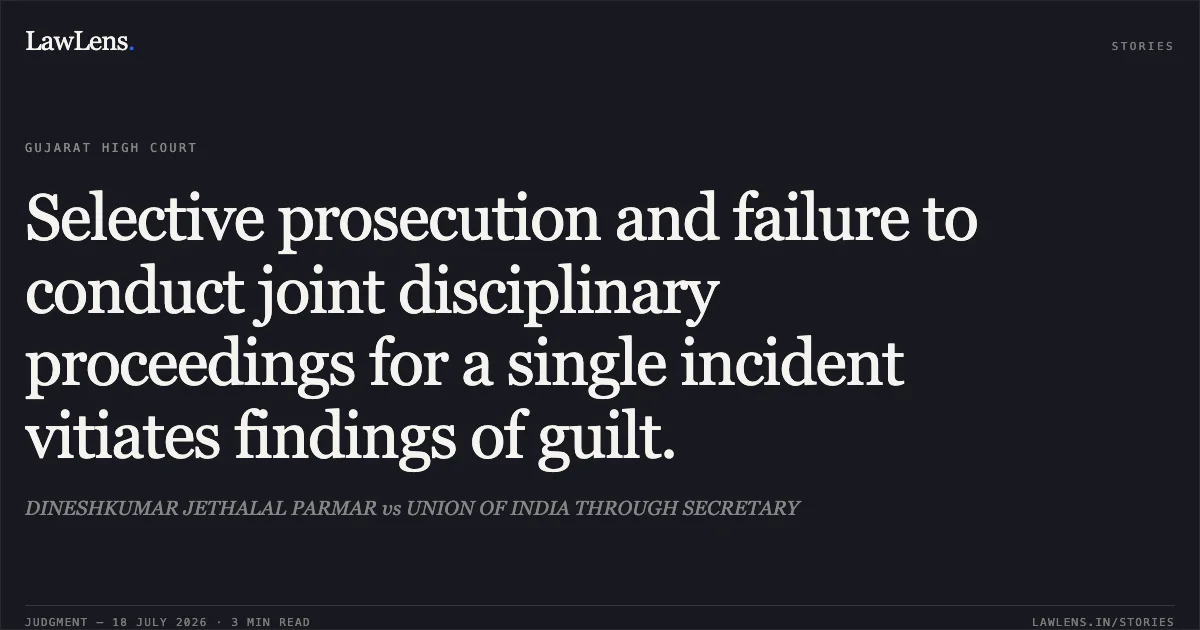
Source reference: para. 44, 753. Whether the disciplinary proceedings were vitiated by selective prosecution, wherein the person alleged to have performed the actual tampering (Worlikar) was treated as a witness rather than a delinquent
Source reference: para. 39, 44Law Applied
The court applied the principle that while judicial review of departmental inquiries is limited, interference is mandatory in cases of patent perversity, mala fides, or "no evidence"
Source reference: para. 26, 45Rule 13 of The Railway Servants (Discipline and Appeal) Rules, 1968, which mandates that where two or more railway servants are concerned in a case, the competent authority may (and normally should) direct disciplinary action in common proceedings
Source reference: para. 75-76The court also invoked the principle that an employer cannot selectively target employees in a coordinated misconduct case to use one as an "approver" to secure findings against others
Source reference: para. 39, 59Reasoning
The court found the inquiry perverse on several grounds. First, the Railways suppressed a crucial statement by S.A. Gajre (Center-in-Charge) who stated the petitioner was absent during the exam
Source reference: para. 51-54Second, though the misconduct was allegedly a coordinated effort involving four officials, the Railways conducted separate inquiries to prevent the contradictions in their stories from coming to light
Source reference: para. 50, 72The court noted that Baria and D.D. Parmar were given minor penalties for the same incident, while the petitioner was removed
Source reference: para. 62-69Crucially, the prosecution’s star witness, Raju Worlikar—who admittedly performed the tampering—was never charged, indicating a "witch hunt" against the petitioner
Source reference: para. 29, 61The court observed that Worlikar’s testimony about "tick marks" was contradicted by the actual answer sheet, which contained only numbers
Source reference: para. 35The failure to hold a joint inquiry under Rule 13 led to a travesty of justice by shielding some and targeting one
Source reference: para. 77-78Holding
The court answered the issues in favor of the petitioner, holding that the proceedings were a "mala fide exercise of power"
It ruled that a common inquiry is the norm for single incidents involving multiple servants to ensure truth and prevent prejudice
Source reference: para. 77The court quashed the removal order (08.04.2005), the appellate order, and the CAT judgment [para. 79]. The petition was allowed, and the petitioner was declared entitled to all consequential benefits, to be computed and paid within eight weeks
Source reference: para. 80Original Court PDF
DINESHKUMAR JETHALAL PARMARvsUNION OF INDIA THROUGH SECRETARY
Click to open original judgment
Original judgment, available to read, download and summarize on LawLens.in