Facts
On 4 March 2011, Dipen Sonowal was driving an auto-rickshaw when it was struck by bus No. AR-02-0311, allegedly driven rashly and negligently by the State Transport Services driver. Dipen Sonowal sustained grievous injuries and died the same day. A criminal case was registered under Sections 279/337/338/304-A/427 IPC against the bus driver.
Source reference: p.3, para. 3His wife, two children and mother filed a claim petition before the MACT, Tinsukia.
Source reference: p.3, para. 4The State and the bus driver did not appear before the Tribunal, and the proceedings continued ex parte. After recording the claimants’ evidence, the Tribunal held that the accident resulted from the bus driver’s rash and negligent driving. It assessed the deceased’s monthly income at Rs.10,000, applied a multiplier of 16, and awarded Rs.15,85,000 with interest at 6% per annum from the date of filing of the claim petition.
Source reference: pp.4–5, paras. 5–8The State appealed under Section 173 of the Motor Vehicles Act, 1988, contending that it had been deprived of an effective opportunity to contest the claim because its engaged advocate failed to appear. The claimants filed a cross-objection seeking enhancement for future prospects and proper compensation under the conventional heads in light of National Insurance Co. Ltd. v. Pranay Sethi.
Source reference: pp.2–3, paras. 2, 9–11Issues
Whether the ex parte judgment and award passed by the MACT warranted interference on the ground that the State was denied an effective opportunity of hearing?
Source reference: p.7, para. 13(i); pp.7–9, paras. 14.1–14.6Whether the claimants were entitled to enhancement of compensation and, if so, to what extent?
Source reference: p.7, para. 13(ii); pp.9–11, paras. 15.1–15.5What relief and directions should be issued?
Source reference: p.7, para. 13(iii); p.11, para. 16Law Applied
The Court applied Section 173 of the Motor Vehicles Act, 1988, governing appeals against awards of the Motor Accident Claims Tribunal.
Source reference: p.2, para. 2It relied on Sarla Verma (Smt.) v. Delhi Transport Corporation, (2009) 6 SCC 121, for selecting the appropriate multiplier and determining the deduction for the deceased’s personal and living expenses; where the deceased leaves four dependants, a one-fourth deduction is appropriate, and for a deceased aged 35 years, the multiplier is 16.
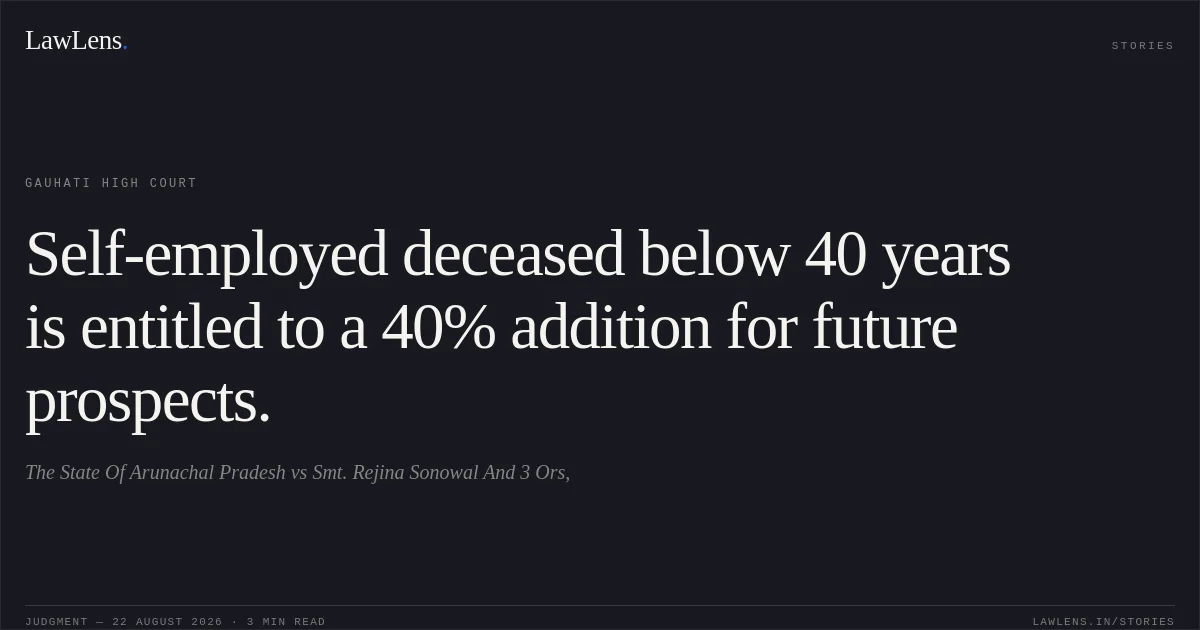
Source reference: pp.4–5, para. 6; p.10, para. 15.3It applied National Insurance Co. Ltd. v. Pranay Sethi, (2017) 16 SCC 680, which requires a 40% addition towards future prospects for a self-employed deceased below 40 years of age and prescribes the applicable amounts under the conventional heads of funeral expenses, loss of estate and loss of consortium.
Source reference: pp.9–10, paras. 15.2–15.4The Court further applied the principle that a party having notice of proceedings and knowledge of the hearing date cannot attribute the consequences of its own failure to participate solely to counsel’s negligence, particularly where the party did not seek setting aside of the ex parte proceedings.
Source reference: pp.7–9, paras. 14.1–14.6Reasoning
The Court rejected the State’s challenge to the ex parte award. The State had admittedly received notice, engaged an advocate, and was aware through its office of the proceedings, but took no effective steps to participate or to have the ex parte proceedings set aside.
Source reference: pp.7–9, paras. 14.1–14.4The award was not passed merely because of the State’s absence; the claimants examined two witnesses and produced documentary evidence, upon which the Tribunal determined negligence and compensation. Accordingly, there was no violation of natural justice warranting appellate interference.
Source reference: pp.8–9, paras. 14.2, 14.5; p.9, para. 14.6On enhancement, the Court accepted the Tribunal’s assessment of the deceased’s monthly income at Rs.10,000 in the absence of documentary proof.
Source reference: p.9, para. 15.1Since the deceased was 35 years old and self-employed, it added 40% towards future prospects, resulting in a monthly income of Rs.14,000. After deducting one-fourth for personal expenses, the monthly contribution to the family was Rs.10,500. Applying the multiplier of 16, the loss of dependency was calculated at Rs.20,16,000.
Source reference: p.10, para. 15.3The Court then substituted the Tribunal’s amounts under the conventional heads with Rs.15,000 for funeral expenses, Rs.15,000 for loss of estate and Rs.1,60,000 for loss of consortium to the wife, two children and mother.
Source reference: p.10, para. 15.4Holding
The appeal filed by the State of Arunachal Pradesh was dismissed, and the claimants’ cross-objection was allowed.
The compensation was enhanced from Rs.15,85,000 to Rs.22,06,000, comprising Rs.20,16,000 for loss of dependency, Rs.15,000 for funeral expenses, Rs.15,000 for loss of estate and Rs.1,60,000 for loss of consortium.
Source reference: p.10, para. 15.4The enhanced amount was directed to carry interest at 6% per annum from the date and in the manner ordered by the Tribunal.
Source reference: p.11, paras. 16.3–16.4The State was directed to deposit or pay the awarded amount, after adjustment of any amount already paid or deposited, within three months from receipt of the certified judgment.
Source reference: p.11, paras. 16.3–16.4Acts & Sections Cited
6 provisions across 2 statutes referred to in this judgment. Each provision opens on LawLens.
Motor Vehicles Act, 19882
Indian Penal Code, 18604
Original Court PDF
The State Of Arunachal PradeshvsSmt. Rejina Sonowal And 3 Ors,
Click to open original judgment
Original judgment, available to read, download and summarize on LawLens.in