Facts
The appellants, who were Respondents 4 and 5 in W.P.(MD) No.29578 of 2025, challenged the order of the learned Single Judge directing the Tamil Nadu Electricity Board/Tamil Nadu Power Distribution Corporation Ltd. (“Board”) to revise the inter se seniority of Assistant Engineers (Electrical) recruited by direct recruitment in 2012.
Source reference: paras. 1–3The writ petitioners contended that the Board had prepared the seniority list on the basis of the reservation roster rather than the comparative marks obtained in the selection process, which consisted of marks in the qualifying examination and interview.
Source reference: paras. 1–3The Board argued that no competitive examination had been conducted, that the seniority list had already been finalised, and that objections were barred by Regulation 97(d) of the Tamil Nadu Electricity Board Service Regulations, which prescribed a three-year period for seeking revision of seniority.
Source reference: para. 4During the appeal, the Board stated that it had prepared an alternate seniority list pursuant to the interim proceedings, while certain other selected candidates sought impleadment in the appeal.
Source reference: paras. 9–10, 18Issues
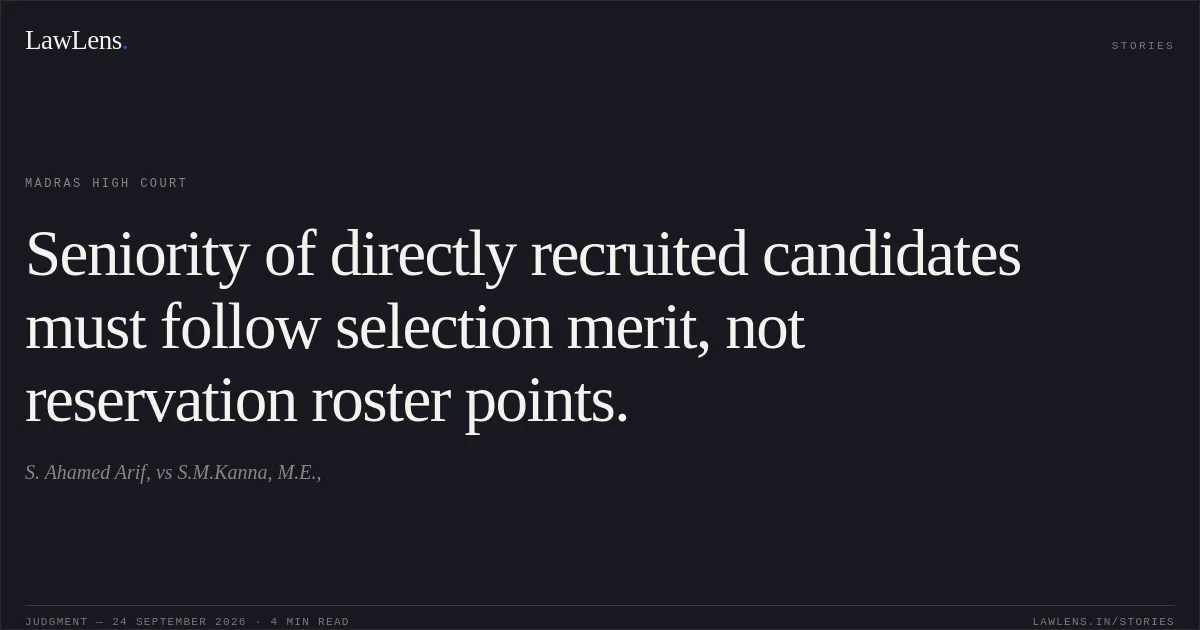
Whether the inter se seniority of Assistant Engineers (Electrical) directly recruited in 2012 could lawfully be determined according to the reservation roster rather than the comparative merit or rank obtained in the selection process?
Source reference: paras. 12–17, 20–30Whether the principle laid down in Bimlesh Tanwar v. State of Haryana, (2003) 5 SCC 605, applied despite the absence of a separate competitive written examination?
Source reference: paras. 6, 12–17, 20–22, 31Whether the writ petition was barred by delay under Regulation 97(d), which required an application for revision of seniority within three years?
Source reference: paras. 14, 16, 23–25, 32Whether the Board’s seniority list constituted an approved seniority list under Regulation 97 of the Service Regulations?
Source reference: paras. 23–27Law Applied
The Court applied Regulation 89(5)(i) of the Tamil Nadu Electricity Board Service Regulations, which permits direct recruitment based on written examination, interview, performance in the qualifying examination, marks awarded for such performance, or a combination of these methods, and requires appointments to be made from candidates selected and arranged in order of preference.
Source reference: paras. 28–30Regulation 97(a) provides that seniority is to be determined by the rank obtained in the “list of approved candidates,” while Regulation 97(d) prescribes a three-year period for seeking revision of seniority, subject to the stated exception for rectification of factual mistakes.
Source reference: para. 24The Court relied principally on Bimlesh Tanwar v. State of Haryana, (2003) 5 SCC 605, which holds that seniority cannot be fixed according to roster points because reservation under Article 16(4) concerns representation at the stage of appointment and does not govern fixation of seniority.
Source reference: para. 31Where direct recruitment involves a comparative assessment enabling selection and rejection of candidates, seniority must follow merit and not the reservation roster.
Source reference: paras. 20–22, 30Reasoning
The Court found that the candidates had not been selected on a random or first-come-first-served basis; rather, the Board awarded marks for the qualifying examination and interview and used those marks to select candidates and reject others.
Source reference: paras. 20–22, 28–30This necessarily involved a relative assessment of merit, even though no separate competitive written examination had been conducted.
Source reference: paras. 20–22, 28–30Regulation 89(5)(i) expressly authorised selection through the methods adopted by the Board, and Regulation 97 required seniority to correspond to the rank in the approved list of candidates.
Source reference: paras. 24–27, 30–31The existing list, however, placed candidates according to roster points, resulting in lower-scoring candidates being ranked above candidates with higher marks; the Court treated this as contrary to both Regulation 97 and the rule in Bimlesh Tanwar.
Source reference: paras. 24–27, 30–31The objection based on delay was rejected because the earlier list was only tentative and the approved seniority list was communicated through the impugned proceedings in 2025; therefore, the cause to challenge the seniority arose upon communication of the final list, not merely on appointment in 2012.
Source reference: paras. 23, 32The Court also distinguished the precedent concerning seniority under separate statutory service rules because, in the present case, Regulation 97 itself required seniority to be based on rank and merit.
Source reference: para. 33Holding
The Division Bench dismissed the writ appeal and affirmed the learned Single Judge’s order setting aside the roster-based seniority list.
It held that the Board must re-fix the seniority of the 2012 direct recruits by taking into account their merit and marks obtained in the selection process, issue notice to all affected parties, and thereafter take steps for promotion to the post of Assistant Executive Engineer (Electrical) in accordance with law.
Source reference: para. 39(5)The exercise was directed to be completed within four weeks from receipt of the judgment.
Source reference: para. 39(5)The interim stay was vacated, the impleadment application was dismissed as superfluous, and there was no order as to costs.
Source reference: paras. 37–39Acts & Sections Cited
1 provisions across 1 statute referred to in this judgment. Each provision opens on LawLens.
Patents Act, 19701
Original Court PDF
S. Ahamed Arif,vsS.M.Kanna, M.E.,
Click to open original judgment
Original judgment, available to read, download and summarize on LawLens.in