01Facts
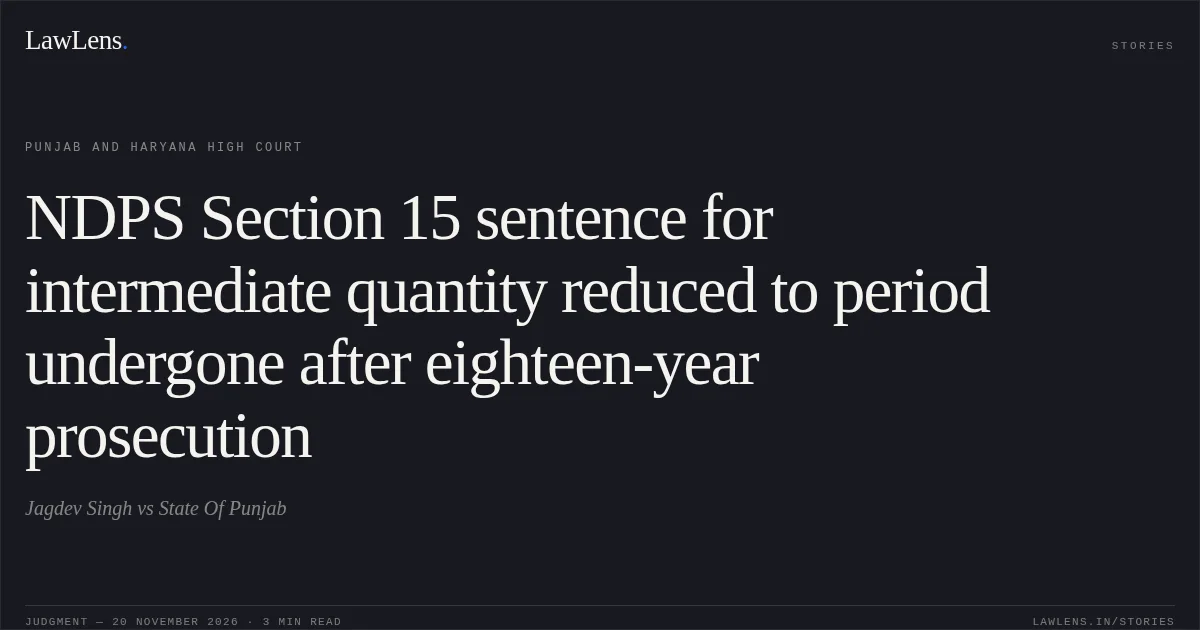
The appellant was convicted under Section 18(c) of the NDPS Act, 1985, for conscious possession of 130 grams of opium.
¶ 1The trial court, the Special Judge under the NDPS Act at Kaithal in Sessions Case (NDPS) No. 62 of 2019, imposed six months' rigorous imprisonment and a fine of Rs. 5,000, with one month's default sentence.
¶ 1The conviction arose from FIR No. 38 dated 08.03.2019, registered at Police Station Guhla.
¶ 1The appellant had already undergone 1 month and 12 days in custody.
¶ 2, 5His counsel argued that no notice under Section 50 of the NDPS Act was served, no independent witness was joined despite a public-place recovery, he was falsely implicated due to pending civil litigation between his son and the legal heirs of Balwinder Singh, and the prosecution witnesses' statements contained contradictions.
¶ 3The appellant did not challenge the conviction on merits and confined his prayer to reducing the sentence to the period already undergone, citing his age of about 90 years.
¶ 3The State supported the conviction and stated that the appellant is not involved in any other case.
¶ 402Issues
i.1. Whether the substantive sentence of rigorous imprisonment should be reduced to the period already undergone, having regard to the intermediate quantity involved, the appellant's age, the duration of prosecution, the custody served, and the absence of other cases.
¶ 5, 603Law Applied
For an intermediate quantity of contraband under the NDPS Act, no minimum punishment is prescribed.
¶ 5Pramod Kumar Mishra v. State of UP (2023) 9 SCC 810 holds that punishment is a means of reformation and reintegration rather than vengeance, and that sentencing requires balancing the nature of the offence, the offender's background, age, mental and emotional condition, rehabilitation potential, prior record, and the community's deterrence needs.
¶ 7Ravada Sasikala v. State of AP, AIR 2017 SC 1166 holds that sentencing serves a deterrent social purpose, that opportunities for reformation must be granted, and that courts must strike a balance between the efficacy of law and the accused's chances of reformation, assessed by the nature of the crime, the manner of its commission, and the accused's conduct.
¶ 8Provisions in the judgment · 2 · Linked ones open on LawLens
Narcotic Drugs and Psychotropic Substances Act, 1985 Section 18Section 50
04Reasoning
The Court expressly did not examine the merits of the rival contentions, as the appellant had confined his challenge to sentence.
¶ 6The Court applied the sentencing principles in Pramod Kumar Mishra and Ravada Sasikala to the specific circumstances, weighing the intermediate quantity of opium, the protracted prosecution of over seven years arising from a 2019 incident, the appellant's age of about 90 years, and the custody already served (1 month and 12 days of a six-month sentence).
¶ 5, 6The absence of any other pending case further supported a reformative approach.
¶ 5The Court concluded that the ends of justice would be met by reducing the substantive sentence to the period already undergone, while leaving the fine and default sentence intact.
¶ 6, 905Holding
The Court upheld the conviction under Section 18(c) of the NDPS Act, 1985, and held that the sentence of imprisonment should be reduced to the period already undergone, on the basis of the intermediate quantity, the appellant's age, the protracted prosecution, and the absence of other cases.
¶ 6, 9(i)–(ii)The fine of Rs. 5,000 and the default sentence of one month's rigorous imprisonment remain unaltered. The appellant's bail or surety bonds stand discharged, and pending miscellaneous applications, if any, are disposed of.
¶ 9(ii), 10Original Court PDF
Amar SinghvsState Of Haryana
Click to open original judgment
Original judgment, available to read, download and summarize on LawLens.in