Facts
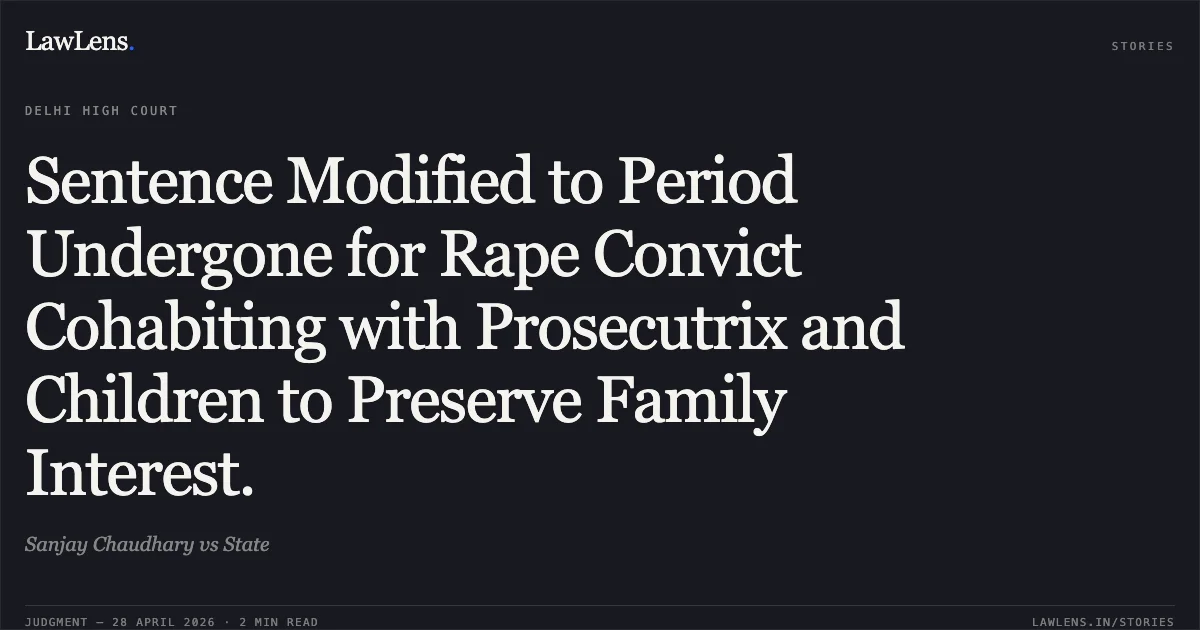
The Appellant was convicted by the trial court on July 19, 2013, for offences under Sections 363, 365, 366, and 376 of the Indian Penal Code (IPC) and sentenced to 10 years of rigorous imprisonment
Source reference: p. 2During the pendency of the appeal, the Appellant’s sentence was suspended on November 19, 2013, after the prosecutrix filed an affidavit stating she had married the Appellant and had no objection to the sentence being set aside
Source reference: p. 3Currently, the parties have been married for approximately 13 years, are residing together peacefully, and have three minor children from the wedlock
Source reference: p. 3, 5The prosecutrix appeared before the High Court to support the Appellant, requesting a modification of the sentence to the period already undergone (approximately 1 year, 10 months, and 7 days) to preserve their family life
Source reference: p. 3, 4Issues
1. Whether the Court should exercise its discretionary jurisdiction to modify the substantive sentence of the Appellant to the period already undergone in light of the subsequent marriage and settled domestic life of the parties
Source reference: p. 4 / para. 10-11Law Applied
The Court emphasized the discretionary power and flexibility inherent in Statutes to secure the ends of justice and address unforeseen situations
Source reference: p. 1-2It relied on the precedents of the Apex Court in K. Kirubakaran vs. State of Tamil Nadu (2025 SCC OnLine SC 2307) and Sandeep Singh Thakur vs. State of Madhya Pradesh (2025 SCC OnLine SC 2927) regarding the invocation of extraordinary jurisdiction to do substantial justice
Source reference: p. 2The court considered the statutory sentencing provisions under Sections 363, 365, 366, and 376 of the IPC, 1860
Source reference: p. 2Reasoning
The Court reasoned that man-made laws must remain flexible to ensure "real, substantial, and comprehensive" justice acceptable to the conscience of society
Source reference: p. 2While the conviction was based on serious offences, the Court analyzed the "entire gamut of facts," specifically the 13-year stable marriage and the welfare of the three minor children
Source reference: p. 4-5The Court observed that the prosecutrix, now the legally wedded wife, unequivocally supported the Appellant and expressed that further incarceration would adversely impact the upbringing and welfare of their children
Source reference: p. 4Applying the principles of extraordinary jurisdiction, the Court found that refusing relief would disturb a settled family structure without serving the ends of justice
Source reference: p. 5Consequently, while the conviction was maintained, the "peculiar circumstances" necessitated a modification of the sentence
Source reference: p. 5Holding
The Court upheld and maintained the judgment of conviction dated July 19, 2013
The Order on Sentence dated July 20, 2013, was modified to the extent that the period of custody already undergone by the Appellant (approx. 1 year, 10 months) was treated as the substantive sentence
Source reference: p. 5The Court clarified that this order is confined to the peculiar facts of this case and shall not be treated as a precedent; the appeal was disposed of accordingly
Source reference: p. 5Acts & Sections Cited
4 provisions across 1 statute referred to in this judgment. Each provision opens on LawLens.
Indian Penal Code, 18604
Original Court PDF
Sanjay ChaudharyvsState
Click to open original judgment
Original judgment, available to read, download and summarize on LawLens.in