Facts
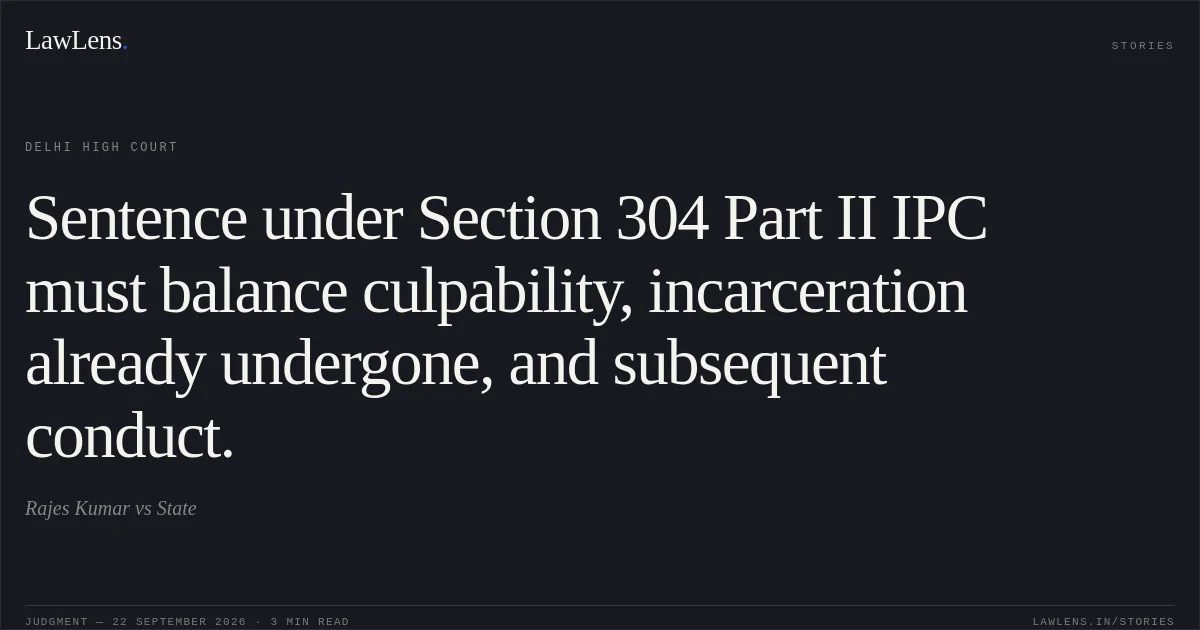
The appellants had originally been convicted under Section 302 IPC. By judgment dated 5 August 2026, the conviction was altered to Section 304 Part II IPC; the conviction of Rahish Khan under Section 25 of the Arms Act was maintained.
Source reference: para. 1Rajesh Kumar claimed to be a first-time offender who had undergone approximately six years’ incarceration and faced trial for about twenty years. Nasim Ahmad @ Sagar claimed to have undergone approximately eight years and eleven months in custody and sought a sentence limited to the period already undergone. Rahish Khan relied upon his occupation as a footpath vendor, his dependent family, and approximately seven years spent in custody.
Source reference: paras. 3–5The prosecution opposed leniency, submitting that Rajesh Kumar and Nasim Ahmad had been declared proclaimed offenders, that Nasim had a conviction under the NDPS Act, and that Rahish had subsequently been involved in offences under Sections 387/34 IPC and 25 of the Arms Act in 2022.
Source reference: para. 6Issues
Whether, after alteration of the appellants’ convictions from Section 302 IPC to Section 304 Part II IPC, the sentence should be restricted to the period already undergone or should a further substantive sentence be imposed?
Source reference: paras. 2, 7–10Whether the appellants’ period of incarceration, family circumstances, antecedents, proclaimed-offender status, and subsequent conduct should affect the quantum of sentence?
Source reference: paras. 3–10Whether the sentence imposed on Rahish Khan under Section 25 of the Arms Act warranted interference or modification?
Source reference: paras. 12–13Law Applied
The Court applied Section 304 Part II IPC, which prescribes punishment for culpable homicide not amounting to murder where the act is committed with the knowledge that it is likely to cause death, and treated the offence as serious despite the alteration from Section 302 IPC.
Source reference: para. 7The Court applied the sentencing principle of proportionality, requiring the sentence to reflect both the gravity of the offence and the degree of proved culpability.
Source reference: paras. 7–8It further applied the principle that mitigating circumstances—such as custody already undergone, family responsibilities, absence or presence of antecedents, and conduct during and after trial—must be balanced against aggravating circumstances and cannot by themselves determine the sentence.
Source reference: paras. 8–10Section 428 CrPC was applied to grant credit for the period already undergone in custody.
Source reference: para. 11Reasoning
The Court held that alteration of the conviction to Section 304 Part II IPC reduced the degree of criminal culpability but did not eliminate the seriousness of causing culpable homicide with the requisite knowledge.
Source reference: para. 7It considered the appellants’ incarceration and the long duration of the trial as relevant mitigating factors, while treating Rahish’s family circumstances as insufficient to eclipse the gravity of the offence.
Source reference: para. 8The Court also considered the adverse factors relied upon by the prosecution, including Nasim’s NDPS conviction, Rahish’s subsequent involvement in criminal cases, and the proclaimed-offender status of Rajesh and Nasim.
Source reference: para. 9Balancing these factors, the Court concluded that a sentence of ten years’ rigorous imprisonment, with statutory set-off, was proportionate for the Section 304 Part II IPC conviction.
Source reference: paras. 10–11In Rahish’s case, the existing one-year sentence under Section 25 of the Arms Act was considered lenient and was therefore left undisturbed, but directed to run concurrently.
Source reference: para. 12Holding
The Court sentenced all three appellants to ten years’ rigorous imprisonment under Section 304 Part II IPC, granting credit for the period already undergone under Section 428 CrPC; the fines and default sentences imposed by the Trial Court remained undisturbed.
Rahish Khan’s one-year rigorous imprisonment under Section 25 of the Arms Act was maintained and directed to run concurrently.
Source reference: para. 12Rahish, already in custody, was directed to serve the remaining sentence after computation of his set-off.
Source reference: para. 13Since Rajesh Kumar and Nasim Ahmad @ Sagar had been declared proclaimed offenders, they were directed to be committed to prison to serve the remaining sentence upon arrest.
Source reference: para. 14The appeals and pending applications were disposed of.
Source reference: para. 16Acts & Sections Cited
9 provisions across 4 statutes referred to in this judgment. Each provision opens on LawLens.
Indian Penal Code, 18604
Arms Act, 19591
Narcotic Drugs and Psychotropic Substances Act, 19853
Code of Criminal Procedure, 19731
Original Court PDF
Rajes KumarvsState
Click to open original judgment
Original judgment, available to read, download and summarize on LawLens.in