Facts
The Petitioner was appointed as a temporary LDC in the Andaman and Nicobar Administration in 1978 and later as a Trained Graduate Teacher (TGT).
Source reference: para. 1In 1988, she was sent on deputation to Navodaya Vidyalaya Samiti (NVS), Faizabad, with a lien on her parent post for two years.
Source reference: para. 2When NVS ordered her repatriation on July 17, 1991, she challenged it before the Allahabad High Court, which stayed the repatriation on August 20, 1991, directing that she "shall not be required to join at her parent department".
Source reference: para. 3This interim order remained in force until January 9, 2008, when the Tribunal (where the case was transferred) directed NVS to consider her for absorption.
Source reference: para. 4-5After being found unsuitable for absorption, she was repatriated in November 2008 and reported to the UT Administration on January 9, 2009.
Source reference: para. 6-7The UT Administration initially refused her joining, labeling her 17-year stay as "unauthorized absence" and "abandonment of service".
Source reference: para. 7, 9Consequently, her retiral benefits were partially withheld or delayed.
Source reference: para. 10The Central Administrative Tribunal (Principal Bench) dismissed her original application in 2018, upholding the government's stand.
Source reference: para. 13Issues
Whether the Petitioner’s stay at the borrowing organization (NVS) from 1991 to 2008, pursuant to a judicial stay order, constitutes "unauthorized absence" or "overstay on deputation" attracting disciplinary consequences.
Source reference: para. 16, 20Whether the Respondents are legally justified in withholding retiral benefits based on DOPT Office Memorandums (OMs) regarding the maximum tenure of deputation.
Source reference: para. 17, 19Law Applied
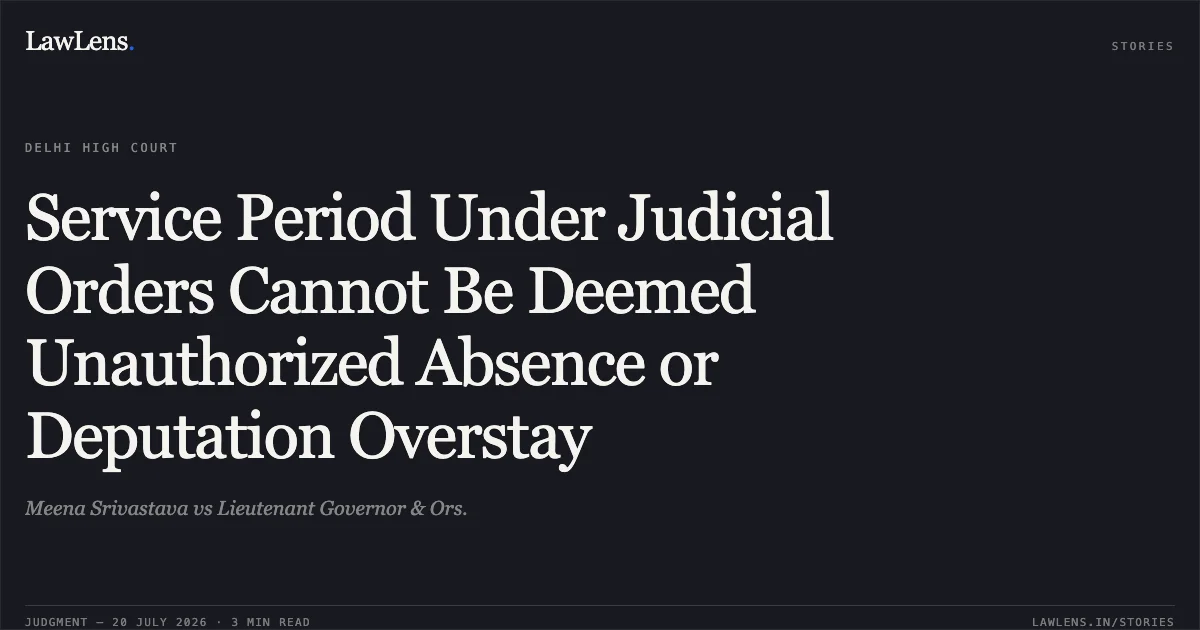
The Court focused on the doctrine of judicial supremacy and the principle that a citizen cannot be penalized for complying with a court order.
Source reference: para. 24DOPT OMs (O.M. No. 6/8/2009-Estt. (Pay II) dated June 17, 2010, and March 1, 2011) stipulate that deputation cannot exceed five years and that overstay results in the period not being counted for pension.
Source reference: para. 12, 13Administrative instructions are inapplicable when a stay is granted by a Constitutional Court.
Source reference: para. 19-20Reasoning
The Court found that the UT Administration’s reliance on DOPT OMs was misplaced because the Petitioner’s stay was governed by a "positive permission" from the Allahabad High Court.
Source reference: para. 20The Court emphasized that the 1991 interim order specifically proscribed the parent department from requiring the Petitioner to rejoin.
Source reference: para. 20The period from 1991 to 2008 could not be termed "unauthorized" as it was sanctioned by a judicial mandate that remained unchallenged for 17 years.
Source reference: para. 20-21The Court criticized the Directorate of Education's stand as "preposterous" and "practically contemptuous," noting that an administrative officer cannot act as a "super-judicial authority" to punish an employee for seeking legal redress.
Source reference: para. 21-22The Court concluded that since the Petitioner was legally barred from returning to her parent cadre by the High Court's stay, no adverse service consequences or "abandonment of service" theories could be applied.
Source reference: para. 23-25Holding
The Court allowed the writ petition and set aside the Tribunal's order.
The Petitioner is entitled to full retiral benefits treating her service as continuous.
Source reference: para. 31The Respondents were directed to disburse all pending retiral benefits within six weeks, failing which a 12% per annum interest rate would apply.
Source reference: para. 32The Court expressed "undisguised displeasure" at the UT Administration's attempt to penalize a citizen for acting in accordance with a court order.
Source reference: para. 22, 25Acts & Sections Cited
1 provisions across 1 statute referred to in this judgment. Each provision opens on LawLens.
Administrative Tribunals Act, 19851
Original Court PDF
Meena SrivastavavsLieutenant Governor & Ors.
Click to open original judgment
Original judgment, available to read, download and summarize on LawLens.in