Facts
M/s. Airtech Projects Engineers Pvt. Ltd. obtained a cash-credit facility from United Bank of India, whose account was declared an NPA after default. The Bank issued a demand notice under Section 13(2) of the Securitisation and Reconstruction of Financial Assets and Enforcement of Security Interest Act, 2002, and initiated measures for sale of the secured property, comprising land and a building in Chennai.
Source reference: para. 4After an earlier sale notice was quashed because the auction was scheduled on a Sunday, the Bank issued a fresh possession-cum-sale notice fixing the auction for 24.04.2009.
Source reference: paras. 5–7The sale notice required each bidder to deposit earnest money of Rs.21,50,000, failing which the offer would be rejected. The auction-purchasers submitted the highest bid of Rs.2,17,40,000 but deposited only Rs.21,15,000 as EMD, resulting in a shortfall of Rs.35,000. The other bidder had made an identical short deposit.
Source reference: para. 7On the date of auction, the auction-purchasers deposited a further amount so that the total deposit equalled 25% of the bid price, and subsequently paid the balance sale consideration. A sale certificate was issued and registered in their favour.
Source reference: paras. 7–9The DRT upheld the sale, but the DRAT held that the auction violated Rule 8(5) of the Security Interest (Enforcement) Rules, 2002 and directed restoration of possession to the borrower. The High Court ultimately dismissed the challenges to the DRAT’s decision, leading to the present appeals.
Source reference: paras. 10–12Issues
Whether the auction-purchasers’ failure to deposit the full EMD stipulated in the sale notice rendered their bids invalid and vitiated the auction?
Source reference: paras. 13–22Whether the auction-purchasers’ payment of 25% of the sale price in compliance with Rule 9(3) cured or rendered insignificant the prior shortfall in the EMD?
Source reference: paras. 18, 20–21Whether the delayed payment of the balance sale consideration invalidated the sale?
Source reference: para. 22Whether the borrower was entitled to interest on the surplus sale proceeds retained by the Bank in a non-interest-bearing account?
Source reference: para. 23Law Applied
The Court applied the SARFAESI Act and Rules 8 and 9 of the Security Interest (Enforcement) Rules, 2002. Rule 8(6) requires the sale notice to specify, inter alia, the earnest money deposit stipulated by the secured creditor, while Rule 9(3) requires the purchaser to immediately deposit 25% of the sale price, failing which the property must be resold; Rule 9(4) governs payment of the balance consideration within the prescribed or extended period, and Rule 9(5) provides for forfeiture upon default.
Source reference: para. 18The Court applied the distinction between essential eligibility conditions and ancillary or subsidiary conditions in tender processes: essential conditions ordinarily require strict compliance, whereas deviation from a non-essential condition may be permissible where it causes no substantial prejudice or injustice.
Source reference: paras. 19–20This principle was drawn from Poddar Steel Corporation v. Ganesh Engineering Works, Om Prakash Sharma v. Ramesh Chand Prashar, Central Coalfields Ltd. v. SLL-SML (Joint Venture Consortium), Bakshi Security & Personnel Services Pvt. Ltd. v. Devkishan Computed Pvt. Ltd., Vidarbha Irrigation Development Corporation v. Anoj Kumar Agarwala, G.J. Fernandez v. State of Karnataka, Indian Railway Catering and Tourism Corporation Ltd. v. Doshion Veolia Water Solutions Pvt. Ltd., National High Speed Rail Corporation Ltd. v. Monte Carlo Ltd., and B.S.N. Joshi & Sons Ltd. v. Nair Coal Services Ltd.
Source reference: paras. 19–20Reasoning
The Court held that the EMD requirement in Clause 7 of the sale notice was a non-statutory condition incorporated to screen out non-serious bidders, rather than an essential statutory eligibility requirement.
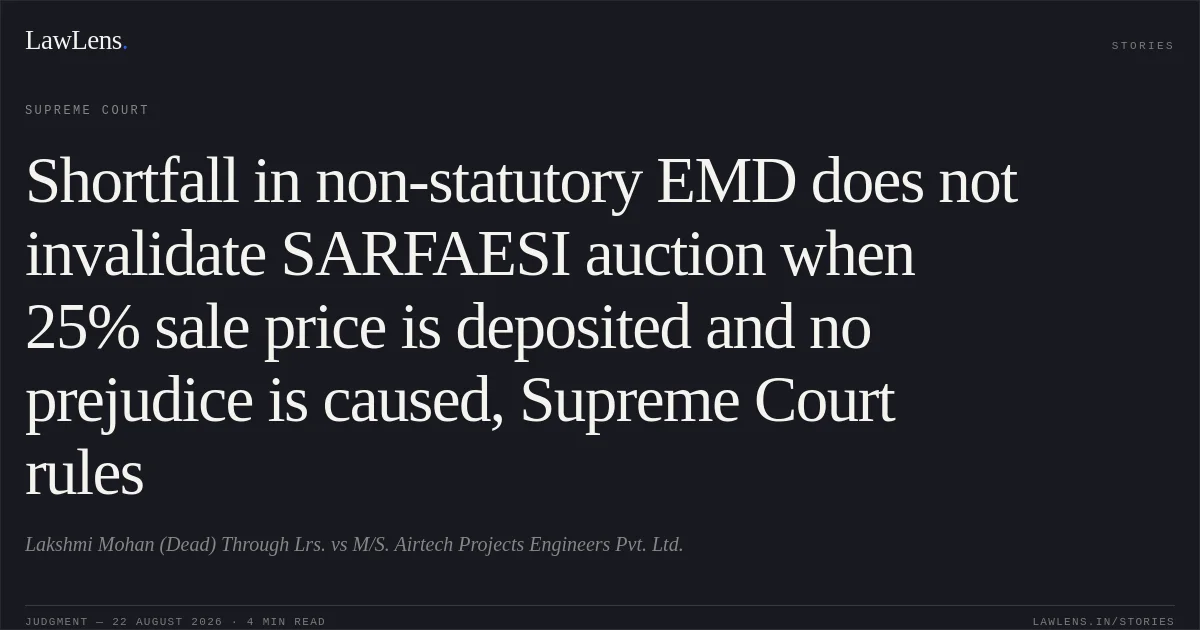
Source reference: para. 20Both bidders had deposited the same amount, Rs.21,15,000, and the Bank had entertained and considered both bids. The successful auction-purchasers thereafter deposited 25% of the bid price, including the EMD, in compliance with the mandatory requirement under Rule 9(3). Since the statutory 25% deposit was made and no prejudice was caused to the borrower or the competing bidder, the Rs.35,000 EMD shortfall did not invalidate the bid or the auction.
Source reference: para. 21The challenge based on delayed payment of the balance consideration was rejected because it had not been raised before the DRT or DRAT. In any event, the sale notice permitted extension by the Bank, and the Bank had deferred the payment date during the pendency of proceedings. The balance was paid immediately after dismissal of the borrower’s challenge, demonstrating that the delay had been authorised or accepted by the Bank.
Source reference: para. 22However, the Bank had retained surplus sale proceeds of Rs.1,33,94,054 in a non-interest-bearing account. The borrower could not be penalised for the Bank’s failure to preserve the surplus in an interest-bearing account and was therefore entitled to interest on that amount.
Source reference: para. 23Holding
The Supreme Court held that the shortfall in the EMD stipulated by the sale notice did not vitiate the auction because the requirement was non-statutory, both bidders were similarly placed, the full 25% of the sale price was deposited in compliance with Rule 9(3), and no prejudice resulted.
The challenge to the timing of payment of the balance consideration was also rejected, as the Bank had extended or deferred the payment period and the amount was paid immediately after the borrower’s proceedings failed.
Source reference: para. 22The Court set aside the High Court’s judgment dated 22.03.2013 and the DRAT’s order dated 20.06.2011, thereby upholding the auction sale and the auction-purchasers’ title.
Source reference: para. 24The Bank was directed to refund Rs.1,33,94,054 to the borrower with interest at 7% per annum from 23.03.2010 until payment.
Source reference: para. 25Civil Appeal Nos. 9228–9231 of 2013 and the Bank’s appeal were allowed; the auction-purchasers’ connected appeals were disposed of. There was no order as to costs.
Source reference: para. 26Acts & Sections Cited
1 provisions across 1 statute referred to in this judgment. Each provision opens on LawLens.
Securitisation and Reconstruction of Financial Assets and Enforcement of Security Interest Act, 20021
Original Court PDF
Lakshmi Mohan (Dead) Through Lrs.vsM/S. Airtech Projects Engineers Pvt. Ltd.
Click to open original judgment
Original judgment, available to read, download and summarize on LawLens.in