Facts
The petitioners, defendants 2 and 3 in O.S. No.368 of 2017, challenged the order dated 25.02.2026 dismissing their application in I.A. No.1 of 2024 for condonation of a 792-day delay in seeking to set aside an ex parte decree in a suit for specific performance.
Source reference: p.1, para.1The defendants were served with summons and entered appearance through the same counsel on 03.01.2018, but did not file a written statement or otherwise contest the suit. They were set ex parte on 30.10.2018, and an ex parte decree was passed on 28.11.2018.
Source reference: p.5, para.10; p.6, para.11The petitioners alleged that they became aware of the decree only on 29.01.2021 and filed the application to set it aside within 30 days thereafter, accompanied by an application under Section 5 of the Limitation Act as a precautionary measure.
Source reference: p.2, para.3; p.5, para.10They also relied on the fact that the younger petitioner was a minor when the suit was instituted.
Source reference: pp.2–4, paras.4,7The Trial Court rejected the explanation, finding that the petitioners had knowledge of the proceedings and had voluntarily engaged counsel. The present revision was filed under Section 115 CPC.
Source reference: p.1, para.1Issues
Whether the petitioners had shown sufficient cause for condoning the 792-day delay in filing the application to set aside the ex parte decree?
Source reference: p.5, para.9; p.6, para.11Whether the alleged minority of the younger petitioner and the assertion that the petitioners were unaware of the ex parte decree justified interference with the Trial Court’s order?
Source reference: pp.3–5, paras.7–8; pp.6–8, paras.12–13Whether the Trial Court’s dismissal of the condone-delay application warranted interference under Section 115 CPC?
Source reference: p.1, para.1; p.8, para.13Law Applied
The Court applied Section 5 of the Limitation Act, 1963, under which delay may be condoned only upon the applicant establishing “sufficient cause”; the burden rests on the applicant to provide a genuine and satisfactory explanation for the entire period of delay.
Source reference: pp.5–8, paras.9–13The Court also considered the remedy for setting aside an ex parte decree under Order IX Rule 13 CPC and exercised its revisional jurisdiction under Section 115 CPC, which does not permit interference merely because another view is possible, particularly where the subordinate court has properly exercised its discretion.
Source reference: pp.5–8, paras.9–13The Court further applied the principle that a litigant who has participated in proceedings, engaged counsel, and failed to act diligently cannot subsequently plead ignorance of the proceedings or take advantage of circumstances arising from that inaction.
Source reference: pp.5–8, paras.9–13Reasoning
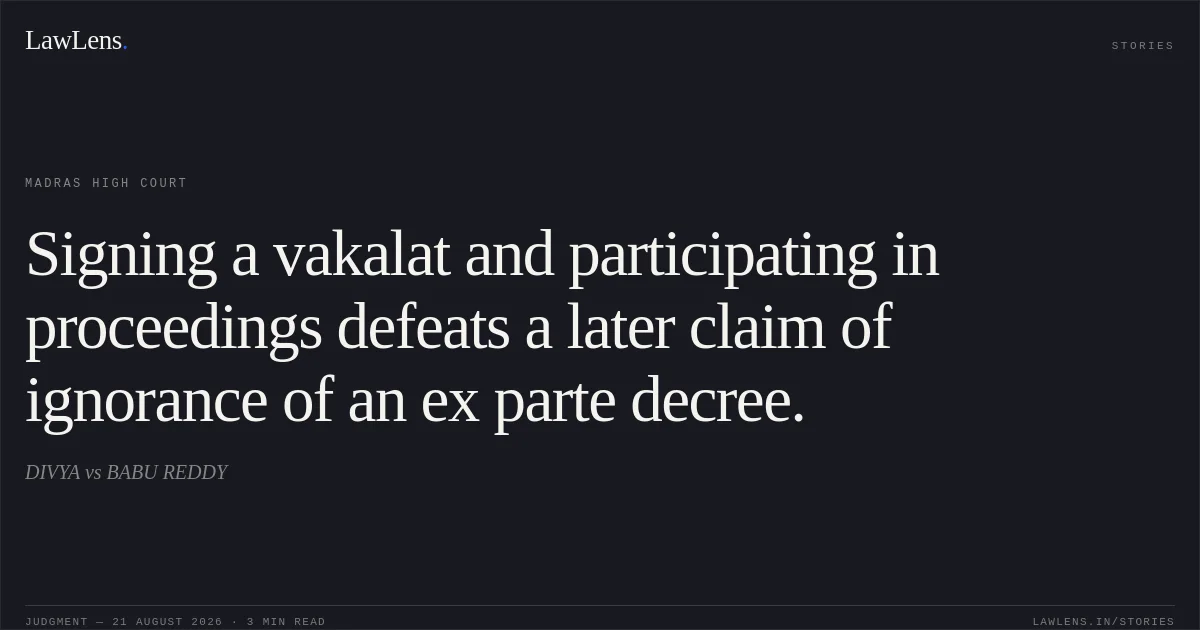
The Court held that the petitioners’ explanation was inconsistent with the record. They had been served with summons, entered appearance through counsel on 03.01.2018, and signed the vakalat individually, although the younger petitioner was allegedly still a minor.
Source reference: p.4, para.8; p.6, para.11The Court found that the petitioners therefore had knowledge of the suit from its inception and could not credibly claim that they first became aware of the decree only in January 2021.
Source reference: p.7, para.12Their signatures on a vakalat in the execution proceedings on 05.12.2019 further undermined the plea of ignorance.
Source reference: p.8, para.13Although the younger petitioner was a minor on the date of institution of the suit, she was shown as a major, signed the vakalat, and no objection was raised before the Trial Court regarding her representation or the manner in which the suit was instituted.
Source reference: pp.4–5, paras.8,12The Court accordingly concluded that the petitioners had not established sufficient cause for the 792-day delay and that the Trial Court’s discretionary order was well reasoned and did not warrant revisional interference.
Source reference: p.8, para.13Holding
The High Court answered the issues against the petitioners. It held that no sufficient or satisfactory cause had been shown for condoning the 792-day delay, and that the plea of minority and alleged lack of knowledge did not justify setting aside the Trial Court’s order.
The Civil Revision Petition was dismissed, the order dated 25.02.2026 in I.A. No.1 of 2024 in O.S. No.368 of 2017 was affirmed, and the connected CMP was also dismissed. No costs were awarded.
Source reference: p.8, para.14Acts & Sections Cited
2 provisions across 2 statutes referred to in this judgment. Each provision opens on LawLens.
Code of Civil Procedure, 19081
Limitation Act, 19631
Original Court PDF
DIVYAvsBABU REDDY
Click to open original judgment
Original judgment, available to read, download and summarize on LawLens.in