Facts
The petitioner invoked Article 226 seeking regularisation of his services with effect from 4 July 2003, revision of terminal and consequential benefits, payment of arrears with interest, and consideration of his representation.
Source reference: para. 1He contended that the controversy was covered by the High Court’s order dated 1 September 2026 in W.P. No. 15213 of 2024 and connected matters.
Source reference: para. 2The State opposed the claim but could not distinguish the petitioner’s case from the precedent relied upon.
Source reference: para. 3In the connected matters, similarly situated Jail Warders, including employees initially appointed after the petitioner, had been granted regularisation from 4 July 2003, whereas the petitioner’s services had been regularised from a later date; the Court had held that denial of parity was discriminatory.
Source reference: paras. 5, 9 of the incorporated orderThe petitioner’s representation seeking the same benefit was rejected by the respondents.
Source reference: paras. 5, 9 of the incorporated orderIssues
Whether the petitioner, being similarly situated to employees whose services were regularised with effect from 4 July 2003, was entitled to the same date of regularisation and consequential benefits under Articles 14 and 226 of the Constitution.
Source reference: paras. 5–6; para. 13 of the incorporated orderWhether the petitioner’s delayed claim was liable to be rejected on the ground of laches, or whether the claim involved a continuing wrong relating to service, pensionary and consequential benefits.
Source reference: paras. 10–12 of the incorporated orderLaw Applied
The Court applied Article 14’s mandate of equal treatment and Article 226 jurisdiction.
Source reference: no citationIt relied on State of U.P. v. Arvind Kumar Shrivastava, (2015) 1 SCC 347, for the principle that identically situated employees should ordinarily receive the same service benefits, subject to exceptions such as delay, laches and acquiescence; however, the Court also recognised that such exceptions do not ordinarily defeat claims arising from a continuing wrong.
Source reference: para. 10; para. 22 of the quoted precedentIt relied on Union of India v. Tarsem Singh, (2008) 8 SCC 648, for the proposition that continuing violations concerning pay fixation, pension and recurring service benefits give rise to a continuing cause of action.
Source reference: para. 11The Court further relied on Bhikhani Devi v. Union of India, 2026 SCC OnLine SC 1055, which treated pensionary and retiral benefits as a continuing cause of action, while limiting arrears in appropriate cases.
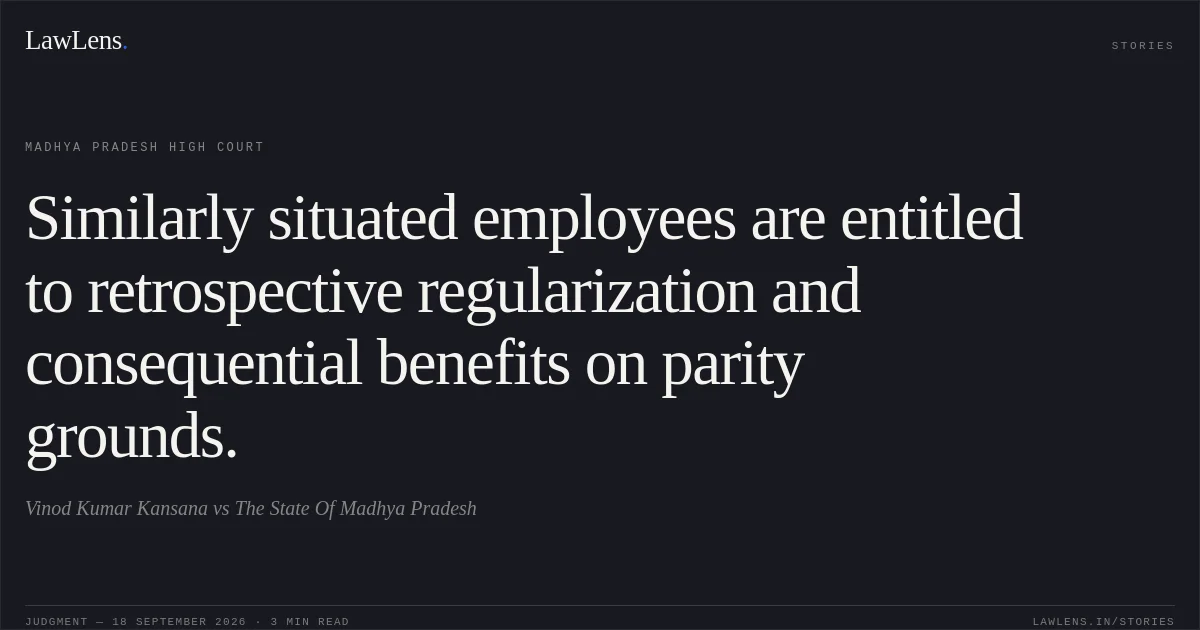
Source reference: para. 8The parity principle was also drawn from the High Court’s decision in Smt. Shyama Rajput v. State of M.P., W.P. No. 8189 of 2021, under which similarly situated employees were directed to be regularised with effect from 4 July 2003 and granted consequential benefits.
Source reference: para. 7 of the incorporated orderReasoning
The Court found that the petitioner was similarly situated to the employees who had obtained regularisation from 4 July 2003 and that the State was unable to distinguish his case from the earlier decision.
Source reference: paras. 2–4Applying the principle that similarly situated employees must receive equal treatment, the Court held that the benefit could not be denied merely because the petitioner approached the Court later.
Source reference: paras. 9–12 of the incorporated orderThe petitioner’s claim concerned regularisation and consequential service or terminal benefits, which constituted a continuing wrong; consequently, delay and laches did not bar relief.
Source reference: paras. 9–12 of the incorporated orderThe Court therefore adopted the earlier decision mutatis mutandis and extended its benefit to the petitioner.
Source reference: para. 6Holding
The petition was disposed of in terms of the order dated 1 September 2026 in W.P. No. 15213 of 2024.
The respondents were directed to regularise the petitioner’s services with effect from 4 July 2003—the date from which the similarly situated employees had been regularised—and to grant all consequential benefits within three months from receipt of the certified copy of the order.
Source reference: para. 6Any pending interlocutory application was also disposed of.
Source reference: para. 7Original Court PDF
Vinod Kumar KansanavsThe State Of Madhya Pradesh
Click to open original judgment
Original judgment, available to read, download and summarize on LawLens.in