Facts
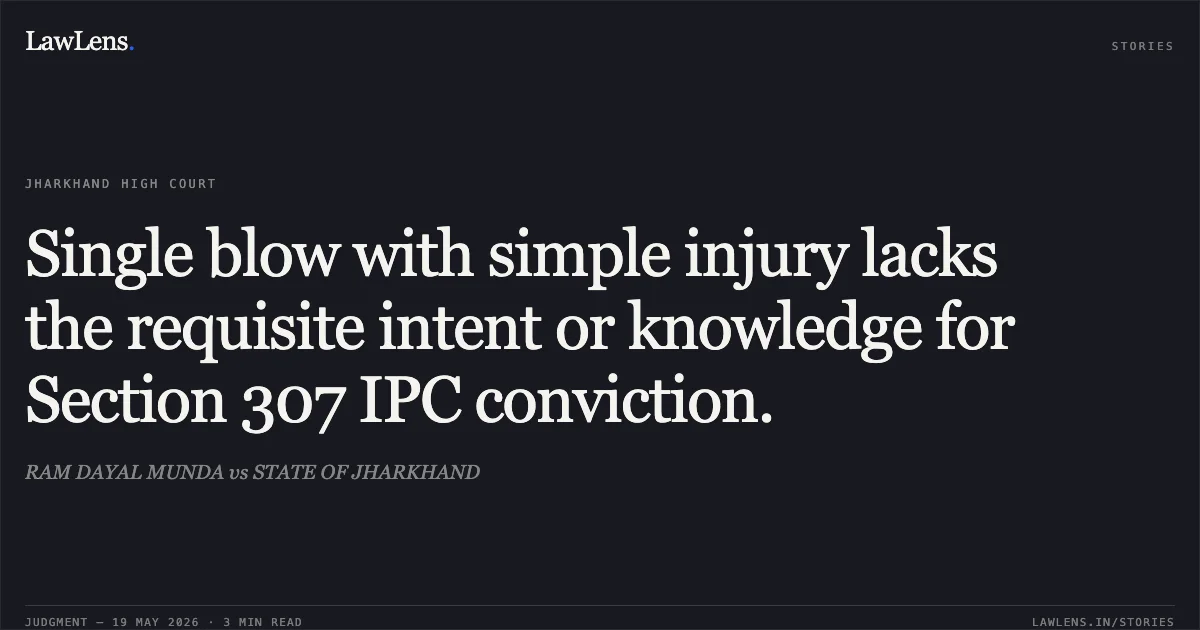
The appellant was convicted by the 2nd Additional Sessions Judge, Hazaribag, under Section 307 of the IPC and sentenced to five years of rigorous imprisonment
Source reference: para. 2The prosecution alleged that on January 6, 1996, at approximately 9:30 P.M., the appellant and several others surrounded the informant’s father, Dasai Karmali (P.W.-1), due to an old land dispute. While others used sticks (lathi), the appellant allegedly inflicted a blow with a sharp-edged weapon (farsa) on the victim's head
Source reference: para. 3The trial court based its conviction on the premise that the injury was inflicted on a vital part of the body
Source reference: para. 8The appellant challenged this, noting the injury was a single blow and medically classified as simple in nature
Source reference: para. 8Issues
1. Whether the single blow resulting in a simple injury on a vital part is sufficient to sustain a conviction for "attempt to murder" under Section 307 of the IPC in the absence of evidence regarding intention or knowledge to cause death
Source reference: para. 8, 122. Whether the appellant is entitled to the benefit of the Probation of Offenders Act, 1958, given his age at the time of the offence and his clean record
Source reference: para. 8, 14Law Applied
Section 307 (Attempt to murder) and Section 324 (Voluntarily causing hurt by dangerous weapons or means) of the Indian Penal Code
Source reference: para. 12-13The court relied on the precedent set by the Hon’ble Apex Court in Hari Singh v. Sukhbir Singh & Others (1988) 4 SCC 551, which established that for Section 307 to apply, the court must determine if the act was committed with the specific intention or knowledge required to constitute murder, gathered from factors like the nature of the weapon, the severity of the blow, and the circumstances, rather than just the result
Source reference: para. 11Section 4 of the Probation of Offenders Act, 1958, regarding release on bond for good conduct
Source reference: para. 14Reasoning
The High Court observed that while the medical evidence (P.W.-9) confirmed a clean-cut wound on the temporal region of the victim's head, the injury was simple in nature
Source reference: para. 10, 12Applying the principles from Hari Singh, the court found that the requisite intention or knowledge for murder was "absolutely lacking"
Source reference: para. 12The court noted there was only a single blow and no evidence suggested the appellant was prevented from repeating the strike; thus, he did not intend to cause more harm than was inflicted in the spur of the moment
Source reference: para. 12The court found the conviction under Section 307 unsustainable, instead determining that the act fell squarely under Section 324 of the IPC
Source reference: para. 12-13Regarding the sentence, the court considered the appellant was 20 years old at the time of the incident, it was his first offence, and the dispute was nearly 30 years old
Source reference: para. 8, 14Holding
The Court dismissed the appeal on merits but modified the conviction from Section 307 IPC to Section 324 IPC
The order of five years of rigorous imprisonment was set aside. Instead, the appellant was directed to be released under Section 4 of the Probation of Offenders Act, 1958, upon furnishing a bond of Rs. 5,000 to maintain peace and good behavior for one year. Failure to furnish the bond within two months would result in the execution of the original sentence
Source reference: para. 14, 15-16Acts & Sections Cited
9 provisions across 2 statutes referred to in this judgment. Each provision opens on LawLens.
Indian Penal Code, 18608
Probation of Offenders Act, 19581
Original Court PDF
RAM DAYAL MUNDAvsSTATE OF JHARKHAND
Click to open original judgment
Original judgment, available to read, download and summarize on LawLens.in