Facts
The petitioner challenged the Internal Complaint Committee (ICC) report dated 06.10.2025, which arose from her sexual harassment complaint filed on 17.04.2025
Source reference: para. 1The petitioner alleged incidents of harassment by respondent no. 5 between 2016 and 2023, continuing into 2024
Source reference: para. 4However, the petitioner worked for an entity outside Delhi's jurisdiction; the alleged incidents, the complaint filing, and the subsequent inquiry all occurred in Gurugram at the office of respondent no. 2
Source reference: para. 2, 4The petitioner approached the Delhi High Court on the basis that the respondent’s office or the Union of India was situated within Delhi
Source reference: para. 3Issues
1. Whether the location of a respondent’s office or the Union of India within Delhi is sufficient to confer territorial jurisdiction under Article 226 of the Constitution when the underlying cause of action arose elsewhere
Source reference: para. 3, 62. Whether the Court should exercise its discretionary jurisdiction under the doctrine of forum conveniens if only a small part of the cause of action arises within its jurisdiction
Source reference: para. 8Law Applied
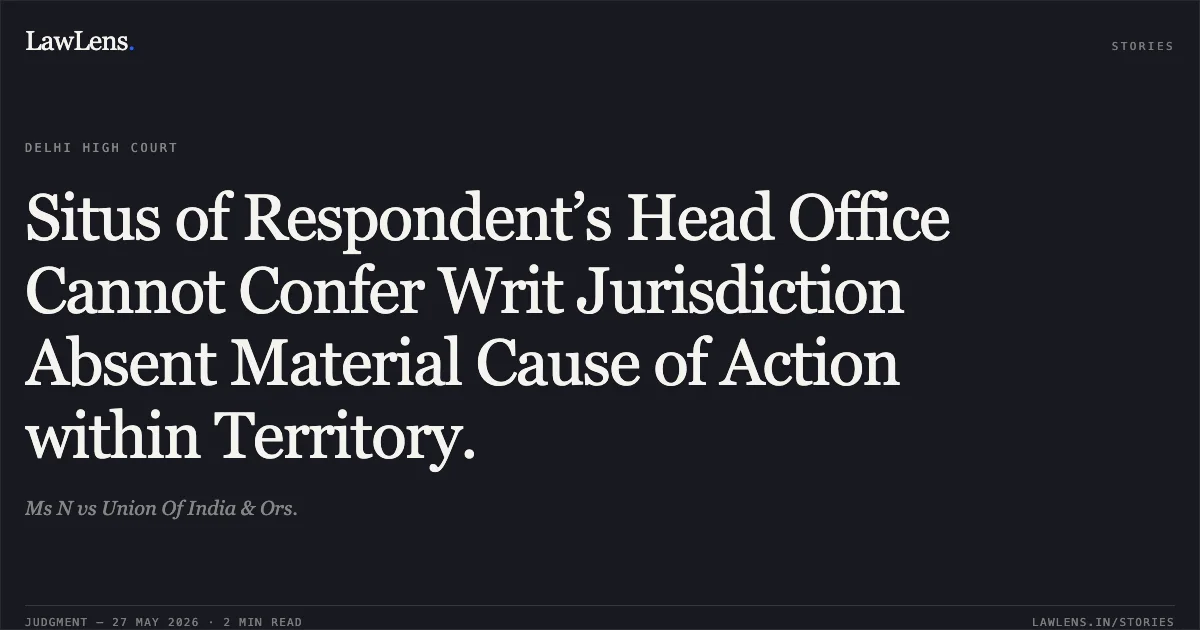
The Court applied the principles of territorial jurisdiction under Article 226 of the Constitution of India, asserting that the situs of a head office or registered office does not automatically determine jurisdiction
Source reference: para. 5It relied on The Indure Pvt. Ltd. v. Government of NCT of Delhi, which held that High Courts should not act as "mini-pan-India Superior Courts" by entertaining cases where the underlying cause lies elsewhere
Source reference: para. 6Furthermore, the Court invoked the doctrine of forum conveniens established in Kusum Ingots Alloys Ltd. v. Union of India, which mandates that even if a small part of the cause of action arises within a court's territory, the court may refuse to exercise discretionary jurisdiction if another forum is more appropriate
Source reference: para. 8Reasoning
The Court observed that not a single incident related to the complaint took place within the territorial limits of Delhi
Source reference: para. 4It reasoned that while a "part" of the cause of action might arguably exist in Delhi due to the respondent's office location, this should not be the sole determinative factor
Source reference: para. 7Applying the reasoning from The Indure Pvt. Ltd., the Court found that the inquiry, the report, and the alleged harassment all occurred in Gurugram
Source reference: para. 2, 4Consequently, the Court determined that the matter was better suited for the jurisdictional High Court where the events actually transpired, invoking forum conveniens to decline the exercise of its discretionary writ jurisdiction
Source reference: para. 8, 9Holding
The Court dismissed the petition on the grounds of lack of territorial jurisdiction/forum non-conveniens
It held that the mere presence of a respondent's office in Delhi does not compel the Court to decide a matter on merits when the cause of action crystallized elsewhere
Source reference: para. 3, 8The petitioner was granted liberty to approach the appropriate jurisdictional High Court, with all rights and contentions left open
Source reference: para. 10, 11Original Court PDF
Ms NvsUnion Of India & Ors.
Click to open original judgment
Original judgment, available to read, download and summarize on LawLens.in