Facts
The Petitioner held a mining lease for limestone in District Satna, Madhya Pradesh
Source reference: para. 2On 02.04.2026, Respondent No. 2 passed an order declaring the said lease as lapsed
Source reference: para. 3The Petitioner filed a revision application and a stay application under Section 30 of the Mines and Minerals (Development and Regulation) (MMDR) Act, 1957, before the Revisional Authority (Respondent No. 1) situated in Delhi
Source reference: para. 1, 3Alleging delay in the disposal of the stay application and the revision petition, the Petitioner approached the Delhi High Court seeking directions for expeditious adjudication
Source reference: para. 4The Petitioner argued that jurisdiction was attracted solely because the Revisional Authority is located in Delhi
Source reference: para. 5Issues
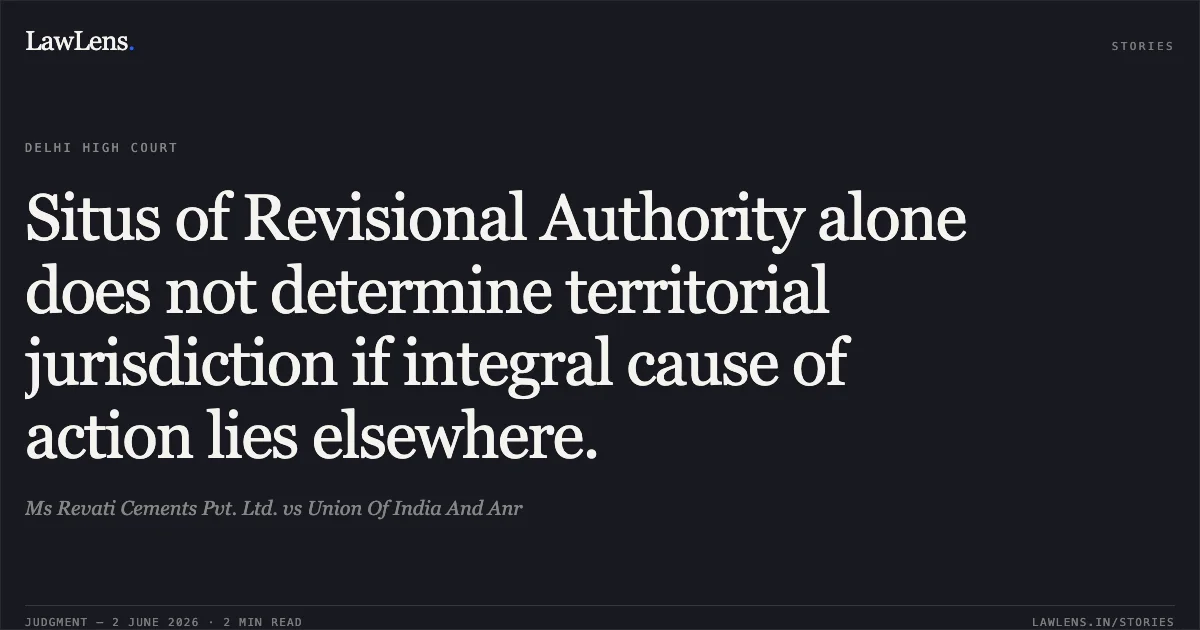
1. Whether the mere location of a Revisional Authority within the territorial limits of a High Court is sufficient to entertain a writ petition when the material and integral cause of action arose elsewhere
Source reference: para. 6, 102. Whether the doctrine of forum non conveniens applies to preclude the exercise of jurisdiction in cases where the subject matter and legal injury are situated outside the Court’s territory
Source reference: para. 11, 12Law Applied
The Court applied the doctrine of forum conveniens and the "material, essential, and integral part of cause of action" test as established in Alchemist Ltd. v. State Bank of Sikkim
Source reference: para. 12It relied on the Full Bench decision in Sterling Agro Industries Ltd v. Union of India, which held that the location of an appellate or revisional authority alone does not constitute forum conveniens
Source reference: para. 12Further, it applied the principles from The Indure Pvt. Ltd. v. Government of NCT of Delhi and M/s Vedanta Ltd. v. Nominated Authority, which mandate that the situs of a head office or the act of passing an order in the national capital are "unchanging constants" and "immaterial" if the underlying dispute and foundational facts lie outside the jurisdiction
Source reference: para. 8, 9, 11Reasoning
The Court observed that the mining lease and the resulting dispute were entirely situated in Madhya Pradesh, outside its territorial jurisdiction
Source reference: para. 5, 13Justice Kaurav reasoned that while a "minuscule part" of the cause of action might arise in Delhi due to the Revisional Authority's location, this does not constitute a "dominant" or "integral" part of the case
Source reference: para. 12, 13The Court emphasized that allowing petitions solely based on the situs of a central authority would turn the Delhi High Court into a "mini-pan-India Superior Court," which is legally untenable
Source reference: para. 9It determined that the "substance of the matter"—the mine's operation and the lapse of the lease—occurred elsewhere, and thus the jurisdictional High Court of the concerned State was the more appropriate forum to grant relief
Source reference: para. 6, 11, 14Holding
The Court answered the issues in the negative and dismissed the writ petition on the grounds of lack of integral territorial jurisdiction and forum non conveniens
The Court held that the mere presence of the Revisional Authority in Delhi is an "unchanging constant" that does not determine jurisdiction when the genesis of the dispute lies elsewhere
Source reference: para. 12, 14Liberty was granted to the Petitioner to approach the jurisdictional High Court (Madhya Pradesh) to agitate the claims
Source reference: para. 15Acts & Sections Cited
1 provisions across 1 statute referred to in this judgment. Each provision opens on LawLens.
Mines and Minerals (Development and Regulation) Act, 19571
Original Court PDF
Ms Revati Cements Pvt. Ltd.vsUnion Of India And Anr
Click to open original judgment
Original judgment, available to read, download and summarize on LawLens.in