01Facts
The petitioners, who claim to be the elected President and Treasurer of Maharaj Vinayak Society, a society registered under the Rajasthan Societies Registration Act, 1958 ("the Act"), allege that their positions were removed by resolutions dated 13.08.2026 and 21.08.2026.
¶ 2–4The resolutions allegedly expelled petitioner No. 2 and another member, and inducted new office-bearers.
¶ 2–4The petitioners allege these meetings were convened without notice and the resolutions were fabricated.
¶ 2–4An FIR was registered on 07.10.2026.
¶ 5On 15.10.2026, Civil Suit No. 129/2026 was filed in the Society's name through Smt. Pinky Jeph, claiming to be Secretary.
¶ 6The suit seeks a declaration that the resolutions are valid, and consequential mandatory and permanent injunctions over the Society's records, offices, accounts and properties.
¶ 6On 16.11.2026, the petitioners applied under Order VII Rule 10 read with Section 151 CPC for return of the plaint under proviso (i) to Section 13(1) of the Act.
¶ 8–9The trial court rejected the application on 18.11.2026.
¶ 8–9The petitioners then filed this writ under Article 227 of the Constitution.
¶ 102Issues
i.1. Whether a writ petition under Article 227 of the Constitution is maintainable against an order rejecting an application under Order VII Rule 10 CPC, given that Order XLIII Rule 1(a) CPC and the proviso to Section 115 CPC bar the usual remedies.
¶ 14, 18, 20–32ii.2. Whether a dispute among members and office-bearers of a society concerning the validity of resolutions removing and expelling office-bearers and members, and inducting new ones, falls within proviso (i) to Section 13(1) of the Act, such that the suit must be referred to the principal Court of original civil jurisdiction.
¶ 34, 37–60iii.3. Whether the exception in proviso (ii) to Section 13(1) applies because the resolutions were allegedly approved unanimously at a General Body Meeting.
¶ 52–5503Law Applied
Order VII Rule 10(1) CPC mandates return of a plaint for presentation before the court in which it ought to have been instituted.
¶ 61Order XLIII Rule 1(a) CPC provides an appeal only against an order directing return, not against its refusal.
¶ 21The proviso to Section 115(1) CPC, as explained in Shiv Shakti Co-operative Housing Society v. Swaraj Developers (2003) 6 SCC 659, bars revision unless the order would finally dispose of the suit.
¶ 21–22Under these constraints, Article 227 supervisory jurisdiction is available for patent jurisdictional error.
¶ 23, 31Proviso (i) to Section 13(1) of the Act, read as an independent substantive provision, requires that "any dispute" among governors, directors, trustees or members of the governing body, or among members of the society, be referred to the principal court of original civil jurisdiction of the district where the society's principal office is situated.
¶ 36–37, 43–45Proviso (ii) to Section 13(1) excepts only matters decided by two-thirds of members for winding up the society.
¶ 40, 52–53The Jodhpur Bench decisions in Shri Bhagwati Prasad v. Ishwar Prasad and the review order in Ishwar Prasad Khandelwal were relied upon.
¶ 41–43For Order VII Rule 10 purposes, jurisdiction is determined from the plaint and the nature of the controversy, not from disputed defences, following Terapalli Dyvasahata Kumar v. S.M. Kantha Raju (2018) 11 SCC 769.
¶ 49Section 6 of the Act governs suing in the Society's name and does not determine forum.
¶ 51Provisions in the judgment · 8 · Linked ones open on LawLens
rajasthan societies registration act, 1958 Section 6Section 13
Code of Civil Procedure, 1908 Section 2Section 9Section 115Section 151
Arbitration and Conciliation Act, 1996 Section 8
Societies Registration Act, 1860 Section 13
04Reasoning
On maintainability, the Court held that an order refusing return of the plaint is not appealable under Order XLIII Rule 1(a) and is not revisable under Section 115 CPC, because allowing the application would not finally dispose of the suit. Article 227 therefore remains available.
¶ 21–31The Court distinguished EXL Careers and Black Diamond Trackparts as not addressing maintainability in this sense.
¶ 24–26On the merits, the Court read proviso (i) broadly. Its use of "any dispute" and its separate treatment of winding-up disputes in proviso (ii) showed it was not confined to dissolution.
¶ 37–40The suit's core relief concerned the constitution of the governing body, removal and expulsion of members, and rival authority of office-bearers. That is an adjustment of the Society's affairs within proviso (i).
¶ 50Authorisation through Smt. Pinky Jeph did not change the nature of the dispute, because her authority itself depended on the impugned resolutions.
¶ 51Proviso (ii) was unavailable because the plaint and resolutions did not concern winding up, and unanimity among persons allegedly present could not substitute for that statutory requirement. The validity of the meeting, notice and quorum were also disputed.
¶ 52–54The trial court had itself recorded no finding on quorum or validity, so it could not presume proviso (ii) applied.
¶ 55The plaintiff's own reply acknowledged an inter se dispute among members, and the FIR and fraud allegations did not take the controversy outside proviso (i).
¶ 56The Court distinguished Sengunthar Education Board and Rajesh Vijayvergiya as not controlling.
¶ 58Given these findings, the trial court's refusal to return the plaint was a patent jurisdictional error warranting Article 227 interference.
¶ 6205Holding
The preliminary objection to maintainability is rejected. Article 227 is the appropriate remedy against refusal to return a plaint in this situation.
¶ 32Disputes among members and governing-body office-bearers concerning the affairs of a society, other than those within proviso (ii), must be referred under proviso (i) to Section 13(1) of the Act to the principal court of original civil jurisdiction where the society's principal office is located, and this reference is mandatory.
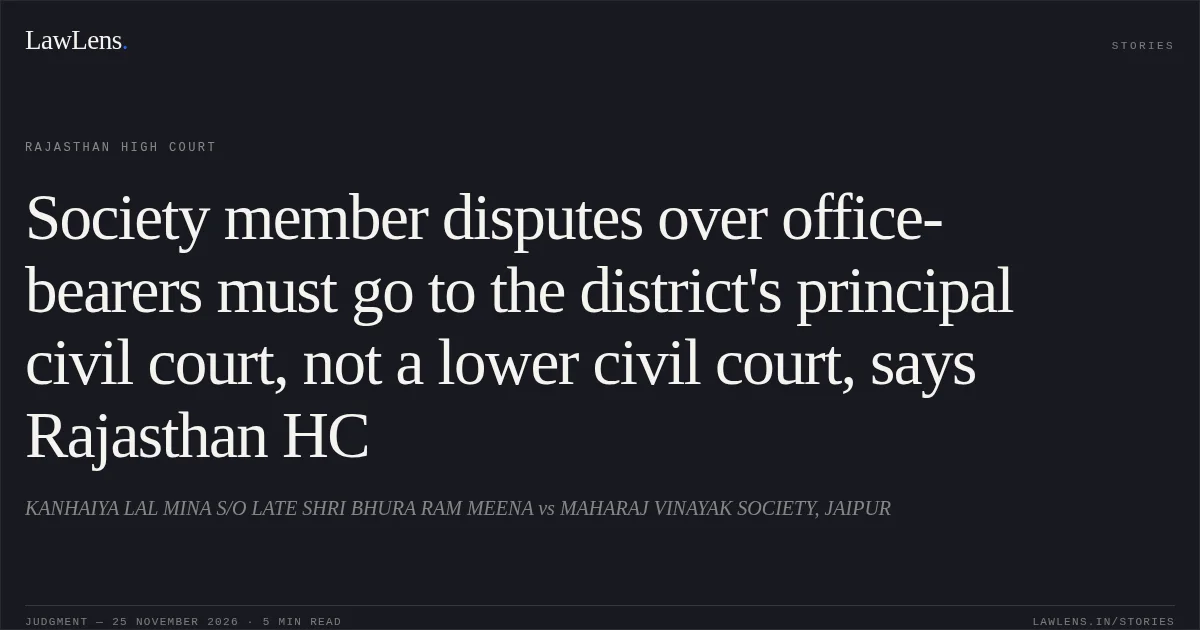
¶ 59The writ petition is allowed. The order dated 18.11.2026 in Civil Suit No. 129/2026 is quashed and set aside, the Order VII Rule 10 application is allowed, and the trial court is directed to return the plaint for presentation before the District Court, Jaipur.
¶ 60–63The Court expressed no opinion on the merits, and all questions remain open for the competent court. The parties may seek interim protection there, and interim arrangements under connected orders remain subject to that court's orders.
¶ 64–65Original Court PDF
KANHAIYA LAL MINA S/O LATE SHRI BHURA RAM MEENAvsMAHARAJ VINAYAK SOCIETY, JAIPUR
Click to open original judgment
Original judgment, available to read, download and summarize on LawLens.in