01Facts
The applicants' land was acquired under the National Highways Act, 1956 ("NH Act").
They applied to the respondent authorities on 04.03.2024 for appointment of an arbitrator. After three months, no arbitrator was appointed under Section 3-G(5) of the NH Act, and the applicants filed applications under Section 11(6) of the Arbitration and Conciliation Act, 1996 ("1996 Act").
¶ 2At the hearing, the respondents objected that such applications were not maintainable in light of Prakash Chand Pradhan (2020) 15 SCC 533. The Court appointed Mr. Naman Maheshwari as Amicus Curiae.
¶ 3The applicants relied on the Supreme Court's SLP (Civil) Diary No. 26933/2025 in Riar Builders Pvt. Ltd. v. Union of India, arguing that the 1996 Act contains no express bar.
¶ 4The respondents and the Amicus contended that the applications were not maintainable and that the applicants' remedy lay in a writ petition or suit for mandamus.
¶ 5–602Issues
i.1. Whether an application under Section 11(6) of the 1996 Act for appointment of an arbitrator is maintainable in respect of land acquired under the NH Act, 1956.
¶ 1 · ¶ 11ii.2. Whether, in the absence of a Section 3-G(5) appointment, the applicants' remedy is limited to a writ petition or suit, or to an application under Section 3-G(5) of the NH Act.
¶ 6 · ¶ 1203Law Applied
Section 3-G(5) and (6) of the NH Act vest power to appoint an arbitrator exclusively in the Central Government and make the 1996 Act applicable "subject to" the NH Act.
¶ 8 · ¶ 10A special statute overrides the general provision of Section 11 of the 1996 Act, as quoted from Gujarat Urja Vikas Nigam Ltd. v. Essar Power Ltd.
¶ 8, citing Prakash Chand Pradhan · ¶ 4–5General Manager (Project), NHIDCL v. Prakash Chand Pradhan (2020) 15 SCC 533 holds that Section 11 cannot be invoked and that the remedy is a writ petition or suit.
¶ 8NHAI v. Sayedabad Tea Co. Ltd. (2020) 15 SCC 161 holds that the NH Act is a complete code, that Section 11 has no application to appointment of arbitrators under Section 3-G(5), and that Section 3-G(6) gives the NH Act overriding effect.
¶ 10 · ¶ 11 (paras. 15–20, 23 of Sayedabad)Provisions in the judgment · 2 · Linked ones open on LawLens
Arbitration and Conciliation Act, 1996 Section 11
Electricity Act, 2003 Section 86
04Reasoning
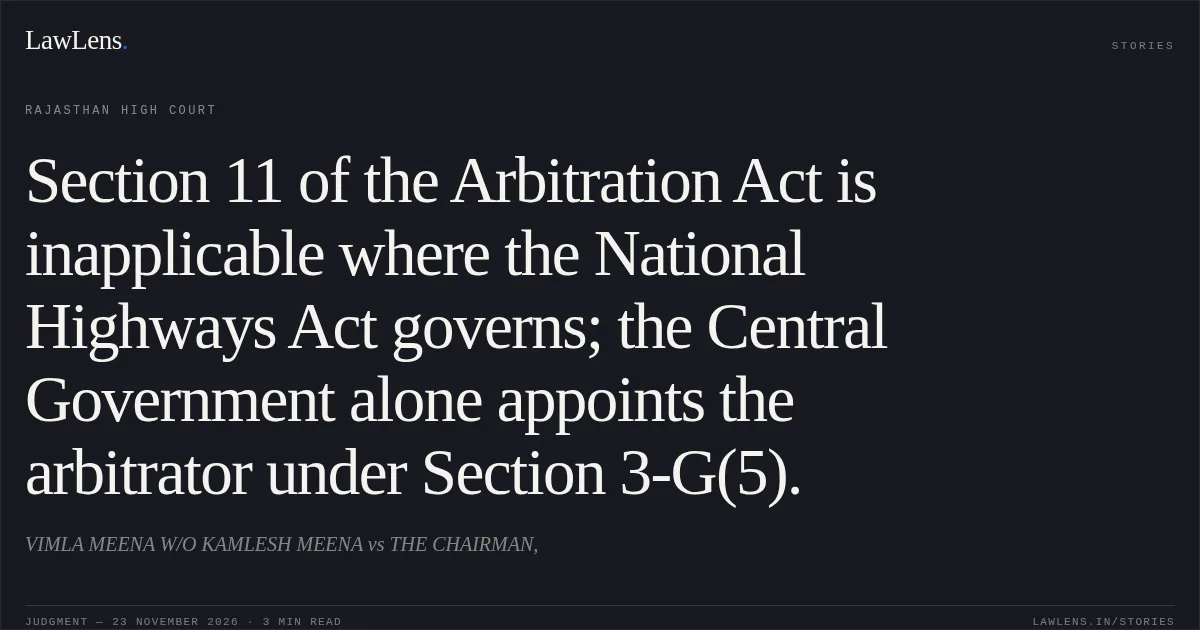
The Court held that the applications concerned acquisition under the NH Act and therefore fell within the exclusive domain of Section 3-G(5).
¶ 8 · ¶ 11Applying Prakash Chand Pradhan, the Court reasoned that Section 11 of the 1996 Act cannot be invoked where the Central Government alone is empowered to appoint an arbitrator, and that the proper remedy in case of inaction is a writ or suit.
¶ 8Sayedabad Tea reinforced this by holding that the NH Act is a self-contained code, and that the "subject to" language in Section 3-G(6) confirms the NH Act's overriding effect.
¶ 10Because the applicants' claim rested entirely on Section 11(6), it failed at the threshold.
¶ 11The order does not address Riar Builders in its reasoning.
¶ 4 · ¶ 8Although the Amicus suggested a writ or suit as the remedy, the Court instead granted liberty to apply under Section 3-G(5), which is the statutory mechanism for appointment.
¶ 6 · ¶ 1205Holding
The Court answered Issue 1 in the negative: applications under Section 11(6) of the 1996 Act are not maintainable for arbitrator appointment in acquisitions under the NH Act.
¶ 11Both applications were rejected. The applicants were granted liberty to file an application under Section 3-G(5) of the NH Act, which is to be decided in accordance with law. The Court expressly made no observation on the merits of any such future application. A copy of the order is to be placed in each connected file.
¶ 12 · ¶ 13 · ¶ 14Original Court PDF
VIMLA MEENA W/O KAMLESH MEENAvsTHE CHAIRMAN,
Click to open original judgment
Original judgment, available to read, download and summarize on LawLens.in