01Facts
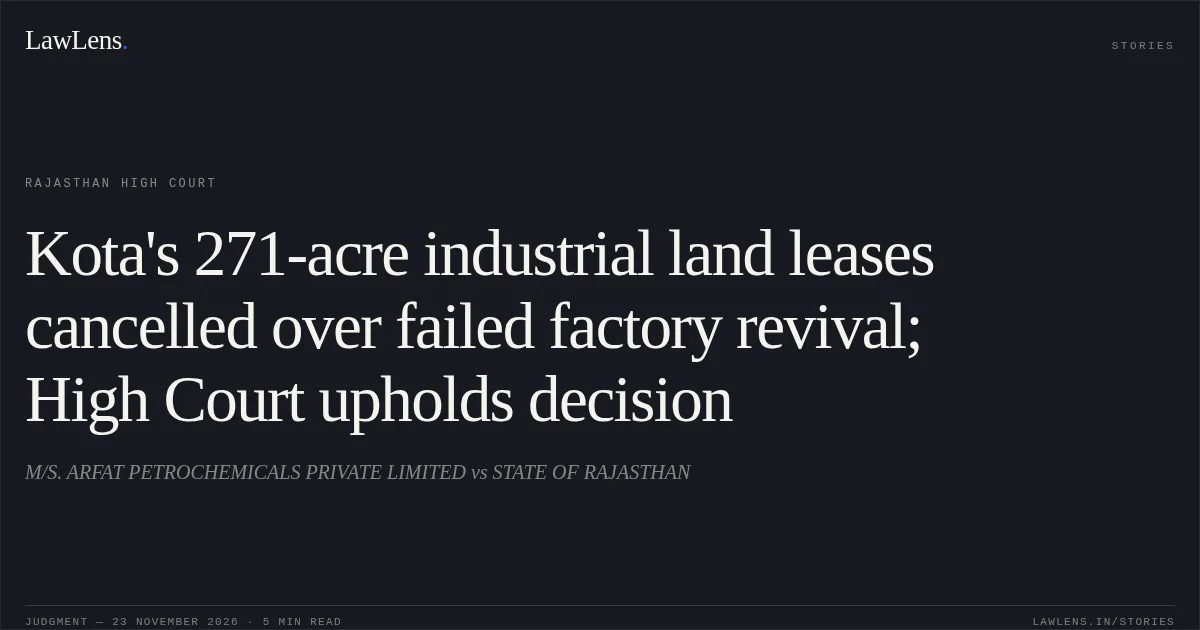
In 1958–1965, the State, through the District Collector, Kota, allotted approximately 271.39 acres in the Large Scale Industrial Area, Kota (LIA, Kota) to JK Synthetics Ltd. (JKSL) under the Rajasthan Industrial Areas Allotment Rules, 1959 ("1959 Rules").
¶ 4JKSL was declared sick by BIFR in 1998.
¶ 5Under a 2001 MoU and tripartite labour settlements of 2002, the appellant company (APPL) undertook to take over the Kota unit, revive the plants, and re-employ workers, with dues of approximately Rs. 40.42 crores to be settled.
¶ 6–8The AAIFR sanctioned the rehabilitation scheme on 23.01.2003 (finalised 07.01.2005).
¶ 9On 17.03.2007, the Collector executed seven lease deeds in favour of APPL covering the seven plots, each with the object of reviving a specific industrial plant.
¶ 10The lease deeds prohibited non-industrial use.
¶ 11Only one unit (acrylic fibre) was recommenced; it suffered a fire in October 2007, and the other six units remained dormant.
¶ 13Subsequent proposals for affordable housing, a denim unit, and conversion to commercial use were either not approved or were withdrawn after a change in government in 2019, following RIICO's approvals of 2018.
¶ 14–15The Supreme Court in Bishwambhar Prasad v. M/s Arafat Petrochemicals Pvt. Ltd. (20.04.2023) upheld the cancellation of the supplementary leases, held that RIICO lacked authority, and, by para. 106, permitted APPL to re-approach the State for conversion.
¶ 16–17APPL's tourism-based conversion proposal (24.05.2023) was rejected by the Collector on 07.03.2025.
¶ 18Show-cause notices dated 16.06.2025 and 17.06.2025 were issued with seven days to reply; APPL replied on 23.06.2025.
¶ 19The Collector was transferred, and his successor passed orders cancelling all seven lease deeds on 24.06.2025.
¶ 19 · ¶ 58, 62.5.1The writ petition was dismissed by the learned Single Judge on 28.09.2026.
¶ 2002Issues
i.1. Whether para. 106 of Bishwambhar Prasad conferred any vested or enforceable right on APPL to seek conversion of the leased land, or merely a liberty to re-approach the State Government.
¶ 64–65ii.2. Whether APPL's tourism conversion application was legally permissible and merited consideration under the 1959 Rules.
¶ 66–68iii.3. Whether, independently of its rejection, cancellation of the seven lease deeds was justified for failure to revive the units, fulfil rehabilitation obligations, and comply with the lease conditions.
¶ 66–68iv.Ancillary questions addressed within the discussion: competence of the Collector; natural justice; legitimate expectation and promissory estoppel; fraud; and public trust.
¶ 62.3 · ¶ 62.5 · ¶ 62.6 · ¶ 62.7 · ¶ 62.803Law Applied
The leases are treated as statutory Government grants governed by Rules 8 and 9 of the 1959 Rules, read with Section 100 of the Rajasthan Land Revenue Act, 1956. Rule 8 bars use of industrial land for any purpose other than the permitted industry and expressly bars tourism units on government allotments, while Rule 9 limits the lessee's rights.
¶ 55.2–55.3 · ¶ 62.1Clause 5(viii) of the lease deeds provides for reversion on breach, and the grantor may resume possession under the grant.
¶ 62.1.1Following Tata Steel Ltd. v. State of Jharkhand and Union of India v. Sir Sobha Singh & Sons, the authority that grants also has the power to resume the grant for breach; the principle of qui approbat non reprobat bars the lessee from challenging the Collector's authority.
¶ 62.3–62.3.1Hajee S.V.M. Mohamed Jamaludeen classifies such allotments as "grants".
¶ 62.4Under Piaggio Vehicles Pvt. Ltd. v. State of U.P., allottees of concessional industrial land are bound by lease covenants, and prolonged non-compliance disentitles them to equitable relief.
¶ 59 · ¶ 62.4.3Natural justice requires a hearing before reversion, but there is no inflexible time period, and the test is whether the opportunity was meaningful and the material actually considered (State of U.P. v. Sudhir Kumar Singh; A.S. Motors; Pimpri Chinchwad Municipal Corp.).
¶ 62.5–62.5.2Legitimate expectation and promissory estoppel cannot compel continuation of an arrangement contrary to statute or public interest, and illegality is not to be perpetuated (M.S. Sanjay v. Indian Bank).
¶ 62.6Fraud may be inferred from cumulative conduct, and fraud vitiates all solemn acts (S.P. Chengalvaraya Naidu v. Jagannath; Meghmala v. G. Narasimha Reddy).
¶ 60 · ¶ 62.7–62.7.2Land held under public trust may not be diverted to private ends (M.C. Mehta v. Kamal Nath).
¶ 62.8Bishwambhar Prasad binds the parties on the industrial character of the land, the State's exclusive authority over land-use change, and the absence of any legitimate expectation from unauthorised permissions, but it does not decide the validity of the 2007 leases or their cancellation, and para. 106 confers no right to conversion.
¶ 57 · ¶ 62.2–62.2.1Provisions in the judgment · 1 · Linked ones open on LawLens
RAJASTHAN LAND REVENUE ACT, 1956 Section 100
04Reasoning
On Issue 1, the Court held that para. 106 merely permitted APPL to re-approach the State. It created no enforceable right to conversion, did not oblige the State to accept the proposal, and gave no immunity from action for breach of existing lease conditions. Rejection of the proposal on 07.03.2025 was therefore within the liberty granted.
¶ 64–65 · ¶ 62.2.1On Issue 2, the Court distinguished two actions. The rejection of the tourism proposal was consistent with Rule 8, the MoA, and the public interest. The cancellation rested on a separate ground: the failure to fulfil the purpose of the transfer, namely reviving seven units and rehabilitating workmen.
¶ 67–68The Court found that six of the seven plants were never revived, the revived unit was closed after a fire, the labour dues were not fully settled, and later applications (Jan Awas Yojana, denim, tourism) were attempts to deviate from the permitted industrial use. Commercial unviability did not extinguish the industrial character of the land.
¶ 62.4.1–62.4.2 · ¶ 62.4.3On procedure, the Court held that separate show-cause notices were issued, a detailed reply was filed, and the successor Collector had the full record. The 20-page reasoned order therefore did not render the hearing illusory.
¶ 62.5.1–62.5.2The Court also found fraud in the cumulative course of conduct: representations of revival and re-employment were used to obtain the AAIFR approval and the leases, and were followed by abandonment and attempted misuse.
¶ 60 · ¶ 62.7–62.7.1The appellant could not rely on expenditure, earlier RIICO permissions, or legitimate expectation to resist cancellation.
¶ 62.605Holding
Issue 1 is answered in the negative: para. 106 of Bishwambhar Prasad conferred only a liberty to apply and no vested right to conversion.
¶ 65Issue 2 is answered as follows: the tourism proposal was rightly rejected under the 1959 Rules, and the cancellation of the seven lease deeds was valid. The leases were statutory grants validly cancelled by the District Collector for breach of their conditions, and the land reverted to the lessor under Clause 5(viii). Natural justice was complied with, fraud was established, and the appellant has no enforceable right, legitimate expectation, or promissory estoppel to retain the land.
¶ 68 · ¶ 69The appeals were dismissed, and the judgment of the learned Single Judge dated 28.09.2026 and the Collector's orders dated 24.06.2025 were affirmed. The judgment applies mutatis mutandis to the connected appeal.
¶ 70 · ¶ 1 · ¶ 71Original Court PDF
M/S. ARFAT PETROCHEMICALS PRIVATE LIMITEDvsSTATE OF RAJASTHAN
Click to open original judgment
Original judgment, available to read, download and summarize on LawLens.in