01Facts
On 14.01.2015, respondent No. 2 lodged a report at P.S. Bagdi Nagar, Pali, alleging that his brother's wife, petitioner No. 1 (Asha), repeatedly left the matrimonial home for her parental house at the instance of her parents, including petitioner No. 2 (Pushpa Devi).
¶ 2 · p. 2It was alleged that the petitioners humiliated the deceased, made unreasonable demands, caused mental harassment, and threatened him, and that petitioner No. 1 had undergone abortions. The deceased allegedly committed suicide by hanging due to mental stress.
¶ 2 · p. 2An FIR was registered under Section 306 IPC.
p. 3During investigation, only a photocopy of an alleged suicide note was recovered; the original was not found.
¶ 2 · p. 3The charge-sheet was filed against the petitioners alone. Suja Ram and Nisha were not found involved, although named in the note.
¶ 2 · p. 3The Additional Sessions Judge, Sojat, framed charge under Section 306 IPC by order dated 27.06.2017 in Sessions Case No. 10/2016. The petitioners challenged that order in revision.
¶ 2 · p. 302Issues
i.1. Whether a photocopy of an alleged suicide note, with no verified authorship and no original recovered, can be relied upon to fasten liability under Section 306 IPC.
¶ 5 · p. 4ii.2. Whether the material on record, taken at its highest, discloses the ingredients of abetment under Section 107 IPC so as to sustain a charge under Section 306 IPC at the framing stage.
¶ 4, 6, 10–11 · pp. 3–5, 803Law Applied
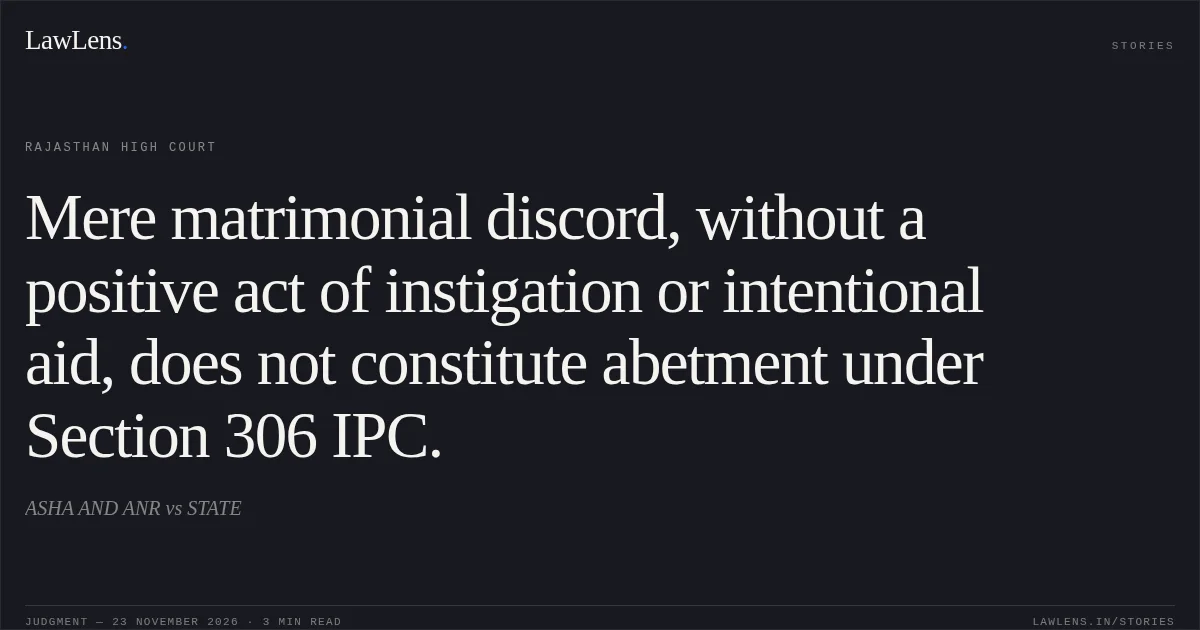
The Court applied Sections 107 and 306 IPC, under which abetment requires instigation, conspiracy with an act or illegal omission, or intentional aid, together with mens rea and a proximate nexus to the act of suicide. Mere matrimonial discord, emotional distress, or strained relations do not suffice.
¶ 4 · p. 3The Court relied on Amalendu Pal @ Jhantu v. State of West Bengal, (2010) 1 SCC 707, which holds that harassment without a positive act of instigation or aid does not amount to abetment, and that a proximate and live link is essential.
¶ 8 · p. 6The Court relied on Madan Mohan Sharma v. State of Rajasthan, S.B. Crl. Rev. No. 733/2012 (decided 11.07.2025), which requires that the foundational ingredients emerge from investigation material at the charge stage and that the accused not be put to trial in their absence.
¶ 9 · p. 7At the framing stage, the Court must sift material to see whether basic ingredients are disclosed, without a meticulous appreciation of evidence or mini-trial.
¶ 10 · p. 7Provisions in the judgment · 2 · Linked ones open on LawLens
Indian Penal Code, 1860 Section 306Section 107
04Reasoning
The Court first found the suicide note unreliable. The charge-sheet itself recorded that only a photocopy was recovered, that it was not sent to the FSL, and that no handwriting opinion or verified specimen was obtained. Its authorship therefore remained unverified and it could not anchor criminal liability.
¶ 5 · p. 4Even taking the note at face value, it disclosed no specific act of instigation or intentional aid. The investigation did not substantiate the abortion allegation, the additional demands, or the threats, and the neighbours' statements did not corroborate sustained harassment.
¶ 6 · p. 5The investigating agency did not find the involvement of the other named persons, which weighed against attributing abetment to the petitioners merely because they were named.
¶ 7 · p. 5Matrimonial discord, even if established, did not constitute abetment. The deceased had lawful alternatives such as separation or legal remedies, and suicide alone cannot prove abetment.
¶ 7 · p. 6Applying Amalendu Pal and Madan Mohan Sharma, the Court found the absence of any positive or deliberate act, so the essential element of instigation or intentional aid was "conspicuously absent" even on the prosecution's own material.
¶ 8–10 · pp. 6–8Continuing the trial would therefore serve no useful purpose.
¶ 11 · p. 805Holding
Both issues are answered against the prosecution. The unverified photocopy of the suicide note cannot ground liability, and the material, taken at its highest, does not disclose the ingredients of abetment under Section 107 IPC required for Section 306 IPC.
¶ 5–6, 10–11 · pp. 4–5, 7–8The revision is allowed. The order dated 27.06.2017 in Sessions Case No. 10/2016 is quashed and set aside insofar as it frames charge under Section 306 IPC against the petitioners, who are discharged from that charge.
¶ 12 · pp. 8–9Original Court PDF
ASHA AND ANRvsSTATE
Click to open original judgment
Original judgment, available to read, download and summarize on LawLens.in