01Facts
The appellant was appointed as a Constable in the Rajasthan Police on 09.11.1990 and posted in the office of the SP, Nagaur.
¶ 3He left his post on 19.02.1996 without leave or permission and went to his native place.
¶ 3On 01.03.1996, his brother was allegedly murdered. FIR No. 8/1996 was registered under Section 302 IPC against him, he was arrested on 15.04.1996, and he was charge-sheeted under Sections 302 and 201 IPC.
¶ 4He remained in police and judicial custody and was placed under suspension.
¶ 4He was later acquitted by the trial court, with the benefit of doubt.
¶ 4A departmental inquiry under Rule 16 of the CCA Rules, 1958 framed five charges: (1) unauthorised absence from 19.02.1996 to 03.02.1997; (2) involvement in the murder; (3) arrest and custody; (4) the charge-sheet; and (5) tarnishing the Department's image.
¶ 5The Enquiry Officer held Charge 1 proved and Charge 5 partly proved.
¶ 6The Disciplinary Authority dismissed the appellant on 07.01.1998.
¶ 6The Appellate Authority (DIG, 30.11.1998) and the Reviewing Authority (Governor, 01.12.2001) affirmed the dismissal.
¶ 7The Single Judge dismissed the writ petition on 20.11.2008.
¶ 8Before the Division Bench, the appellant confined his challenge to the quantum of punishment.
¶ 9, 12, 23The Disciplinary Authority's order recorded no finding on Charges 2–4 because of the acquittal.
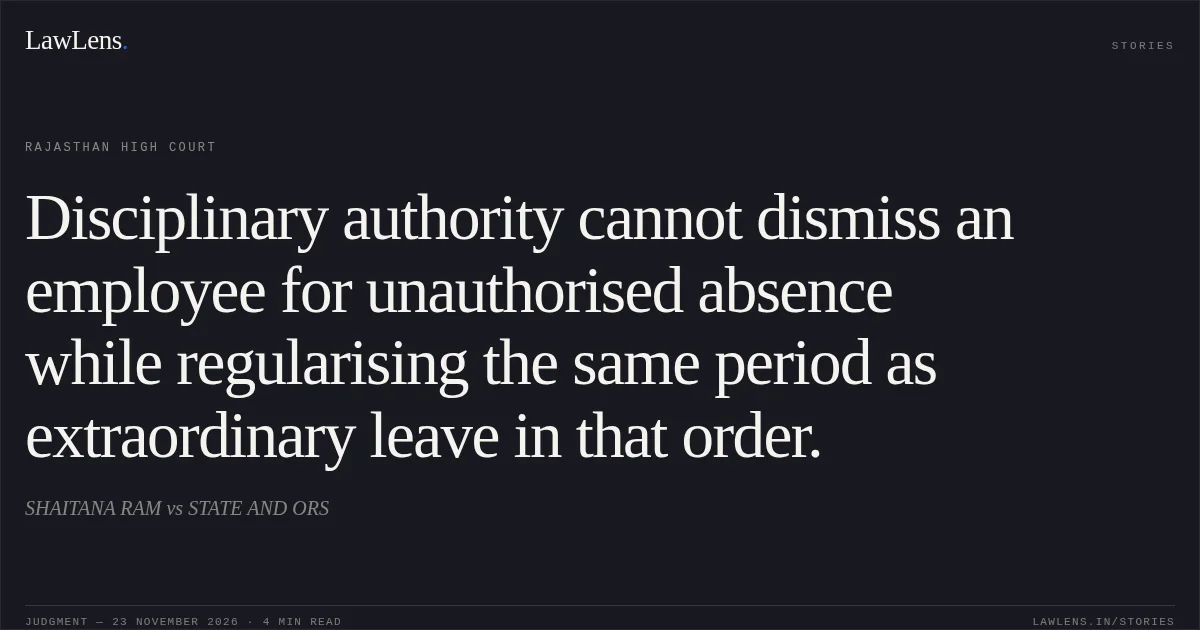
¶ 24The Disciplinary Authority held that absence from 15.04.1996 to 03.02.1997 could not be treated as unauthorised because the appellant was in custody. It treated only 19.02.1996 to 15.04.1996 (56 days) as unauthorised absence, imposed dismissal for it, and in the same order regularised that period as leave without pay.
¶ 2602Issues
i.1. Whether the Disciplinary Authority could, in the same order, dismiss the employee for unauthorised absence while regularising that very period by granting extraordinary leave.
¶ 26–28, 31ii.2. Whether unauthorised absence is necessarily wilful absence, and whether the circumstances beyond the employee's control were properly considered.
¶ 25iii.3. Whether the dismissal order is sustainable and, if not, what relief is appropriate, including whether reinstatement or compensation should be granted.
¶ 32–3803Law Applied
Rule 86 of the Rajasthan Civil Services Rules, 1951 treats absence without leave as wilful absence, and regularises the period by granting leave due or commuting it into extraordinary leave.
¶ 27Rule 96 of the Rajasthan Civil Services Rules, 1951 governs extraordinary leave, which is leave without pay.
¶ 27Rule 20 of the Rajasthan Pension Rules, 1996 provides that extraordinary leave counts towards qualifying service only in specified circumstances.
¶ 27In State of Punjab v. Dr. P.S. Singla (2008), the Supreme Court held that where dismissal or removal is imposed, no consequential order on the absence is needed, but any order regularising the absence does not revoke the punishment.
¶ 29–30In Mithilesh Kumar Pathak v. Union of India, 2026 INSC 1219, the Supreme Court held that unauthorised absence and wilful absence are not synonymous, and that the circumstances, explanation and supporting material must be examined before determining gravity.
¶ 25On relief, the Court relied on O.P. Bhandari (1986) 4 SCC 337.
¶ 35On relief, the Court relied on Jayant Vasantrao Hiwarkar (2017) 11 SCC 244.
¶ 36In Maharashtra SRTC v. Mahadeo Krishna Naik, 2025 INSC 218, the Supreme Court permitted lump-sum compensation in lieu of reinstatement where reinstatement is not feasible.
¶ 34, 37Provisions in the judgment · 2 · Linked ones open on LawLens
Indian Penal Code, 1860 Section 302Section 201
04Reasoning
The Court found the Disciplinary Authority's order internally contradictory, because it regularised the 56-day absence by granting leave without pay, yet dismissed the appellant for that same absence.
¶ 24, 26, 31Under Singla, a dismissal needs no consequential order on absence, but once the authority passes one, it regularises the period, and the same authority cannot both regularise and penalise it ("appropriating and re-probating").
¶ 29–31The authority treated the post-15.04.1996 period as beyond the appellant's control because he was in custody, without assessing whether the earlier 56 days were wilful in light of Mithilesh Kumar Pathak.
¶ 25–26Because the appellant had not raised these grounds before the authorities or the Single Judge, the Court held that they could not be re-examined on that basis, but it still found the dismissal order unsustainable on the record.
¶ 32Although the appellant had served about five years and his past conduct was unsatisfactory, reinstatement was not appropriate after 28 years out of service in a disciplined force.
¶ 33, 38The Court granted lump-sum compensation in lieu of reinstatement, relying on the Supreme Court's approach in Bhandari, Hiwarkar and Mahadeo Krishna Naik.
¶ 34–3805Holding
The dismissal order dated 07.01.1998 is not sustainable, because the Disciplinary Authority could not dismiss the appellant for absence that it had itself regularised by granting leave without pay.
¶ 31–32The Special Appeal is disposed of. The State Government is directed to pay the appellant a lump-sum compensation of ₹20,00,000 within three months of receiving a certified copy of the judgment, failing which 6% per annum interest is payable until actual payment. The appellant is not entitled to reinstatement or consequential service benefits. The stay petition and pending applications are disposed of.
¶ 39–40Original Court PDF
SHAITANA RAMvsSTATE AND ORS
Click to open original judgment
Original judgment, available to read, download and summarize on LawLens.in