01Facts
The appellant-complainant advanced ₹3,00,000 to the respondent-accused on 17.09.2018, repayable after eight months
¶ 3In discharge of that liability, the respondent issued Cheque No. 736392 dated 18.07.2019 for ₹3,00,000, drawn on State Bank of India, Housing Board Branch, Bikaner
¶ 3The cheque was dishonoured on 22.07.2019 with the remark "Opening Balance Insufficient," and the appellant received this information on 23.07.2019
¶ 3A demand notice dated 29.07.2019 was allegedly issued, calling for payment within fifteen days
¶ 3On non-payment, a complaint under Section 138 of the Negotiable Instruments Act, 1881 (NI Act) was filed before the Special Judicial Magistrate (N.I. Act Cases) No. 2, Bikaner
¶ 3By judgment dated 14.05.2024, the trial court acquitted the respondent, principally because the appellant failed to prove that the statutory notice was dispatched to her correct address
¶ 3 · ¶ 5The trial court found that the postal receipt (Ex.P-4) bore the name of one Narayan Chand and an address on Baba Ramdev Road, not the respondent's address at B-6/75, Rajmata Sudarshana Nagar, and that the respondent's name did not appear on it. Consequently, the presumption of service under Section 27 of the General Clauses Act, 1897 could not be drawn
¶ 6The appellant admitted these facts in cross-examination
¶ 9The respondent led no defence evidence
¶ 11Leave to appeal was granted on 10.07.2025
¶ 202Issues
i.1. Whether the trial court erred in acquitting the respondent under Section 138 NI Act on the ground that the statutory demand notice was not proved to have been dispatched to, or served upon, the respondent at her correct address, warranting interference in appeal against acquittal
¶ 1 · ¶ 5 · ¶ 12ii.2. Whether the respondent's failure to lead defence evidence dispenses with the complainant's initial burden to prove the essential ingredients of the offence under Section 138 NI Act
¶ 1103Law Applied
Section 138 NI Act, which makes the service of a statutory demand notice and the drawer's failure to pay within fifteen days essential ingredients of the offence; the notice requirement is not a mere procedural formality but affords the drawer an opportunity to discharge liability and avoid prosecution
¶ 7Section 27 of the General Clauses Act, 1897, under which service by registered post is presumed only where foundational requirements are met, namely proper addressing, prepayment and posting; absent proof of dispatch to the correct address, the presumption cannot be drawn automatically
¶ 8The complainant bears the initial burden of establishing the essential ingredients of the offence, and this burden is not displaced by the respondent's failure to lead defence evidence
¶ 11Provisions in the judgment · 2 · Linked ones open on LawLens
Negotiable Instruments Act, 1881 Section 138
General Clauses Act, 1897 Section 27
04Reasoning
The Court examined the impugned judgment, particularly paras 11 and 12 of that judgment, and found that the trial court had recorded a categorical finding that the postal receipt (Ex.P-4) did not correspond to the respondent's address and bore a third party's name
¶ 6 · ¶ 9Because the appellant's own cross-examination confirmed this discrepancy, the foundational requirement for the Section 27 presumption was unmet
¶ 9The mere exhibition of the demand notice (Ex.P-3) and tracking report (Ex.P-5) did not cure the defect, since there was no reliable proof of dispatch to the correct address
¶ 10Without a valid notice, the fifteen-day period for payment could not be reckoned, so the cause of action under Section 138 was not shown to have arisen
¶ 10The Court held that the respondent's silence in defence does not relieve the complainant of the initial burden to prove the offence's ingredients
¶ 11The Court found no perversity, illegality, or infirmity in the trial court's appreciation of evidence
¶ 1205Holding
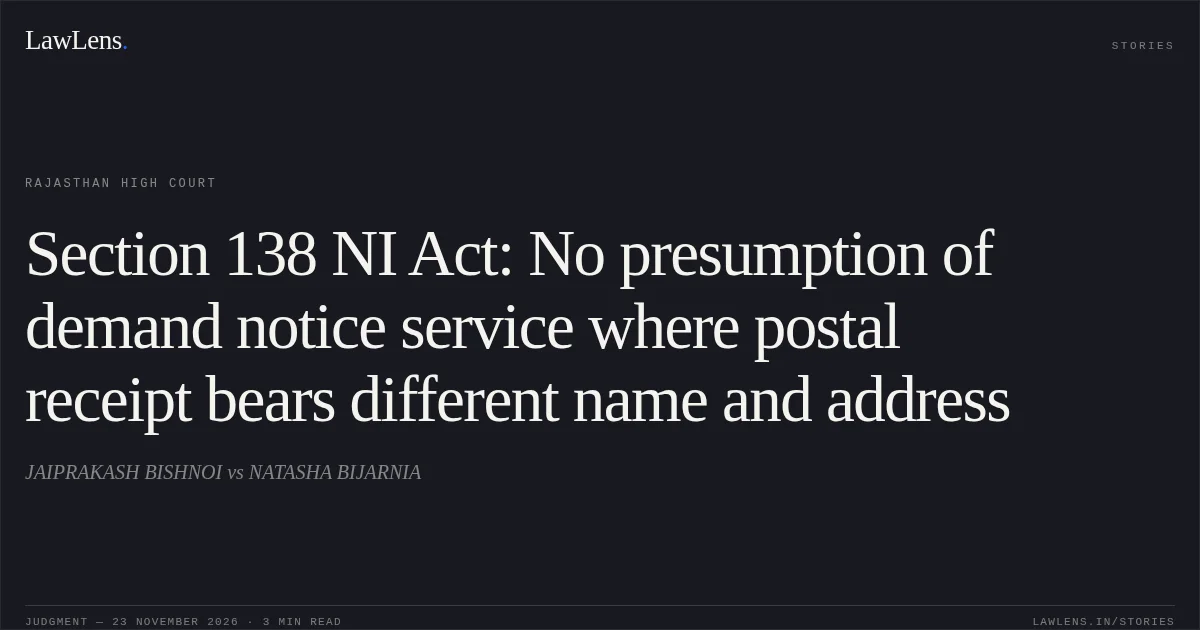
The statutory notice was not proved to have been dispatched to the respondent's correct address, so the Section 27 presumption of service was unavailable and the Section 138 cause of action was not established
¶ 9–10The absence of defence evidence does not discharge the complainant's initial burden
¶ 11The trial court's acquittal was not perverse or illegal and did not warrant appellate interference
¶ 12–13The appeal against acquittal is dismissed, and the trial court record is ordered to be sent back forthwith
¶ 14–15Original Court PDF
JAIPRAKASH BISHNOIvsNATASHA BIJARNIA
Click to open original judgment
Original judgment, available to read, download and summarize on LawLens.in