Facts
M/s Lahoty Buildcon Ltd. filed a composite application under Section 9 of the Arbitration and Conciliation Act, 1996, seeking interim measures based on two agreements dated 9 November 2024 and 20 June 2025, each containing an arbitration clause.
Source reference: paras. 3–7, pp. 3–4Marudhara Primeinfra objected that the agreements concerned separate projects and obligations and could not be combined in one application. It sought rejection of the Section 9 application under Order VII Rule 11 CPC. The Commercial Court dismissed that application as not maintainable but kept the substantive objection to the composite application open for consideration at the final hearing.
Source reference: paras. 3–7, pp. 3–4Marudhara challenged that order under Article 227; Lahoty separately sought expeditious determination of the pending Section 9 application.
Source reference: paras. 2, 37, pp. 3, 16Issues
Whether Order VII Rule 11 CPC could be invoked to reject, at the threshold, an application under Section 9 of the Arbitration and Conciliation Act, 1996, on the ground that it combined claims arising from two allegedly independent agreements.
Source reference: paras. 19, 23–24, pp. 9–10Whether the Commercial Court’s decision to reserve the objection to the composite application for consideration at the final hearing disclosed a jurisdictional error warranting interference under Article 227.
Source reference: paras. 31–34, pp. 13–14Whether the pending Section 9 application should be directed to be decided expeditiously.
Source reference: paras. 37–38, p. 16Law Applied
Section 9 of the Arbitration and Conciliation Act, 1996 empowers a court to grant interim measures in aid of arbitration; an application under that provision is not a suit but an interlocutory proceeding intended to protect the arbitral process (Firm Ashok Traders v. Gurumukh Das Saluja, (2004) 3 SCC 155).
Source reference: paras. 20–21, p. 9Although procedural principles of the CPC may be relevant, its technicalities should not obstruct the exercise of Section 9 jurisdiction (Essar House Pvt. Ltd. v. Arcellor Mittal Nippon Steel India Ltd., (2022) 20 SCC 178).
Source reference: para. 22, p. 10Order VII Rule 11 CPC specifically provides for rejection of a plaint and, absent a statutory basis for its application, does not provide a mechanism to reject a Section 9 application.
Source reference: paras. 24–28, pp. 10–12Whether disputes under separate agreements can be treated together depends on the agreements, their interrelationship, the disputes, and the interim relief sought; Duro Felguera, S.A. v. Gangavaram Port Ltd., (2017) 9 SCC 729, does not resolve that fact-dependent question at the threshold.
Source reference: para. 30, pp. 12–13Article 227 supervisory intervention is warranted only for jurisdictional error, manifest perversity, failure to exercise jurisdiction, or comparable grave injustice.
Source reference: para. 34, p. 14Reasoning
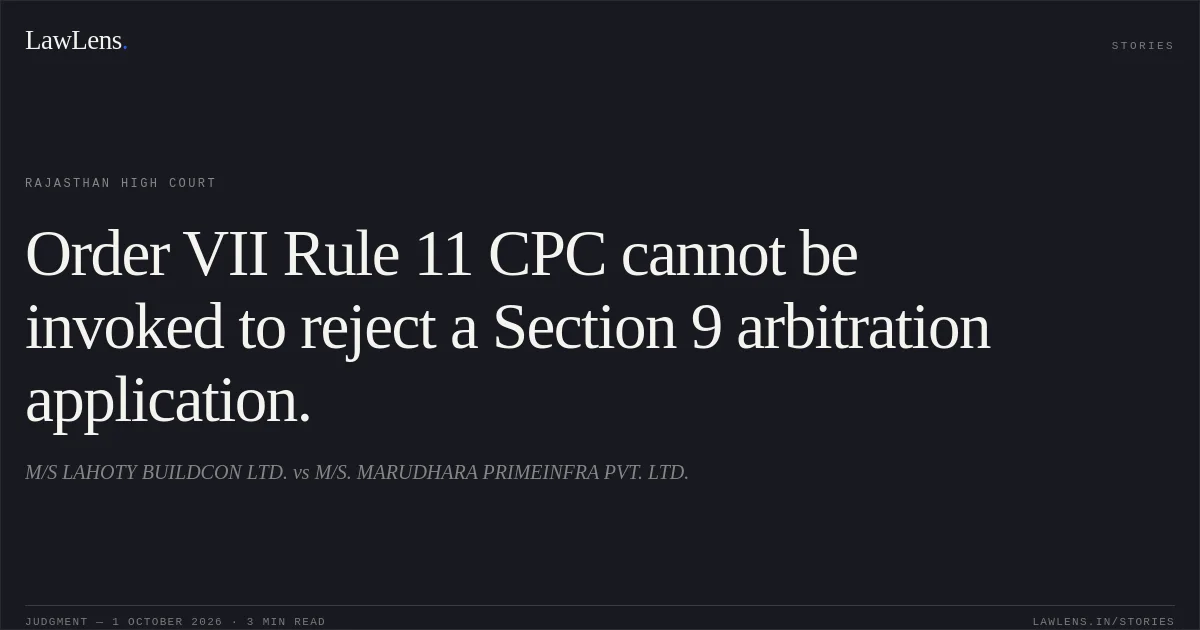
The Court held that a Section 9 application is neither a plaint nor an ordinary civil suit, and therefore Order VII Rule 11 could not be used to compel its rejection at the threshold.
Source reference: paras. 24, 28, pp. 10, 12Marudhara’s objection—that two agreements were independent and required separate proceedings—was not a purely legal question apparent on the face of the application: deciding it could require examination of the agreements, their arbitration clauses, the parties’ obligations, the disputes, and the relief claimed.
Source reference: paras. 30, 33, pp. 12–14Because the Commercial Court had preserved that objection for decision on the merits, it had not denied Marudhara an opportunity to raise it, and its procedural decision disclosed no ground for Article 227 intervention.
Source reference: paras. 31–35, pp. 13–15Given the interim nature of the Section 9 proceeding, the Court also considered an expeditious decision appropriate.
Source reference: para. 38, p. 16Holding
The Court dismissed Marudhara’s writ petition, holding that the Commercial Court was justified in declining to reject the Section 9 application under Order VII Rule 11 CPC.
It expressly left open the objection that the two agreements were independent and that the composite application was consequently not maintainable, directing the Commercial Court to decide that objection on its merits and in accordance with law, uninfluenced by the High Court’s ruling on Order VII Rule 11.
Source reference: paras. 35–36, pp. 14–15The Court disposed of Lahoty’s writ petition by directing the Commercial Court to decide the pending Section 9 application expeditiously, preferably within four months of receiving the judgment.
Source reference: paras. 37–39, p. 16Acts & Sections Cited
3 provisions across 2 statutes referred to in this judgment. Each provision opens on LawLens.
Code of Civil Procedure, 19081
Arbitration and Conciliation Act, 19962
Original Court PDF
M/S LAHOTY BUILDCON LTD.vsM/S. MARUDHARA PRIMEINFRA PVT. LTD.
Click to open original judgment
Original judgment, available to read, download and summarize on LawLens.in