01Facts
The petitioner, a widow, and respondent Nos. 2 to 11 (co-landlords) filed an eviction petition on 27.11.2008 against the tenant, respondent No. 1, in respect of a shop at AMC Property No. 311/15, Purani Mandi, Ajmer.
The petitioner pleaded bona fide need to start her own cosmetic business to support herself and her two sons after her husband's death.
¶ 2The tenant denied the need and asserted that the landlords held several alternative commercial premises and were already running other businesses.
¶ 3After recording oral and documentary evidence, including the petitioner's testimony as PW-1 and the tenant's testimony as DW-1, the Rent Tribunal, Ajmer, on 31.05.2018 held the need bona fide, finding the alternative properties were held by or used by other family members and the demised premises more suitable.
¶ 4In Rent Appeal No. 67/2018, the tenant produced additional documents under Order 41 Rule 27 CPC, including sale deeds, relinquishment deeds and photographs. The Appellate Rent Tribunal admitted them, held that the petitioner belonged to a joint Hindu family with unpartitioned jointly purchased properties, noted she already ran a business from 'Nakhrali', treated the need as a "mere desire", and on 03.08.2021 allowed the appeal and dismissed the eviction petition.
¶ 5The petitioner challenged this under Article 227 of the Constitution. The tenant objected that the writ was not maintainable because the other co-landlords had accepted the decision.
¶ 602Issues
i.1. Whether a writ petition under Article 227 is maintainable by one co-landlord when the other co-landlords have accepted the appellate judgment.
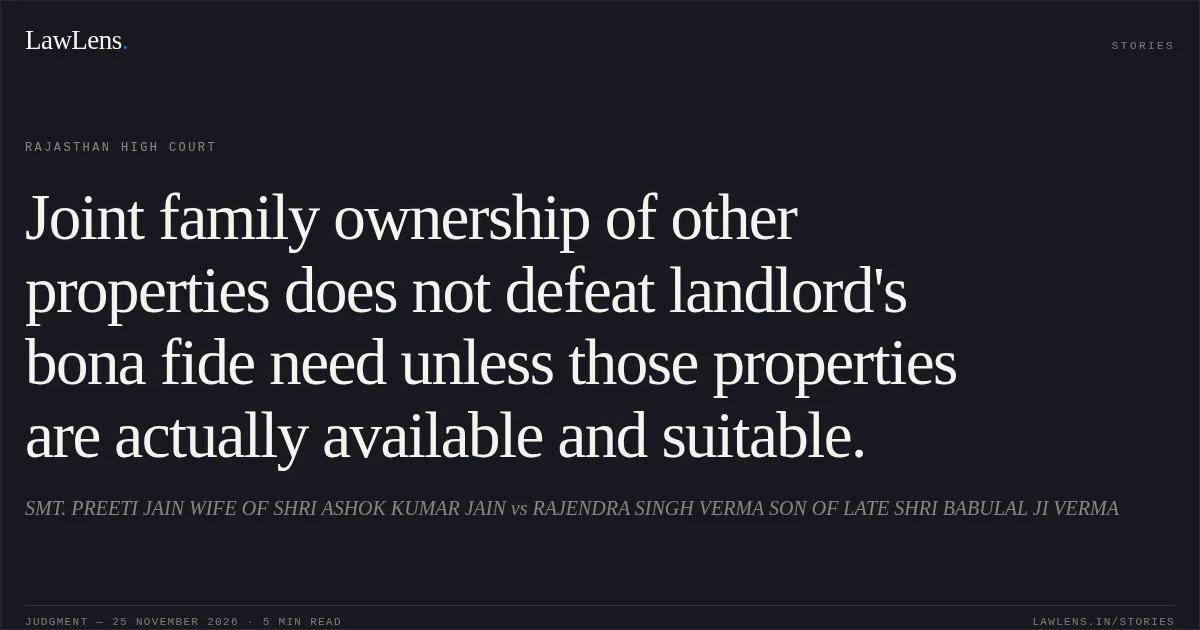
¶ 6 · ¶ 32ii.2. Whether the Appellate Rent Tribunal erred in holding that the petitioner's requirement was a mere desire, merely because jointly owned properties and her existing business at 'Nakhrali' were available.
¶ 13 · ¶ 20 · ¶ 21 · ¶ 29iii.3. Whether the absence of partition among the joint family precludes an individual co-owner-landlord from seeking eviction.
¶ 25iv.4. Whether the impugned judgment warrants interference under Article 227 of the Constitution.
¶ 34 · ¶ 3503Law Applied
Section 9(i) of the Rajasthan Rent Control Act, 2001 permits eviction where premises are "required reasonably and bonafide by the landlord" for his or his family's use or occupation, or for any person for whose benefit they are held.
¶ 22Under Shiv Sarup Gupta v. Dr. Mahesh Chand Gupta (1999) 6 SCC 222, need is tested objectively, and an alternative accommodation defeats the claim only if it is reasonably suitable and actually available.
¶ 14Sarla Ahuja v. United India Insurance (1998) 8 SCC 119, Akhileshwar Kumar v. Mustaqim (2003) 1 SCC 462 and Uday Shankar Upadhyay v. Naveen Maheshwari (2010) 1 SCC 503 hold that the landlord is the best judge of his requirement and the choice of premises, and the tenant cannot dictate it.
¶ 15 · ¶ 16 · ¶ 17Anil Bajaj v. Vinod Ahuja (2014) 15 SCC 610 holds that ownership of other premises does not foreclose eviction if the landlord genuinely intends to use the tenanted premises.
¶ 18Mohd. Ayub v. Mukesh Chand (2012) 2 SCC 155 holds that the need need not be dire necessity.
¶ 19Joginder Pal v. Naval Kishore Behal (2002) 5 SCC 397 and Dwarkaprasad v. Niranjan (2003) 4 SCC 549 give "his own" a liberal meaning covering dependant family members and the landlord's obligation to settle them in business.
¶ 23 · ¶ 24India Umbrella Manufacturing v. Bhagabandei Agarwalla (2004) 3 SCC 178 and Sri Ram Pasricha v. Jagannath (1976) 4 SCC 184 recognise a co-owner's right to maintain eviction proceedings.
¶ 25On Article 227, Shalini Shyam Shetty (2010) 8 SCC 329, Garment Craft (2022) 4 SCC 181, Ranjeet Singh (2004) 3 SCC 682 and Nandi Infrastructure (2026) 4 SCC 235 confine the High Court to supervisory review, not reappreciation of evidence, but permit interference where the tribunal misdirects itself on law or records perverse findings.
¶ 34Provisions in the judgment · 3 · Linked ones open on LawLens
rajasthan rent control act, 2001 Section 9Section 13Section 14
04Reasoning
The Court held the preliminary objection untenable. The petitioner was an original landlord, the petition was jointly instituted, and the requirement pleaded was specifically hers, so she had standing to challenge the rejection.
¶ 32On the merits, the Court held that the Appellate Tribunal erred by treating joint ownership as proof of availability. Ownership and actual availability are distinct, and the Tribunal did not examine whether the properties were vacant, in the petitioner's exclusive control, or suitable for a cosmetic business.
¶ 21 · ¶ 22 · ¶ 29The Court also held that absence of partition cannot defeat an individual co-landlord's claim, since co-owners may sue for eviction.
¶ 25Her existing business at 'Nakhrali' did not disprove the genuine need for another venue, and the Tribunal recorded no cogent finding that the proposed business was fictitious.
¶ 26The size comparison (4×4 sq. ft. versus larger showrooms) was rejected because location, accessibility and commercial suitability are relevant, and the Rent Tribunal had found the Purani Mandi main-market shop more suitable.
¶ 27The Court accepted that a mere desire is not a bona fide necessity, but found the petitioner's pleaded intent, her testimony, her circumstances as a widow supporting two sons, and the favourable admissions of DW-1 and DW-2 supported a genuine requirement, with no material contradiction shown in her evidence.
¶ 26 · ¶ 28Under Anil Bajaj and Akhileshwar Kumar, the choice of premises rested with the landlord.
¶ 30The tenant's occupation for over sixty years did not create an indefeasible right to retain possession.
¶ 33The Court distinguished Ranjeet Singh, Maqboolunnisa and Ram Prakash on the facts.
¶ 31Although the Court reiterated that Article 227 is not an appellate remedy, it held that the Appellate Tribunal's findings were perverse and based on a misapplication of settled principles, which justified interference.
¶ 34 · ¶ 3505Holding
The writ petition is maintainable, and the petitioner, as an original co-landlord who pleaded her own requirement, is competent to challenge the rejection of her claim.
¶ 32The Appellate Rent Tribunal's judgment dated 03.08.2021 in Rent Appeal No. 67/2018 is quashed and set aside, and the Rent Tribunal's judgment dated 31.05.2018 in Eviction Petition No. 441/2012 (179/2008) is restored.
¶ 36The tenant must hand over vacant and peaceful possession of the demised premises to the petitioner.
¶ 37The petitioner remains bound by the proviso to Section 9(i) of the Rajasthan Rent Control Act, 2001, which restricts re-letting within the prescribed period, and the tenant may invoke that remedy if it is breached. Pending applications stand disposed of.
¶ 38 · ¶ 39Original Court PDF
SMT. PREETI JAIN WIFE OF SHRI ASHOK KUMAR JAINvsRAJENDRA SINGH VERMA SON OF LATE SHRI BABULAL JI VERMA
Click to open original judgment
Original judgment, available to read, download and summarize on LawLens.in