Facts
The appellant-plaintiff, Goma Devi, executed a registered sale deed dated 16 April 2009 in favour of the respondents in respect of the disputed agricultural land for a stated consideration of ₹24,00,000.
Source reference: paras. 12–14The sale deed recited that the entire consideration had been paid through cheques, possession had been delivered to the purchasers, and the purchasers were authorised to have their names entered in the revenue records.
Source reference: paras. 12–14The plaintiff subsequently alleged that the respondents had obtained the sale deed by fraud and had not paid the sale consideration because the cheques were stopped or dishonoured.
Source reference: paras. 1–2The trial court dismissed the plaintiff’s claims for declaration, cancellation and injunction, while directing the defendants to deposit ₹24,00,000 with 4% interest from 16 May 2009 until the date of judgment, leaving the plaintiff entitled to withdraw the amount in accordance with law.
Source reference: para. 1Issues
Whether non-payment or alleged non-realisation of the sale consideration rendered the registered sale deed dated 16 April 2009 void, ineffective or liable to be cancelled.
Source reference: paras. 15, 20–22Whether the plaintiff proved that the sale deed had been procured by fraud, misrepresentation or without her free consent so as to justify declaratory and injunctive relief.
Source reference: paras. 2, 17–19Whether the plaintiff was entitled to cancellation of the sale deed rather than a remedy for recovery of any unpaid sale consideration.
Source reference: paras. 20–23Whether the trial court’s findings against the plaintiff on the relevant issues suffered from any legal or evidentiary error warranting appellate interference.
Source reference: paras. 11, 24–25Law Applied
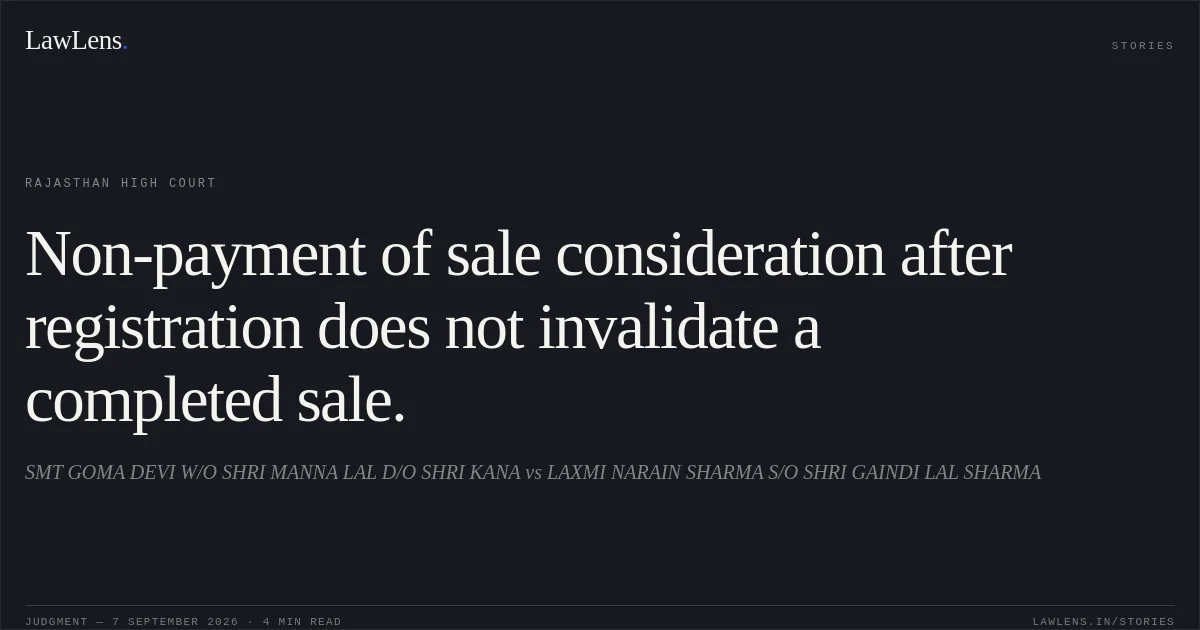
The Court primarily applied Section 54 of the Transfer of Property Act, 1882, which defines a sale as a transfer of ownership in exchange for a price “paid or promised or part-paid and part-promised”; therefore, payment of the entire consideration at the time of execution is not a condition precedent to completion of a registered sale.
Source reference: paras. 20–21Under the principles stated in Vidhyadhar v. Manikrao, (1999) 3 SCC 573, Kaliaperumal v. Rajagopal, (2009) 4 SCC 193, and Dahiben v. Arvindbhai Kalyanji Bhanusali, (2020) 7 SCC 366, non-payment of the balance consideration ordinarily does not invalidate a completed sale where the parties intended title to pass; the vendor’s remedy is to recover the unpaid consideration.
Source reference: paras. 20–22The vendor may also have a charge for the unpaid price under Section 55(4)(b) of the Transfer of Property Act.
Source reference: paras. 20–22The parties’ intention is to be gathered from the recitals of the sale deed, their conduct, delivery of possession and the evidence on record.
Source reference: para. 20Reasoning
The Court found that the registered sale deed expressly recorded payment of the consideration, delivery of possession and transfer of ownership.
Source reference: paras. 12–14The plaintiff had not pleaded that the sale deed was fabricated or that her signatures or execution were denied; rather, the admitted case was that the deed had been executed between the parties.
Source reference: paras. 12–14The evidence further showed that possession had been handed over, the defendants’ names had been entered in the revenue records, and at least substantial amounts had been received by or on behalf of the plaintiff.
Source reference: paras. 18–19, 23The subsequent stopping or dishonour of cheques, even if established, could at most give rise to a claim for recovery of the unpaid consideration and could not, by itself, undo the completed transfer of title under Section 54.
Source reference: paras. 20–23The allegation of fraud was also not substantiated.
Source reference: paras. 16–17The defendants had issued notices after learning of the plaintiff’s prior transaction with Laxmi Narain, and their conduct in notifying the bank and asserting the existence of a dispute was inconsistent with a finding of fraudulent non-payment.
Source reference: paras. 16–17The Court therefore held that the trial court had properly evaluated the oral and documentary evidence and committed no legal error in rejecting the claims for cancellation and injunction.
Source reference: para. 24Holding
The High Court answered the core issues against the plaintiff.
It held that the registered sale deed dated 16 April 2009 was valid and effective, and that alleged non-payment or non-realisation of part of the sale consideration did not justify its cancellation.
Source reference: paras. 20–23The plaintiff’s remedy, if any, was to recover the unpaid consideration, not to seek invalidation of the sale deed.
Source reference: paras. 20–23The appeal was dismissed as meritless, and the trial court’s judgment and decree dated 8 February 2019 were affirmed.
Source reference: para. 25The parties were directed to bear their own costs.
Source reference: para. 25The Court clarified that its observations would not affect the merits of the pending proceedings under Section 138 of the Negotiable Instruments Act or the separate civil proceedings between the parties, which were to be decided independently on their own evidence.
Source reference: para. 28Acts & Sections Cited
2 provisions across 1 statute referred to in this judgment. Each provision opens on LawLens.
Transfer of Property Act, 18822
Original Court PDF
SMT GOMA DEVI W/O SHRI MANNA LAL D/O SHRI KANAvsLAXMI NARAIN SHARMA S/O SHRI GAINDI LAL SHARMA
Click to open original judgment
Original judgment, available to read, download and summarize on LawLens.in