Facts
The prosecution alleged that on 19.10.1995, the informant (PW-7) found the accused's cattle grazing in his field. Upon protesting, the accused persons allegedly assaulted the informant and his brother, Paras Singh (deceased).
Source reference: para. 3It was alleged that the appellant (Dumar Bin) inflicted a fatal spear blow to Paras Singh's abdomen.
Source reference: para. 3The Trial Court convicted the appellant under Section 302 IPC, sentencing him to life imprisonment, while eight co-accused were acquitted.
Source reference: para. 2, 11The appellant challenged this on the grounds that the informant (PW-7) and all independent witnesses turned hostile, leaving the conviction based solely on the uncorroborated testimony of the deceased's son (PW-8).
Source reference: para. 9-10Issues
1. Whether the prosecution established the guilt of the appellant beyond reasonable doubt given that the informant and independent witnesses turned hostile.
Source reference: para. 392. Whether the testimony of PW-8 (son of the deceased) qualifies as "sterling witness" evidence sufficient to sustain a conviction without corroboration.
Source reference: para. 403. Whether the non-examination of the Investigating Officer (I.O.) caused material prejudice to the defense.
Source reference: para. 41Law Applied
Section 302 of the IPC regarding murder.
Source reference: para. 2Rai Sandeep @ Deepu v. State (NCT of Delhi), which defined a "sterling witness" as one of very high quality whose version is unassailable and consistent.
Source reference: para. 14, 21The principle from Vadivelu Thevar v. State of Madras that a court may convict on the testimony of a solitary witness if they are "wholly reliable".
Source reference: para. 15, 16The doctrine of the "presumption of innocence" and the "benefit of doubt" as established in Kali Ram v. State of Himachal Pradesh, asserting that if two views are possible, the one favorable to the accused must be adopted.
Source reference: para. 43Reasoning
The Court found that the prosecution case rested entirely on PW-8, as the informant (PW-7) and other eye-witnesses (PW-1, PW-4) turned hostile and failed to identify the assailants.
Source reference: para. 39-40The Court determined that PW-8 could not be considered a "sterling witness" because his testimony contained material contradictions, particularly regarding his arrival at the scene—stating in cross-examination that he arrived after the assault was complete and did not see the weapon.
Source reference: para. 36, 40The non-examination of the I.O. was found to have caused serious prejudice as it prevented the defense from proving contradictions under Section 161 CrPC and hindered the verification of the place of occurrence.
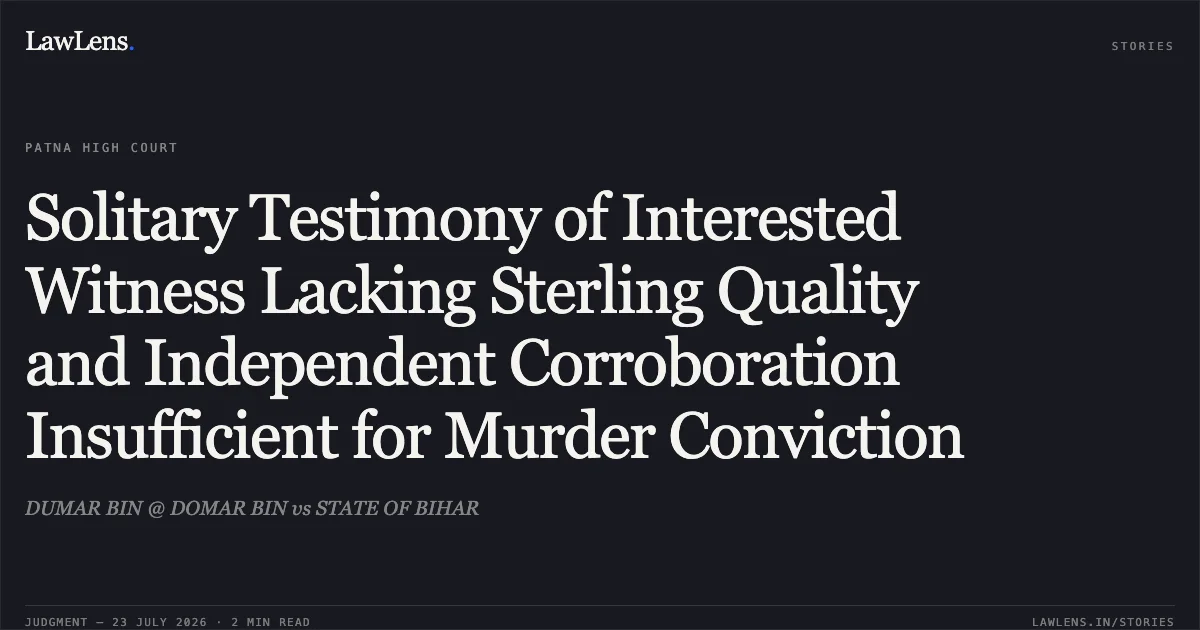
Source reference: para. 41Since the sole witness was an "interested witness" (the son) and his testimony was not of "sterling quality," the Court held the evidence failed to meet the standard of proof "beyond reasonable doubt".
Source reference: para. 42-44Holding
The Court answered the issues in the negative, holding that the prosecution failed to prove its case beyond reasonable doubt.
The High Court set aside the Judgment of Conviction dated 15.09.2000 and the Order of Sentence dated 16.09.2000; the appellant was acquitted of the charges under Section 302 IPC and discharged from his bail bonds.
Source reference: para. 45The Registry was directed to return the Lower Court Records.
Source reference: para. 47Acts & Sections Cited
10 provisions across 2 statutes referred to in this judgment. Each provision opens on LawLens.
Indian Penal Code, 18607
Code of Criminal Procedure, 19733
Original Court PDF
DUMAR BIN @ DOMAR BINvsSTATE OF BIHAR
Click to open original judgment
Original judgment, available to read, download and summarize on LawLens.in