01Facts
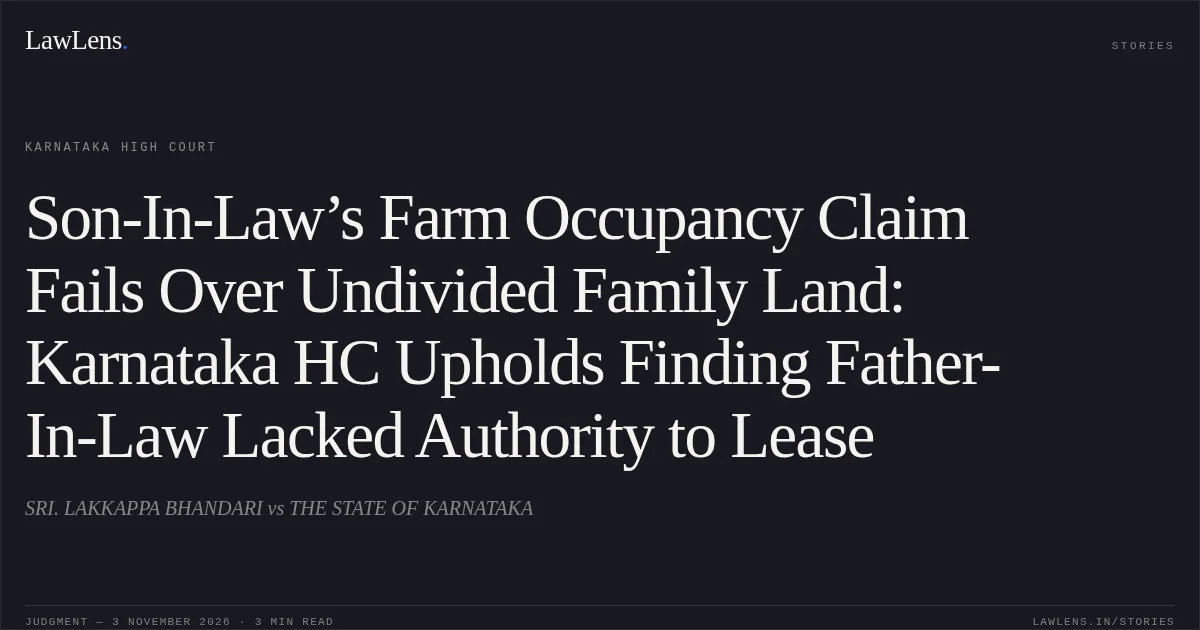
Late M. Lakkappa Bhandari claimed to be a tenant under his father-in-law, Sankappa Rai, and sought occupancy rights over the scheduled lands by filing Form No. 7. The Land Tribunal initially granted the claim in 1981, but those orders were set aside and the matter remanded.
¶ 3–4, 9–12On fresh consideration, the Tribunal rejected the claim in 2004, finding that the alleged lease was not lawfully created because the lands were joint-family properties governed by the Madras Aliya Santhana law and Sankappa Rai lacked authority to lease them. The Single Judge dismissed the petition challenging that decision. The claimants appealed.
¶ 3–4, 9–1202Issues
i.1. Whether the appellants established a legally valid tenancy entitling the original claimant to occupancy rights under the Karnataka Land Reforms Act, 1961.
¶ 15 · ¶ 16–23ii.2. Whether the Tribunal’s order was invalid because a member who had heard the matter did not sign it, having regard to Rules 16 and 17(8) of the Karnataka Land Reforms Rules, 1974.
¶ 25–2803Law Applied
Under Sections 44 and 48A of the Karnataka Land Reforms Act, 1961, statutory vesting and registration as an occupant require the claimant to establish a tenancy recognised by law on the relevant date; possession or production of a lease document alone does not establish that entitlement.
¶ 22Section 2(12) defines “family” for the purposes of that Act, but a person’s exclusion from that definition does not itself establish a tenancy or resolve whether the lessor had authority to grant one.
¶ 18–19, 23Rule 17(8) requires an order to be signed by the Chairman and the other members who heard the case, while Rule 16 prescribes a quorum of three members, including the Chairman; the provisions must be read together in light of the circumstances in which the order was signed and pronounced.
¶ 25–28The Court considered Kalyanamma v. State of Karnataka, 1980 (1) KLJ 34, and Vijaya Bank v. Secretary to Government of Karnataka, Revenue Department, ILR 2008 Kar. 1481, and upheld the Single Judge’s distinction of those authorities on the facts.
¶ 11, 28Provisions in the judgment · 3 · Linked ones open on LawLens
KARNATAKA HIGH COURT ACT, 1961 Section 4
KARNATAKA LAND REFORMS ACT, 1961 Section 2Section 44
04Reasoning
The Court held that the claimant’s status as Sankappa Rai’s son-in-law did not, by itself, bar a tenancy; the decisive question was whether Sankappa Rai had authority to create one. The Tribunal had found that the lands were joint-family properties, that Sankappa Rai had only a maintenance right and no exclusive interest, and that the properties had not been divided by metes and bounds.
¶ 20–24, 29–30In that context, the lease documents and rent receipts did not establish a legally valid tenancy, and the earlier grant of occupancy rights could not assist the appellants because it had been set aside.
¶ 20–24, 29–30On procedure, the Court accepted the finding that the order was signed and pronounced when the prescribed quorum was present, and that the absent member had not expressed an opinion; the appellants therefore failed to show that the omission invalidated the order under Rules 16 and 17(8).
¶ 26–28, 3005Holding
The Court answered the appeal against the appellants, finding no ground to interfere with the Single Judge’s decision.
¶ 31–32It dismissed the writ appeal and affirmed both the Single Judge’s order dated 11 January 2016 and the Land Tribunal’s order dated 30 January 2004 rejecting the occupancy-rights claim.
¶ 31–32Original Court PDF
SRI. LAKKAPPA BHANDARIvsTHE STATE OF KARNATAKA
Click to open original judgment
Original judgment, available to read, download and summarize on LawLens.in