Facts
The third Petitioner-Company and the Respondent entered into a transaction for the sale of land, formalized by a registered sale deed
Source reference: p.4In furtherance of this, the third petitioner issued four post-dated cheques totaling ₹91,65,000/- as part of the sale consideration
Source reference: p.4On June 20, 2025, these cheques were dishonoured for insufficient funds
Source reference: p.4The Respondent, through her Special Power of Attorney (SPA) holder, issued a legal notice on July 17, 2025, and subsequently initiated proceedings under Section 138 of the Negotiable Instruments Act, 1881 (the Act)
Source reference: p.4The concerned Court took cognizance of the offence and registered C.C.No.44968 of 2025
Source reference: p.4The petitioners sought to quash these proceedings primarily on two grounds: first, that the SPA holder did not explicitly aver in the complaint that he was aware of the transaction, and second, that a civil suit (O.S.No.5 of 2026) for recovery of money based on the same cause of action was pending
Source reference: p.5It was an admitted fact that the SPA holder, Sri S. Manohar, was one of the signatories to the sale deed, along with the complainant (his mother) and his brother
Source reference: p.8, 10The SPA holder, in his sworn statement, affirmed that he was "well aware of the facts of the case and hence, competent to swear to this affidavit"
Source reference: p.11, para. 8The complainant had granted the SPA to her son due to her health issues, specifically suffering from cancer
Source reference: p.15Issues
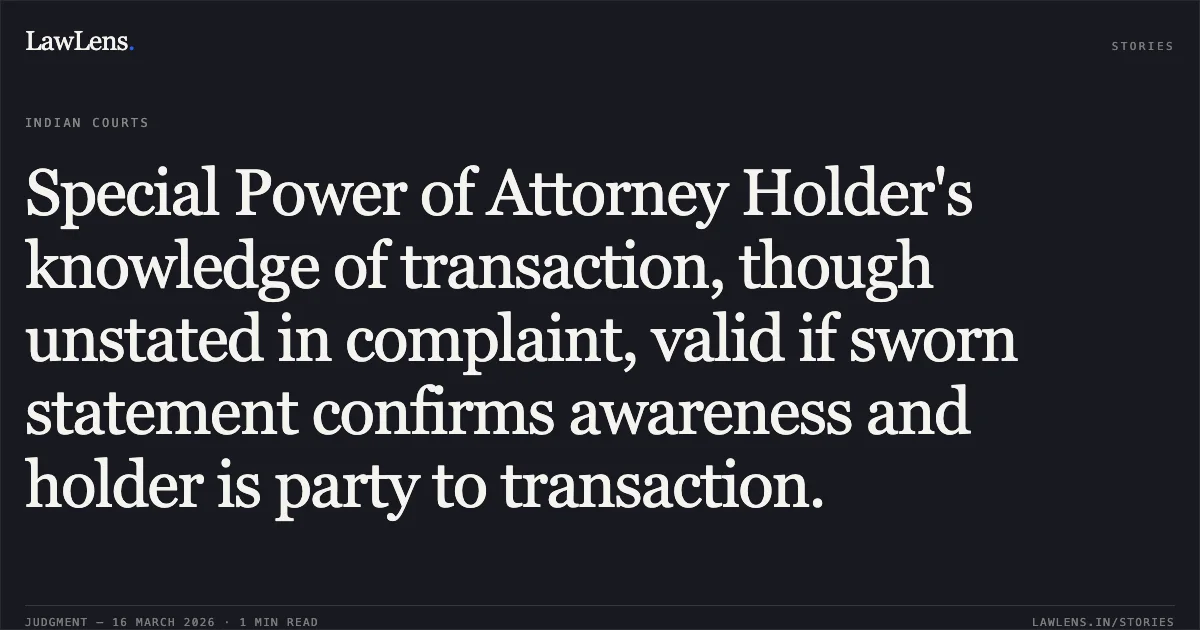
1. Whether a complaint filed under Section 138 of the Negotiable Instruments Act, 1881, by a Special Power of Attorney holder is maintainable if the complaint itself does not explicitly state that the power of attorney holder is aware of the transaction
Source reference: p.5, 102. Whether the pendency of a civil suit for recovery of money for the same cause of action bars the initiation or continuation of criminal proceedings under Section 138 of the Negotiable Instruments Act, 1881
Source reference: p.5, 16Law Applied
The court applied Section 138 of the Negotiable Instruments Act, 1881, pertaining to the dishonour of cheques
Source reference: p.4It relied on the Supreme Court's judgment in A.C. Narayanan v. State of Maharashtra, (2014) 11 SCC 790, which established that a power of attorney holder must aver complete awareness of facts for a complaint under Section 138 to be entertainable
Source reference: p.5-6, 10The court also applied the principle that civil and criminal proceedings can run concurrently, citing D. Purushotama Reddy v. K. Sateesh, (2008) 8 SCC 505 and CREF Finance Limited v. Shanthi Homes Private Limited, 2013 SCC OnLine Kar 7562, which held that simultaneous civil suits and Section 138 complaints for the same cause of action are maintainable
Source reference: p.16-18Reasoning
The Court analyzed the first issue by distinguishing the instant case from a typical scenario where a stranger SPA holder might lack specific knowledge.
Source reference: no citationIt noted that the SPA holder, Sri S. Manohar, was not a stranger but a signatory to the underlying sale deed transaction
Source reference: p.8, 10Despite the complaint not explicitly averring his awareness, his sworn statement clearly stated he was "well aware of the facts of the case" and competent to depose
Source reference: p.11, para. 8The court reasoned that given his direct involvement as a signatory, it would be "superfluous" to insist on a specific averment of awareness in the complaint itself
Source reference: p.10The court further acknowledged the complainant's reason for granting SPA (health issues)
Source reference: p.15Therefore, the absence of a specific line in the complaint itself, in these "peculiar facts," was deemed not to vitiate the complaint or its maintainability
Source reference: p.10, 15Regarding the second issue, the court found the argument untenable, citing well-established legal principles.
Source reference: no citationIt referred to D. Purushotama Reddy v. K. Sateesh and CREF Finance Limited v. Shanthi Homes Private Limited, both affirming that a civil suit for money recovery and a criminal complaint under Section 138 of the Act can proceed "hand in hand" or "simultaneously"
Source reference: p.16-18The court underscored that one aims at penalizing cheque dishonour, while the other seeks money recovery under general law, thus serving distinct purposes
Source reference: p.16Holding
The High Court held that the absence of a specific averment in the complaint by the Special Power of Attorney holder regarding his awareness of the transaction did not vitiate the proceedings under Section 138 of the NI Act, considering he was a signatory to the transaction and explicitly affirmed his awareness in his sworn statement
The court further held that the pendency of a civil suit for recovery of money does not preclude the parallel initiation or continuation of criminal proceedings under Section 138 of the NI Act
Source reference: p.16, 18Consequently, finding no merit in the petitioners' arguments, the criminal petition was dismissed
Source reference: p.19Acts & Sections Cited
5 provisions across 3 statutes referred to in this judgment. Each provision opens on LawLens.
Bharatiya Nagarik Suraksha Sanhita, 20231
Code of Criminal Procedure, 19732
Negotiable Instruments Act, 18812
Original Court PDF
SRI. VIMAL JAIN KATARIAvsSMT. R. G. MANJULA
Click to open original judgment
Original judgment, available to read, download and summarize on LawLens.in