Facts
The complainant’s company entered into a subcontract with VDB Projects Private Limited for storm-water drain works.
Source reference: pp. 6–7, 9–10, 12–13The complainant alleged that, although approximately ₹107 crore had been received for completed work, ₹40 crore remained payable; the petitioners maintained that the dispute concerned contractual payments and that substantial sums had already been paid.
Source reference: pp. 6–7, 9–10, 12–13The parties did not dispute that ₹17 crore had been paid by the date of the complaint, but disputed the amount remaining due and the contractual deduction to which VDB was entitled.
Source reference: pp. 6–7, 9–10, 12–13The complainant’s allegations led to registration of Crime No. 289/2018 under Section 420 IPC. The petitioners sought quashing of the FIR under Section 482 CrPC, contending that the dispute was civil in nature.
Source reference: pp. 3, 5–8Issues
Whether the FIR alleging cheating under Section 420 IPC should be quashed under Section 482 CrPC on the ground that the dispute arose from a contractual payment dispute.
Source reference: pp. 5–6, 10–13Whether the allegations required investigation into whether dishonest intention existed at the inception of the transaction.
Source reference: pp. 12–14Law Applied
The petitions were brought under Section 482 of the Code of Criminal Procedure, seeking to quash an FIR alleging an offence under Section 420 of the Indian Penal Code.
Source reference: p. 3The Court relied on Dineshbhai Chandubhai Patel v. State of Gujarat, holding that where a complaint discloses allegations of an offence, the High Court should not obstruct investigation.
Source reference: pp. 10–13It also referred to Sau Kamal Shivaji Pokarnekar v. State of Maharashtra, for the principle that proceedings should not be quashed at the initial stage merely because the allegations appear civil in nature.
Source reference: p. 10The petitioners relied on State of Haryana v. Bhajan Lal and other authorities concerning abuse of criminal process in essentially civil disputes; the complainant relied on authorities supporting investigation where the complaint alleges criminal conduct.
Source reference: pp. 8–11For cheating, the relevant question identified by the Court was whether there was an intention to cheat at the inception of the transaction.
Source reference: p. 13Reasoning
The Court noted that the existence of the contract, the work performed, and receipt of approximately ₹107 crore were not disputed; the parties instead contested the amount payable and the effect of the contractual deduction.
Source reference: pp. 12–13Although ₹17 crore had been paid by the date of the complaint, the complainant alleged that a substantial balance remained due and that the petitioners had cheated it.
Source reference: pp. 9–10, 12In light of those specific allegations and the competing accounts of payment, the Court declined to decide at the quashing stage whether the matter was purely civil or involved cheating.
Source reference: pp. 13–14It held that the Investigating Officer should investigate whether dishonest intention existed at the inception and determine whether the allegations disclosed an offence or a payment-recovery dispute.
Source reference: pp. 13–14Holding
The Court held that the petitioners had not established grounds to quash the FIR.
Both criminal petitions were dismissed, leaving it to the Investigating Officer to investigate the allegations and decide whether the case warranted a charge sheet or an ‘A’ or ‘B’ report.
Source reference: pp. 13–14Acts & Sections Cited
2 provisions across 2 statutes referred to in this judgment. Each provision opens on LawLens.
Code of Criminal Procedure, 19731
Indian Penal Code, 18601
Original Court PDF
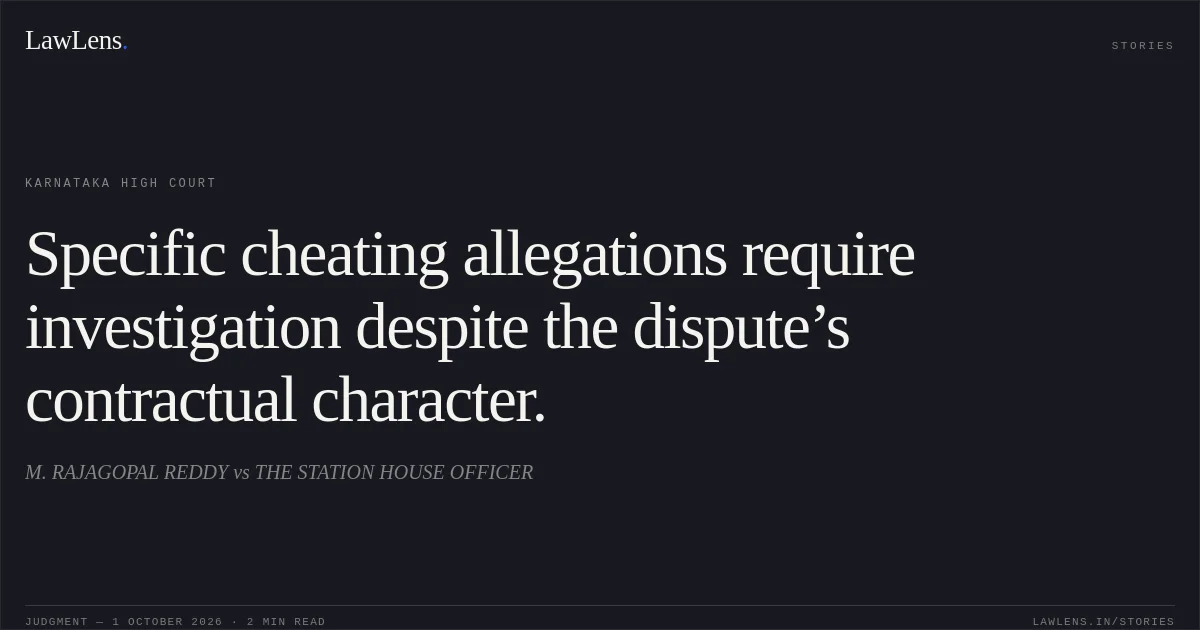
M. RAJAGOPAL REDDYvsTHE STATION HOUSE OFFICER
Click to open original judgment
Original judgment, available to read, download and summarize on LawLens.in